



 Chat with AI
Exam 15: Monopoly.

Exam 1: Ten Principles of Economics.349 Questions
Exam 2: Thinking Like an Economist.535 Questions
Exam 3: Interdependence and the Gains from Trade.443 Questions
Exam 4: The Market Forces of Supply and Demand.571 Questions
Exam 5: Elasticity and Its Application510 Questions
Exam 6: Supply, Demand, And Government Policies.557 Questions
Exam 7: Consumers, Producers, and the Efficiency of Markets.460 Questions
Exam 8: Application: The Costs of Taxation.424 Questions
Exam 9: Application: International Trade.410 Questions
Exam 10: Externalities.441 Questions
Exam 11: Public Goods and Common Resources.349 Questions
Exam 12: The Design of the Tax System.478 Questions
Exam 13: The Costs of Production.533 Questions
Exam 14: Firms in Competitive Markets.478 Questions
Exam 15: Monopoly.526 Questions
Exam 16: Monopolistic Competition.497 Questions
Exam 17: Oligopoly.410 Questions
Exam 18: The Market For the Factors of Production.463 Questions
Exam 19: Earnings and Discrimination.398 Questions
Exam 20: Income Inequality and Poverty.374 Questions
Exam 21: The Theory of Consumer Choice.462 Questions
Exam 22: Frontiers in Microeconomics.353 Questions
Select questions type


For a monopolist,when does marginal revenue exceed average revenue?
(Multiple Choice)
4.8/5  (83)
(83) If the government regulates the price that a natural monopolist can charge to be equal to the firm's average total cost,the firm will
(Multiple Choice)
4.7/5 (82)
(82) Scenario 15-1
Consider a transportation corporation named C.R. Evans that has just completed the development of a new subway system in a medium-sized town in the Northwest. Currently, there are plenty of seats on the subway, and it is never crowded. Its capacity far exceeds the needs of the city. After just a few years of operation, the shareholders of C.R. Evans experienced incredible rates of return on their investment due to the profitability of the corporation.
-Refer to Scenario 15-1.Which of the following statements is most likely to be true?
(i)New entrants to the market know they will have a smaller market share than C.R.Evans currently has.
(ii)C.R.Evans is most likely experiencing increasing average total cost.
(iii)C.R.Evans is a natural monopoly.
(Multiple Choice)
4.9/5 (76)
(76) Policymakers are discussing various proposals regarding how to deal with natural monopolies.Senator Huff wants to regulate natural monopolies by equating price with average total cost.Huff contends that such a policy will ensure that monopolies make every effort to reduce costs.Senator Puff wants the government to own natural monopolies.Puff argues that government-owned monopolies usually do a better job of holding down costs than privately owned monopolies.Which senator's argument is correct?
(Multiple Choice)
4.9/5 (89)
(89) Which of the following statements is correct for a monopolist? i)
The firm maximizes profits by equating marginal revenue with marginal cost.
Ii)
The firm maximizes profits by equating price with marginal cost.
Iii)
Demand equals marginal revenue.
Iv)
Average revenue equals price.
(Multiple Choice)
4.9/5 (87)
(87) Table 15-18
Tommy's Tie Company, a monopolist, has the following cost and revenue information. Assume that Tommy's is able to engage in perfect price discrimination.
 -Refer to Table 15-18.If the monopolist can engage in perfect price discrimination,what is the quantity that maximizes economic profit?
 (Multiple Choice)
4.8/5 (73)
(73) Figure 15-16
 -Refer to Figure 15-16.If the monopoly firm is not allowed to price discriminate,then consumer surplus amounts to
 (Multiple Choice)
4.8/5 (72)
(72) If a pharmaceutical company discovers a new drug and successfully patents it,patent law gives the firm
(Multiple Choice)
4.8/5 (82)
(82) What is the deadweight loss due to profit-maximizing monopoly pricing under the following conditions: The price charged for goods produced is $10.The intersection of the marginal revenue and marginal cost curves occurs where output is 100 units and marginal revenue is $5.The socially efficient level of production is 110 units.The demand curve is linear and downward sloping,and the marginal cost curve is constant.
(Short Answer)
4.8/5 (77)
(77) Movie theatres charge different prices to different groups of people based on the differing marginal costs that exist from group to group.
(True/False)
4.8/5 (91)
(91) Scenario 15-3
A monopoly firm maximizes its profit by producing Q = 500 units of output. At that level of output, its marginal revenue is $30, its average revenue is $60, and its average total cost is $34.
-Refer to Scenario 15-3.At Q = 500,the firm's total revenue is
(Multiple Choice)
4.9/5 (81)
(81) Suppose when a monopolist produces 50 units its average revenue is $8 per unit,its marginal revenue is $4 per unit,its marginal cost is $4 per unit,and its average total cost is $3 per unit.What can we conclude about this monopolist?
(Multiple Choice)
4.9/5 (65)
(65) A monopoly is an inefficient way to produce a product because
(Multiple Choice)
4.8/5 (77)
(77) Figure 15-13
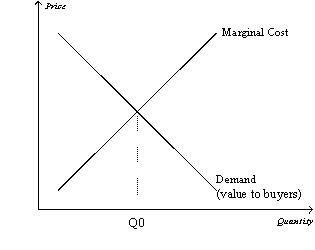 -Refer to Figure 15-13.A benevolent social planner would have the monopoly operate at an output level
 (Multiple Choice)
4.9/5 (91)
(91) "Monopolists do not worry about efficient production and minimizing costs since they can just pass along any increase in costs to their consumers." This statement is
(Multiple Choice)
4.9/5 (78)
(78) Customers who purchase an audio CD from Sally's Sounds are charged 20% more than customers who purchase the audio CD from the Sally's Sounds website.This is an example of
(Multiple Choice)
4.8/5 (86)
(86) 
Filters
- Essay(0)
- Multiple Choice(0)
- Short Answer(0)
- True False(0)
- Matching(0)