



 Chat with AI
Exam 15: Monopoly.

Exam 1: Ten Principles of Economics.349 Questions
Exam 2: Thinking Like an Economist.535 Questions
Exam 3: Interdependence and the Gains from Trade.443 Questions
Exam 4: The Market Forces of Supply and Demand.571 Questions
Exam 5: Elasticity and Its Application510 Questions
Exam 6: Supply, Demand, And Government Policies.557 Questions
Exam 7: Consumers, Producers, and the Efficiency of Markets.460 Questions
Exam 8: Application: The Costs of Taxation.424 Questions
Exam 9: Application: International Trade.410 Questions
Exam 10: Externalities.441 Questions
Exam 11: Public Goods and Common Resources.349 Questions
Exam 12: The Design of the Tax System.478 Questions
Exam 13: The Costs of Production.533 Questions
Exam 14: Firms in Competitive Markets.478 Questions
Exam 15: Monopoly.526 Questions
Exam 16: Monopolistic Competition.497 Questions
Exam 17: Oligopoly.410 Questions
Exam 18: The Market For the Factors of Production.463 Questions
Exam 19: Earnings and Discrimination.398 Questions
Exam 20: Income Inequality and Poverty.374 Questions
Exam 21: The Theory of Consumer Choice.462 Questions
Exam 22: Frontiers in Microeconomics.353 Questions
Select questions type


Table 15-18
Tommy's Tie Company, a monopolist, has the following cost and revenue information. Assume that Tommy's is able to engage in perfect price discrimination.
 -Refer to Table 15-18.If the monopolist can engage in perfect price discrimination,what is the total revenue when 7 ties are sold?
 (Multiple Choice)
4.9/5  (88)
(88) Figure 15-2


 -Refer to Figure 15-2.Which panel could represent the demand curve facing a local cable television provider if that firm in a monopolist?
 (Multiple Choice)
4.8/5 (95)
(95) In the market for "home heating" consumers typically have several options (e.g.,electricity,heating fuel,natural gas,propane,etc.),yet we often think of firms in this industry as behaving like monopolists.Discuss the context in which your electricity provider is a monopolist.Is this characterization universally applicable? Explain your answer.
(Essay)
4.9/5 (71)
(71) Scenario 15-6
The concert promoters of a heavy-metal band, WeR2Loud, know that there are two types of concert-goers: die-hard fans and casual fans. For a particular WeR2Loud concert, there are 1,000 die-hard fans who will pay $150 for a ticket and 500 casual fans who will pay $50 for a ticket. There are 1,500 seats available at the concert venue. Suppose the cost of putting on the concert is $50,000, which includes the cost of the band, lighting, security, etc.
-Refer to Scenario 15-6.How much profit will the concert promoters earn if they set the price of each ticket at $50?
(Multiple Choice)
4.8/5 (97)
(97) Table 15-4
A monopolist faces the following demand curve:
 -Refer to Table 15-4.If the monopolist produces 10 units,what is its average revenue?
 (Multiple Choice)
4.8/5 (77)
(77) Figure 15-15
 -Refer to Figure 15-15.If the monopoly firm perfectly price discriminates,then consumer surplus amounts to
 (Multiple Choice)
4.9/5 (73)
(73) Table 15-18
Tommy's Tie Company, a monopolist, has the following cost and revenue information. Assume that Tommy's is able to engage in perfect price discrimination.
-Refer to Table 15-18.If the monopolist can engage in perfect price discrimination,what is the average revenue when 7 ties are sold?
-Refer to Table 15-18.If the monopolist can engage in perfect price discrimination,what is the average revenue when 7 ties are sold? (Multiple Choice)
4.9/5 (79)
(79) Figure 15-17
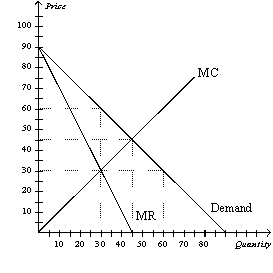 -Refer to Figure 15-17.The deadweight loss caused by a profit-maximizing monopoly amounts to
 (Multiple Choice)
4.8/5 (77)
(77) If the monopolist's linear demand curve intersects the quantity axis at Q = 30,then the monopolist's marginal revenue will be equal to zero at
(Multiple Choice)
4.8/5 (84)
(84) Table 15-13
The following table gives information on the price, quantity, and total cost of production for a monopolist.
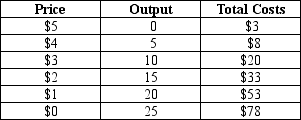 -Refer to Table 15-13.If the monopolist maximizes profits,he will charge a price of
 (Multiple Choice)
4.9/5 (75)
(75) Figure 15-2
-Refer to Figure 15-2.Which panel could represent the demand curve facing a soybean farmer?
-Refer to Figure 15-2.Which panel could represent the demand curve facing a soybean farmer? (Multiple Choice)
4.8/5 (95)
(95) Table 15-8
The following table provides information on the price, quantity, and average total cost for a monopoly.
 -Refer to Table 15-8.How much extra revenue does the monopolist earn when he lowers the price from $18 to $12?
 (Multiple Choice)
4.9/5 (87)
(87) Because a monopolist does not face competition from other firms,the outcome in a market with a monopoly
(Multiple Choice)
4.7/5 (89)
(89) A movie theater can increase its profits through price discrimination by charging a higher price to adults and a lower price to children if it
(Multiple Choice)
4.8/5 (86)
(86) Figure 15-17
-Refer to Figure 15-17.The consumer surplus at the monopolist's profit-maximizing price is
-Refer to Figure 15-17.The consumer surplus at the monopolist's profit-maximizing price is (Multiple Choice)
4.9/5 (69)
(69) What happens to the price and quantity sold of a drug when its patent runs out?
(i)The price will fall.
(ii)The quantity sold will fall.
(iii)The marginal cost of producing the drug will rise.
(Multiple Choice)
4.7/5 (83)
(83) Figure 15-7
 -Refer to Figure 15-7.What area represents the total surplus lost due to monopoly pricing?
 (Multiple Choice)
5.0/5 (75)
(75) Scenario 15-4
Suppose a monopolist has a demand curve that can be expressed as P=90-Q. The monopolist's marginal revenue curve can be expressed as MR=90-2Q. The monopolist has constant marginal costs and average total costs of $10.
-Refer to Scenario 15-4.The profit-maximizing monopolist will have a deadweight loss of
(Multiple Choice)
4.9/5 (80)
(80) 
Filters
- Essay(0)
- Multiple Choice(0)
- Short Answer(0)
- True False(0)
- Matching(0)