



 Chat with AI
Exam 15: Monopoly.

Exam 1: Ten Principles of Economics.349 Questions
Exam 2: Thinking Like an Economist.535 Questions
Exam 3: Interdependence and the Gains from Trade.443 Questions
Exam 4: The Market Forces of Supply and Demand.571 Questions
Exam 5: Elasticity and Its Application510 Questions
Exam 6: Supply, Demand, And Government Policies.557 Questions
Exam 7: Consumers, Producers, and the Efficiency of Markets.460 Questions
Exam 8: Application: The Costs of Taxation.424 Questions
Exam 9: Application: International Trade.410 Questions
Exam 10: Externalities.441 Questions
Exam 11: Public Goods and Common Resources.349 Questions
Exam 12: The Design of the Tax System.478 Questions
Exam 13: The Costs of Production.533 Questions
Exam 14: Firms in Competitive Markets.478 Questions
Exam 15: Monopoly.526 Questions
Exam 16: Monopolistic Competition.497 Questions
Exam 17: Oligopoly.410 Questions
Exam 18: The Market For the Factors of Production.463 Questions
Exam 19: Earnings and Discrimination.398 Questions
Exam 20: Income Inequality and Poverty.374 Questions
Exam 21: The Theory of Consumer Choice.462 Questions
Exam 22: Frontiers in Microeconomics.353 Questions
Select questions type


Figure 15-1
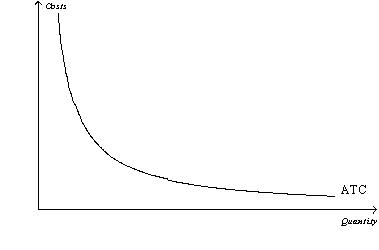 -Refer to Figure 15-1.Considering the relationship between average total cost and marginal cost,the marginal cost curve for this firm must
 (Multiple Choice)
5.0/5  (84)
(84) Which of the following is not an example of a barrier to entry?
(Multiple Choice)
4.7/5 (66)
(66) If the government deems a newly-invented drug to be truly original,the pharmaceutical company is given the exclusive right to manufacture and sell the drug for 50 years.
(True/False)
4.9/5 (80)
(80) Table 15-17
 -Refer to Table 15-17.If a monopolist faces a constant marginal cost of $2,how much output should the firm produce?
 (Multiple Choice)
4.9/5 (83)
(83) Selling a good at a price determined by the intersection of the demand curve and the marginal cost curve is consistent with the
(i)socially-optimal level of output.
(ii)market solution for profit-maximizing competitive firms.
(iii)market solution for a profit-maximizing monopoly.
(Multiple Choice)
4.8/5 (77)
(77) Since natural monopolies have a declining average cost curve,regulating natural monopolies by setting price equal to marginal cost would
(Multiple Choice)
5.0/5 (67)
(67) Scenario 15-5
An airline knows that there are two types of travelers: business travelers and vacationers. For a particular flight, there are 100 business travelers who will pay $600 for a ticket while there are 50 vacationers who will pay $300 for a ticket. There are 150 seats available on the plane. Suppose the cost to the airline of providing the flight is $20,000, which includes the cost of the pilots, flight attendants, fuel, etc.
-Refer to Scenario 15-5.How much profit will the airline earn if it sets the price of each ticket at $600?
(Multiple Choice)
4.8/5 (75)
(75) When we compare economic welfare in a monopoly market to a competitive market,the profits earned by the monopolist represent
(Multiple Choice)
4.7/5 (71)
(71) A monopolist's profit is equal to (Price - Marginal Cost)* Quantity.
(True/False)
4.8/5 (72)
(72) Government intervention always reduces monopoly deadweight loss.
(True/False)
4.9/5 (76)
(76) Figure 15-4
 -Refer to Figure 15-4.A profit-maximizing monopoly's total cost is equal to
 (Multiple Choice)
4.8/5 (88)
(88) When we compare economic welfare in a monopoly market to a competitive market,the profits earned by the monopolist represent
(Multiple Choice)
4.7/5 (79)
(79) During the life of a drug patent,the monopoly pharmaceutical firm maximizes profit by producing the quantity at which marginal revenue equals marginal cost.
(True/False)
4.9/5 (73)
(73) Suppose when a monopolist produces 75 units its average revenue is $10 per unit,its marginal revenue is $5 per unit,its marginal cost is $6 per unit,and its average total cost is $5 per unit.What can we conclude about this monopolist?
(Multiple Choice)
4.8/5 (77)
(77) Figure 15-3
 -Refer to Figure 15-3.Profit can always be increased by increasing the level of output by one unit if the monopolist is currently operating at
(i)Q0.
(ii)Q1.
(iii)Q2.
(iv)Q3.
-Refer to Figure 15-3.Profit can always be increased by increasing the level of output by one unit if the monopolist is currently operating at
(i)Q0.
(ii)Q1.
(iii)Q2.
(iv)Q3. (Multiple Choice)
4.9/5 (72)
(72) Scenario 15-8
Mega Media Cable TV is able to purchase an exclusive right to sell a premium sports channel in its market area. Let's assume that Mega Media pays $100,000 a year for the exclusive marketing rights to the sports channel. Since Mega Media has already installed cable to all of the homes in its market area, the marginal cost of delivering the sports channel to subscribers is zero. The manager of Mega Media needs to know what price to charge for the sports channel service to maximize her profit. Before setting price, she hires an economist to estimate demand for the sports channel. The economist discovers that there are two types of subscribers who value premium sporting channels. First are the 3,000 die-hard sports fans who will pay as much as $150 a year for the new channel. Second, the premium sports channel will appeal to 20,000 occasional sports viewers who will pay as much as $25 a year for a subscription to it.
-Refer to Scenario 15-8.If Mega Media Cable TV is unable to price discriminate,what price will it choose to maximize its profit,and what is the amount of the profit?
(Multiple Choice)
4.8/5 (94)
(94) 
Filters
- Essay(0)
- Multiple Choice(0)
- Short Answer(0)
- True False(0)
- Matching(0)