



 Chat with AI
Exam 15: Monopoly.

Exam 1: Ten Principles of Economics.349 Questions
Exam 2: Thinking Like an Economist.535 Questions
Exam 3: Interdependence and the Gains from Trade.443 Questions
Exam 4: The Market Forces of Supply and Demand.571 Questions
Exam 5: Elasticity and Its Application510 Questions
Exam 6: Supply, Demand, And Government Policies.557 Questions
Exam 7: Consumers, Producers, and the Efficiency of Markets.460 Questions
Exam 8: Application: The Costs of Taxation.424 Questions
Exam 9: Application: International Trade.410 Questions
Exam 10: Externalities.441 Questions
Exam 11: Public Goods and Common Resources.349 Questions
Exam 12: The Design of the Tax System.478 Questions
Exam 13: The Costs of Production.533 Questions
Exam 14: Firms in Competitive Markets.478 Questions
Exam 15: Monopoly.526 Questions
Exam 16: Monopolistic Competition.497 Questions
Exam 17: Oligopoly.410 Questions
Exam 18: The Market For the Factors of Production.463 Questions
Exam 19: Earnings and Discrimination.398 Questions
Exam 20: Income Inequality and Poverty.374 Questions
Exam 21: The Theory of Consumer Choice.462 Questions
Exam 22: Frontiers in Microeconomics.353 Questions
Select questions type


Figure 15-10
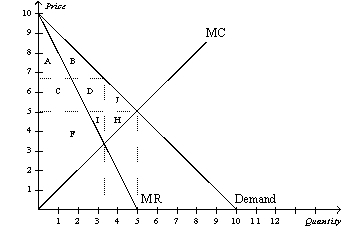 -Refer to Figure 15-10.Which area represents the deadweight loss from monopoly?
 (Multiple Choice)
4.8/5  (76)
(76) Table 15-4
A monopolist faces the following demand curve:
 -Refer to Table 15-4.If the monopolist produces 5 units,what is its average revenue?
 (Multiple Choice)
4.8/5 (83)
(83) Scenario 15-3
A monopoly firm maximizes its profit by producing Q = 500 units of output. At that level of output, its marginal revenue is $30, its average revenue is $60, and its average total cost is $34.
-Refer to Scenario 15-3.At Q = 500,the firm's profit is
(Multiple Choice)
4.8/5 (78)
(78) What is the shape of the monopolist's marginal revenue curve?
(Multiple Choice)
4.8/5 (86)
(86) Scenario 15-6
The concert promoters of a heavy-metal band, WeR2Loud, know that there are two types of concert-goers: die-hard fans and casual fans. For a particular WeR2Loud concert, there are 1,000 die-hard fans who will pay $150 for a ticket and 500 casual fans who will pay $50 for a ticket. There are 1,500 seats available at the concert venue. Suppose the cost of putting on the concert is $50,000, which includes the cost of the band, lighting, security, etc.
-Refer to Scenario 15-6.How much additional profit can the concert promoters earn by charging each customer their willingness to pay relative to charging a flat price of $50 per ticket?
(Multiple Choice)
4.8/5 (65)
(65) A monopolist maximizes profit by producing an output level where marginal cost equals price.
(True/False)
4.8/5 (86)
(86) Describe how government is involved in creating a monopoly.Why might the government create one? Give an example.
(Essay)
4.8/5 (89)
(89) Table 15-6
A monopolist faces the following demand curve:
 -Refer to Table 15-6.Suppose the monopolist has total fixed costs equal to $5 and a variable cost equal to $4 per unit for all units produced.What is the profit-maximizing price?
 (Multiple Choice)
4.9/5 (84)
(84) Scenario 15-4
Suppose a monopolist has a demand curve that can be expressed as P=90-Q. The monopolist's marginal revenue curve can be expressed as MR=90-2Q. The monopolist has constant marginal costs and average total costs of $10.
-Refer to Scenario 15-4.The profit-maximizing monopolist will produce an output level of
(Multiple Choice)
4.8/5 (81)
(81) Consumers' willingness to pay for a good minus the amount they actually pay for it equals
(Multiple Choice)
4.8/5 (79)
(79) There has been much discussion of deregulating electricity and natural gas delivery companies in the United States.Discuss the likely effect of deregulation on prices in these two industries.
(Essay)
4.8/5 (90)
(90) When a monopolist is able to sell its product at different prices,it is engaging in
(Multiple Choice)
4.7/5 (73)
(73) In a market characterized by monopoly,the market demand curve is
(Multiple Choice)
4.8/5 (65)
(65) 
Filters
- Essay(0)
- Multiple Choice(0)
- Short Answer(0)
- True False(0)
- Matching(0)