



 Chat with AI
Exam 7: Inflation

Exam 1: Introducing the Economic Way of Thinking176 Questions
Exam 2: Production Possibilities, Opportunity Cost, and Economic Growth200 Questions
Exam 3: Market Demand and Supply348 Questions
Exam 4: Markets in Action261 Questions
Exam 5: Gross Domestic Product223 Questions
Exam 6: Business Cycles and Unemployment194 Questions
Exam 7: Inflation126 Questions
Exam 8: The Keynesian Model235 Questions
Exam 9: The Keynesian Model in Action202 Questions
Exam 10: Aggregate Demand and Supply187 Questions
Exam 11: Fiscal Policy223 Questions
Exam 12: The Public Sector127 Questions
Exam 13: Federal Deficits, Surpluses, and the National Debt99 Questions
Exam 14: Money and the Federal Reserve System154 Questions
Exam 15: Money Creation243 Questions
Exam 16: Monetary Policy213 Questions
Exam 17: The Phillips Curve and Expectations Theory120 Questions
Exam 18: International Trade and Finance248 Questions
Exam 19: Economies in Transition104 Questions
Exam 20: Growth and the Less-Developed Countries117 Questions
Exam 21: Applying Graphs to Economics68 Questions
Exam 22: Consumer Surplus, Producer Surplus, and Market Efficiency68 Questions
Exam 23: the Self-Correcting Aggregate Demand and Supply Model83 Questions
Exam 24: Policy Disputes Using the Self-Correcting Aggregate Demand and Supply Model36 Questions
Select questions type


Assume that the real rate of interest is 5 percent and a lender charges a nominal interest rate of 15 percent. If a borrower expects that the rate of inflation next year will be 10 percent and the actual rate of inflation next year is 10 percent,
(Multiple Choice)
4.9/5  (81)
(81) Exhibit 7-1 Consumer Price Index 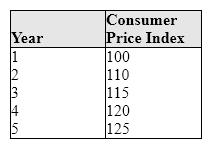 As shown in Exhibit 7-1, the rate of inflation for Year 2 is:
 (Multiple Choice)
4.9/5 (76)
(76) Suppose the consumer price index (CPI)for Year X is 130. This means the average price of goods and services is:
(Multiple Choice)
4.9/5 (86)
(86) Inflation psychosis and wage-price spirals are two types of hyperinflation.
(True/False)
5.0/5 (89)
(89) Exhibit 7-2 Consumer Price Index 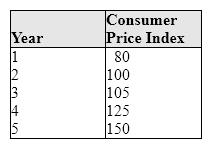 As shown in Exhibit 7-2, the rate of inflation for Year 4 is:
 (Multiple Choice)
5.0/5 (74)
(74) Exhibit 7-1 Consumer Price Index 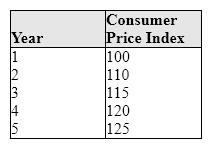 As shown in Exhibit 7-1, the rate of inflation for Year 5 is:
 (Multiple Choice)
4.9/5 (65)
(65) If the consumer price index (CPI)in Year 1 was 200 and the CPI in Year 2 was 215, the rate of inflation was:
(Multiple Choice)
4.9/5 (88)
(88) As inflation drives up prices, people attempt to find substitutes and adjust what they buy. The resulting substitution bias problem causes the CPI to:
(Multiple Choice)
4.8/5 (65)
(65) During periods of inflation, the general price level of goods and services in the economy rises.
(True/False)
4.8/5 (83)
(83) The consumer price index (CPI)includes only a market basket of goods and services purchased by the typical urban consumer.
(True/False)
4.7/5 (78)
(78) Which of the following would understate the consumer price index?
(Multiple Choice)
4.9/5 (78)
(78) When the inflation rate rises, the purchasing power of nominal income:
(Multiple Choice)
4.8/5 (77)
(77) If the consumer price index in Year 1 was 200 and the CPI for Year 2 was 230, the rate of inflation was:
(Multiple Choice)
4.8/5 (69)
(69) Consider an economy with only two goods: bread and wine. In 1982, the typical family bought 4 loaves of bread at 50¢ per loaf and 2 bottles of wine for $9 per bottle. In Year X, bread cost 75¢ per loaf and wine cost $10 per bottle. The CPI for Year X (using a 1982 base year)is:
(Multiple Choice)
4.8/5 (83)
(83) The substitution bias is believed to cause the consumer price index to:
(Multiple Choice)
4.8/5 (87)
(87) 
Filters
- Essay(0)
- Multiple Choice(0)
- Short Answer(0)
- True False(0)
- Matching(0)