



 Chat with AI
Exam 7: Inflation

Exam 1: Introducing the Economic Way of Thinking176 Questions
Exam 2: Production Possibilities, Opportunity Cost, and Economic Growth200 Questions
Exam 3: Market Demand and Supply348 Questions
Exam 4: Markets in Action261 Questions
Exam 5: Gross Domestic Product223 Questions
Exam 6: Business Cycles and Unemployment194 Questions
Exam 7: Inflation126 Questions
Exam 8: The Keynesian Model235 Questions
Exam 9: The Keynesian Model in Action202 Questions
Exam 10: Aggregate Demand and Supply187 Questions
Exam 11: Fiscal Policy223 Questions
Exam 12: The Public Sector127 Questions
Exam 13: Federal Deficits, Surpluses, and the National Debt99 Questions
Exam 14: Money and the Federal Reserve System154 Questions
Exam 15: Money Creation243 Questions
Exam 16: Monetary Policy213 Questions
Exam 17: The Phillips Curve and Expectations Theory120 Questions
Exam 18: International Trade and Finance248 Questions
Exam 19: Economies in Transition104 Questions
Exam 20: Growth and the Less-Developed Countries117 Questions
Exam 21: Applying Graphs to Economics68 Questions
Exam 22: Consumer Surplus, Producer Surplus, and Market Efficiency68 Questions
Exam 23: the Self-Correcting Aggregate Demand and Supply Model83 Questions
Exam 24: Policy Disputes Using the Self-Correcting Aggregate Demand and Supply Model36 Questions
Select questions type


Suppose that last year you borrowed $100 at 5 percent interest to purchase a $100 pair of Nike cross-training shoes. This year you repaid the bank with interest. If the inflation rate was 10 percent last year, your purchase of the shoes would:
(Multiple Choice)
4.9/5  (86)
(86) Suppose a market basket of goods and services costs $400 in the base year and the consumer price index (CPI)is currently 125. This indicates the price of the market basket of goods is now:
(Multiple Choice)
4.9/5 (78)
(78) Exhibit 7-2 Consumer Price Index 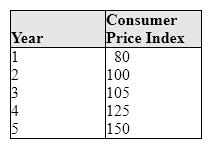 As shown in Exhibit 7-2, the rate of inflation for Year 5 is:
 (Multiple Choice)
4.9/5 (83)
(83) The real interest rate is the annual percentage amount of money that is earned on a sum loaned or deposited in a bank.
(True/False)
4.9/5 (73)
(73) Cost-push inflation is caused by too much money chasing too few goods.
(True/False)
4.8/5 (78)
(78) Demand-pull inflation is typically caused by rapidly rising costs of production.
(True/False)
4.8/5 (84)
(84) As the price of gasoline rose during the 1970s, consumers cut back on their use of gasoline relative to other consumer goods. This situation contributed to which bias in the consumer price index?
(Multiple Choice)
4.8/5 (85)
(85) A dramatic and sustained increase in oil prices would most likely:
(Multiple Choice)
4.8/5 (86)
(86) Last year the Jones family earned $40,000. This year their income is $42,000. In an economy with an inflation rate of 10 percent, which of the following is correct?
(Multiple Choice)
4.9/5 (87)
(87) Suppose that the consumer price index of a country was 160 at Year X and 168 at the end of Year Y. What was the country's inflation rate during Year Y?
(Multiple Choice)
4.9/5 (72)
(72) Disinflation and deflation mean a decrease in the average price level.
(True/False)
4.7/5 (90)
(90) Suppose that the consumer price index (CPI)was 160 in Year X and 166 in Year Y, inflation during Year Y was approximately:
(Multiple Choice)
4.7/5 (72)
(72) The likely result of an economy operating at full employment is:
(Multiple Choice)
4.8/5 (82)
(82) Inflation reduces the purchasing power of nominal income and increases the purchasing power of fixed income.
(True/False)
4.8/5 (97)
(97) 
Filters
- Essay(0)
- Multiple Choice(0)
- Short Answer(0)
- True False(0)
- Matching(0)