



 Chat with AI
Exam 12: Pure Monopoly

Exam 1: Limits, Alternatives, and Choices107 Questions
Exam 2: The Market System and the Circular Flow287 Questions
Exam 3: Demand, Supply, and Market Equilibrium151 Questions
Exam 4: Market Failures Caused by Externalities Asymmetric Information229 Questions
Exam 5: Public Goods, Public Choice, and Government Failure268 Questions
Exam 6: Elasticity399 Questions
Exam 7: Utility Maximization358 Questions
Exam 8: Behavioral Economics311 Questions
Exam 9: Businesses and the Costs of Production445 Questions
Exam 10: Pure Competition in the Short Run342 Questions
Exam 11: Pure Competition in the Long Run250 Questions
Exam 12: Pure Monopoly407 Questions
Exam 13: Monopolistic Competition279 Questions
Exam 14: Oligopoly and Strategic Behavior362 Questions
Exam 15: Technology, RD, and Efficiency309 Questions
Exam 16: The Demand for Resources359 Questions
Exam 17: Wage Determination168 Questions
Exam 18: Rent, Interest, and Profit305 Questions
Exam 19: Natural Resource and Energy Economics337 Questions
Exam 20: Public Finance: Expenditures and Taxes336 Questions
Exam 21: Antitrust Policy and Regulation264 Questions
Exam 22: Agriculture: Economics and Policy265 Questions
Exam 23: Income Inequality, Poverty, and Discrimination324 Questions
Exam 24: Health Care280 Questions
Exam 25: Immigration259 Questions
Exam 26: International Trade347 Questions
Exam 27: The Balance of Payments, Exchange Rates, and Trade Deficits318 Questions
Exam 28: The Economics of Developing Countries277 Questions
Select questions type


Suppose a pure monopolist is charging a price of $12 and the associated marginal revenue is $9. We thus know that
(Multiple Choice)
4.8/5  (93)
(93) 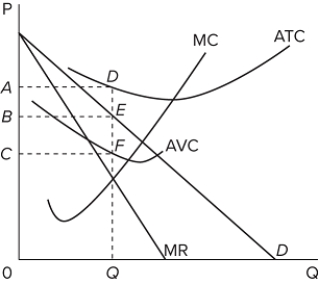 Refer to the graph for a monopolist in short-run equilibrium. This monopolist
 (Multiple Choice)
4.8/5 (69)
(69) Why is there a supply curve in pure competition but no supply curve in pure monopoly?
(Essay)
4.9/5 (63)
(63) 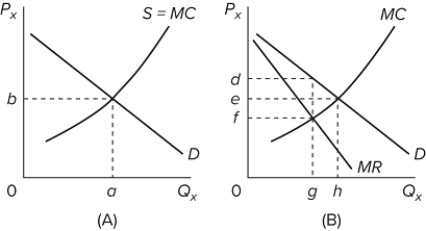 Refer to the diagrams. With the industry structures represented by diagram
 (Multiple Choice)
4.9/5 (72)
(72) 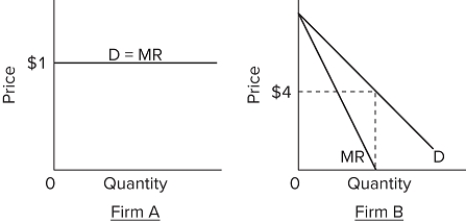 Refer to the diagrams. The demand for Firm A's product is
In the middle ages, the French government auctioned off monopoly rights to the sale of salt. Economic theory predicts that the highest bids would
(Multiple Choice)
4.9/5 (83)
(83) A nondiscriminating pure monopolist finds that it can sell its 50th unit of output for $50. We can surmise that the marginal
(Multiple Choice)
4.8/5 (76)
(76) How is the fair-return price used in regulating monopolies? Is this an easy regulation to implement? Why or why not?
(Essay)
4.9/5 (72)
(72) Natural monopoly may result where products produce substantial network effects and can be simultaneously consumed by a large number of consumers.
(True/False)
4.9/5 (87)
(87) Price discrimination will result in consumers with more elastic demand purchasing more of the good than when a single price is charged to all consumers in the market.
(True/False)
4.9/5 (81)
(81) When a pure monopolist is producing its profit-maximizing output, price will
(Multiple Choice)
4.8/5 (73)
(73) Answer the question on the basis of the accompanying demand schedule. 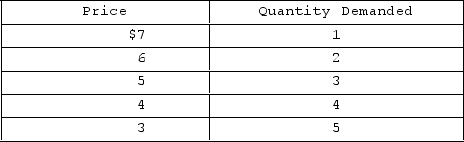 At the point where 3 units are being sold, the coefficient of price elasticity of demand
 (Multiple Choice)
4.9/5 (75)
(75) What is the price discrimination strategy used by companies that sell products online? Can consumers overcome this?
(Essay)
4.8/5 (71)
(71) If the XYZ Company can sell 4 units per week at $10 per unit and 5 units per week at $9 per unit, the marginal revenue of the fifth unit is $5.
(True/False)
4.8/5 (67)
(67) A single-price monopoly is economically inefficient because, at the profit-maximizing output,
(Multiple Choice)
4.9/5 (71)
(71) 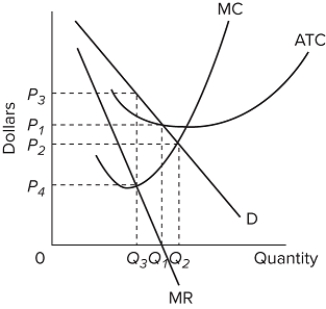 Refer to the diagram for a pure monopolist. If the monopolist is unregulated, it will maximize profits by charging
 (Multiple Choice)
4.8/5 (71)
(71) 
Filters
- Essay(0)
- Multiple Choice(0)
- Short Answer(0)
- True False(0)
- Matching(0)