



 Chat with AI
Exam 12: Pure Monopoly

Exam 1: Limits, Alternatives, and Choices107 Questions
Exam 2: The Market System and the Circular Flow287 Questions
Exam 3: Demand, Supply, and Market Equilibrium151 Questions
Exam 4: Market Failures Caused by Externalities Asymmetric Information229 Questions
Exam 5: Public Goods, Public Choice, and Government Failure268 Questions
Exam 6: Elasticity399 Questions
Exam 7: Utility Maximization358 Questions
Exam 8: Behavioral Economics311 Questions
Exam 9: Businesses and the Costs of Production445 Questions
Exam 10: Pure Competition in the Short Run342 Questions
Exam 11: Pure Competition in the Long Run250 Questions
Exam 12: Pure Monopoly407 Questions
Exam 13: Monopolistic Competition279 Questions
Exam 14: Oligopoly and Strategic Behavior362 Questions
Exam 15: Technology, RD, and Efficiency309 Questions
Exam 16: The Demand for Resources359 Questions
Exam 17: Wage Determination168 Questions
Exam 18: Rent, Interest, and Profit305 Questions
Exam 19: Natural Resource and Energy Economics337 Questions
Exam 20: Public Finance: Expenditures and Taxes336 Questions
Exam 21: Antitrust Policy and Regulation264 Questions
Exam 22: Agriculture: Economics and Policy265 Questions
Exam 23: Income Inequality, Poverty, and Discrimination324 Questions
Exam 24: Health Care280 Questions
Exam 25: Immigration259 Questions
Exam 26: International Trade347 Questions
Exam 27: The Balance of Payments, Exchange Rates, and Trade Deficits318 Questions
Exam 28: The Economics of Developing Countries277 Questions
Select questions type


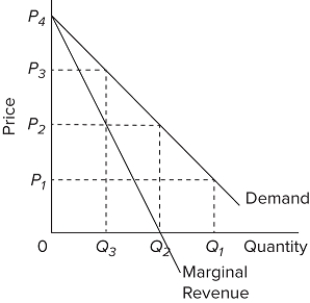 Refer to the diagram. If this somehow was a costless product (that is, the total cost of any level of output was zero), the firm would maximize profits by
 (Multiple Choice)
4.9/5  (72)
(72) 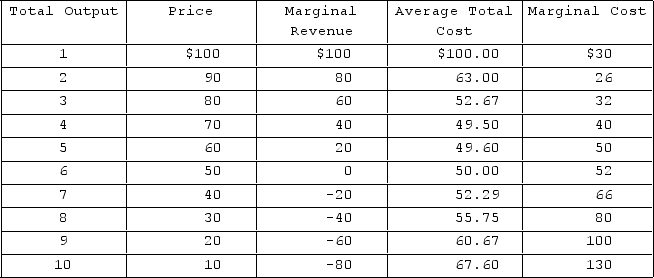 Refer to the data for a nondiscriminating monopolist. At its profit-maximizing output, this firm will be operating in the
 (Multiple Choice)
4.8/5 (85)
(85) 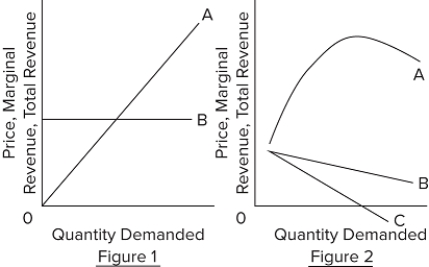 Refer to the two diagrams for individual firms. In Figure 2 the firm's demand and marginal revenue curves are represented by
 (Multiple Choice)
4.8/5 (92)
(92) 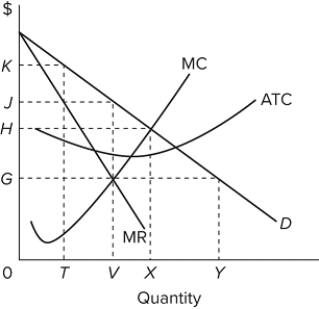 Refer to the graph for a profit-maximizing monopolist. The firm will set its price equal to the distance:
 (Multiple Choice)
4.8/5 (89)
(89) Network effects and simultaneous consumption tend to foster the development of
(Multiple Choice)
5.0/5 (78)
(78) A pure monopolist is producing an output such that ATC = $4, P = $5, MC = $2, MR = $3, and AVC = $2.50. This firm is realizing
(Multiple Choice)
4.8/5 (78)
(78) 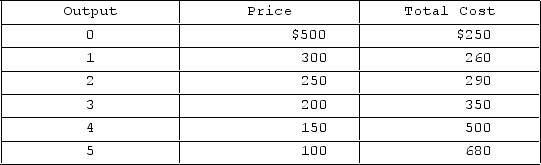 Refer to the demand and cost data for a pure monopolist given in the table. If the monopolist perfectly price-discriminated and sold each unit of the product at the maximum price the buyer of that unit would be willing to pay, and if the monopolist maximized profits, then the total profit received would be
 (Multiple Choice)
4.7/5 (66)
(66) Monopolists are said to be allocatively inefficient because
(Multiple Choice)
4.9/5 (86)
(86) The profit-maximizing output of a pure monopoly is not socially optimal, because in equilibrium
(Multiple Choice)
4.8/5 (75)
(75) 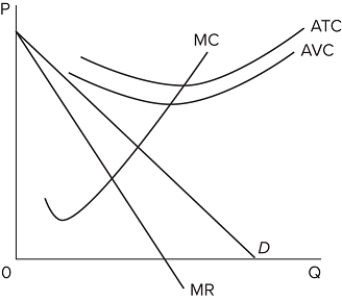 A profit-maximizing monopolist facing the situation shown in the graph should
 (Multiple Choice)
5.0/5 (89)
(89)  If the profit-maximizing pure monopolist whose information is in the accompanying table is able to price discriminate, charging each customer the price associated with each given level of output, how many units will the firm produce?
 (Multiple Choice)
4.7/5 (75)
(75) What is the relationship between economies of scale and a natural monopoly?
(Essay)
4.8/5 (93)
(93) For a pure nondiscriminating monopolist, marginal revenue is less than price because
(Multiple Choice)
5.0/5 (84)
(84) In which one of the following market models is X-inefficiency least likely to be present?
(Multiple Choice)
4.9/5 (70)
(70) For a monopolist to sell an output level of 10 units, the price must be $8. MR at this output level will be
(Multiple Choice)
4.7/5 (83)
(83) Answer the question on the basis of the accompanying table, which shows the demand schedule facing a nondiscriminating monopolist.  Assume that this monopolist faces zero production costs. The profit-maximizing monopolist will set a price of
 (Multiple Choice)
5.0/5 (65)
(65) A monopoly results in productive inefficiency because at the profit-maximizing output level,
(Multiple Choice)
4.9/5 (78)
(78) 
Filters
- Essay(0)
- Multiple Choice(0)
- Short Answer(0)
- True False(0)
- Matching(0)