



 Chat with AI
Exam 12: Pure Monopoly

Exam 1: Limits, Alternatives, and Choices107 Questions
Exam 2: The Market System and the Circular Flow287 Questions
Exam 3: Demand, Supply, and Market Equilibrium151 Questions
Exam 4: Market Failures Caused by Externalities Asymmetric Information229 Questions
Exam 5: Public Goods, Public Choice, and Government Failure268 Questions
Exam 6: Elasticity399 Questions
Exam 7: Utility Maximization358 Questions
Exam 8: Behavioral Economics311 Questions
Exam 9: Businesses and the Costs of Production445 Questions
Exam 10: Pure Competition in the Short Run342 Questions
Exam 11: Pure Competition in the Long Run250 Questions
Exam 12: Pure Monopoly407 Questions
Exam 13: Monopolistic Competition279 Questions
Exam 14: Oligopoly and Strategic Behavior362 Questions
Exam 15: Technology, RD, and Efficiency309 Questions
Exam 16: The Demand for Resources359 Questions
Exam 17: Wage Determination168 Questions
Exam 18: Rent, Interest, and Profit305 Questions
Exam 19: Natural Resource and Energy Economics337 Questions
Exam 20: Public Finance: Expenditures and Taxes336 Questions
Exam 21: Antitrust Policy and Regulation264 Questions
Exam 22: Agriculture: Economics and Policy265 Questions
Exam 23: Income Inequality, Poverty, and Discrimination324 Questions
Exam 24: Health Care280 Questions
Exam 25: Immigration259 Questions
Exam 26: International Trade347 Questions
Exam 27: The Balance of Payments, Exchange Rates, and Trade Deficits318 Questions
Exam 28: The Economics of Developing Countries277 Questions
Select questions type


Assume that a monopolist faces a linear demand curve and that it produces the output quantity where total revenue is maximized. At that output, the price elasticity of demand for the product is
(Multiple Choice)
4.9/5  (91)
(91) 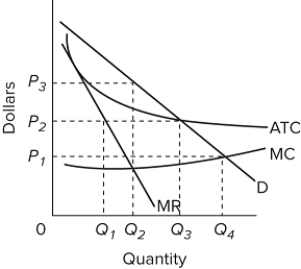 Refer to the diagram for a natural monopolist. If a regulatory commission set a maximum price of P ₁, the monopolist would produce output
 (Multiple Choice)
4.7/5 (72)
(72) 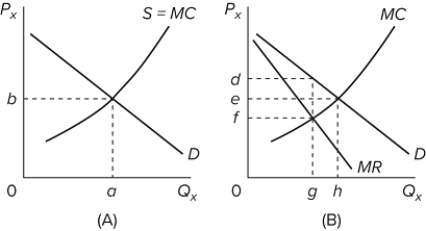 Refer to the diagrams. With the industry structures represented by diagram
 (Multiple Choice)
4.8/5 (69)
(69) Price discrimination occurs whenever a firm sells a good for two different prices.
(True/False)
4.8/5 (80)
(80) If you want to enjoy a Major League Baseball game at the stadium in St Louis, you must patronize the Cardinals. This makes the Cardinals organization a
(Multiple Choice)
4.8/5 (75)
(75) 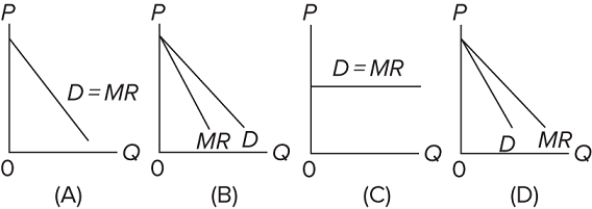 Which of the diagrams correctly portrays a nondiscriminating pure monopolist's demand (D)and marginal revenue (MR)curves?
 (Multiple Choice)
4.7/5 (81)
(81) If a nondiscriminating imperfectly competitive firm is selling its 100th unit of output for $35, its marginal revenue
(Multiple Choice)
4.7/5 (84)
(84) 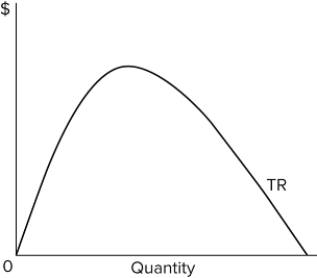 Refer to the graph, which shows a total revenue curve for a monopolist. If total revenue declines as output expands, demand is
 (Multiple Choice)
4.8/5 (89)
(89) 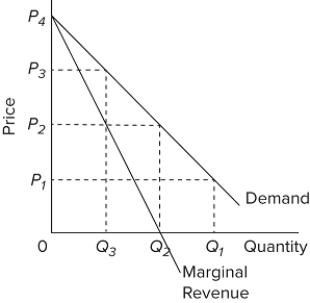 In the accompanying diagram, demand is relatively elastic
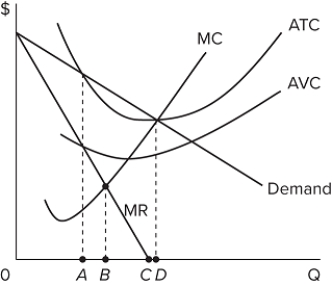 In the graph, what is the profit-maximizing level of output for this pure monopolist?
 (Multiple Choice)
4.7/5 (80)
(80) Allocative inefficiency happens in a monopoly because at the profit-maximizing output level,
(Multiple Choice)
4.8/5 (71)
(71) Under pure monopoly, a profit-maximizing firm will produce
(Multiple Choice)
5.0/5 (65)
(65) 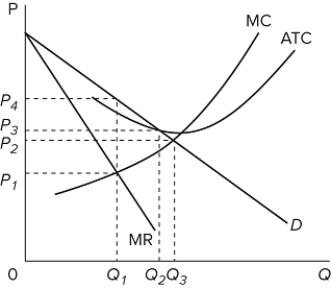 Refer to the graph for a pure monopoly. If the government regulated the monopoly and made the firm set a fair-return price, what price and quantity levels would we observe in the short run?
 (Multiple Choice)
4.9/5 (80)
(80) 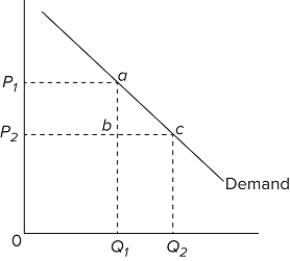 The quantitative difference between areas Q ₁ bcQ ₂ and P ₁ P ₂ ba in the diagram measures
 (Multiple Choice)
4.9/5 (72)
(72) 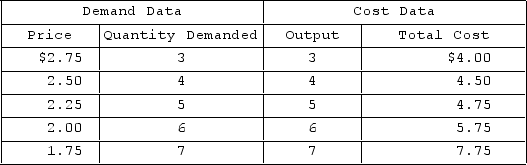 Answer the question on the basis of the demand and cost data for a pure monopolist. The profit-maximizing quantity of output for the monopolist will be
 (Multiple Choice)
5.0/5 (76)
(76) 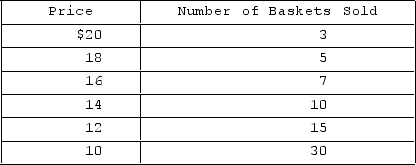 The table shows the demand schedule facing Nina, a monopolist selling baskets. What is the change in total revenue if she lowers the price from $20 to $18?
 (Multiple Choice)
4.8/5 (81)
(81) 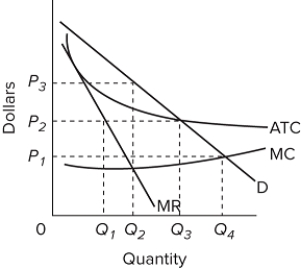 Refer to the diagram for a natural monopolist. If a regulatory commission were to set a maximum price of P3, the monopolist would
 (Multiple Choice)
4.8/5 (88)
(88) One major barrier to entry under pure monopoly arises from
(Multiple Choice)
4.8/5 (83)
(83) In order to maximize profits, the monopolist will produce the output level where MR = MC and charge a price equal to MR and MC.
(True/False)
4.7/5 (73)
(73) 
Filters
- Essay(0)
- Multiple Choice(0)
- Short Answer(0)
- True False(0)
- Matching(0)