



 Chat with AI
Exam 12: Pure Monopoly

Exam 1: Limits, Alternatives, and Choices107 Questions
Exam 2: The Market System and the Circular Flow287 Questions
Exam 3: Demand, Supply, and Market Equilibrium151 Questions
Exam 4: Market Failures Caused by Externalities Asymmetric Information229 Questions
Exam 5: Public Goods, Public Choice, and Government Failure268 Questions
Exam 6: Elasticity399 Questions
Exam 7: Utility Maximization358 Questions
Exam 8: Behavioral Economics311 Questions
Exam 9: Businesses and the Costs of Production445 Questions
Exam 10: Pure Competition in the Short Run342 Questions
Exam 11: Pure Competition in the Long Run250 Questions
Exam 12: Pure Monopoly407 Questions
Exam 13: Monopolistic Competition279 Questions
Exam 14: Oligopoly and Strategic Behavior362 Questions
Exam 15: Technology, RD, and Efficiency309 Questions
Exam 16: The Demand for Resources359 Questions
Exam 17: Wage Determination168 Questions
Exam 18: Rent, Interest, and Profit305 Questions
Exam 19: Natural Resource and Energy Economics337 Questions
Exam 20: Public Finance: Expenditures and Taxes336 Questions
Exam 21: Antitrust Policy and Regulation264 Questions
Exam 22: Agriculture: Economics and Policy265 Questions
Exam 23: Income Inequality, Poverty, and Discrimination324 Questions
Exam 24: Health Care280 Questions
Exam 25: Immigration259 Questions
Exam 26: International Trade347 Questions
Exam 27: The Balance of Payments, Exchange Rates, and Trade Deficits318 Questions
Exam 28: The Economics of Developing Countries277 Questions
Select questions type


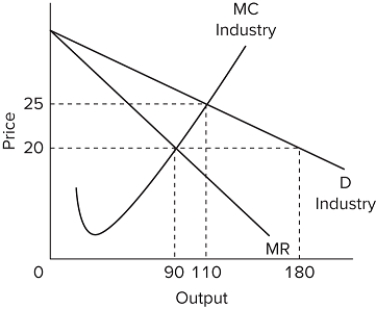 If the industry depicted in this graph were purely competitive, then the market price would be
 (Multiple Choice)
4.8/5  (75)
(75) Assume that the owners of the only gambling casino in Wisconsin spend large sums of money lobbying state government officials to protect their gambling monopoly. Economists refer to these expenditures as
(Multiple Choice)
4.9/5 (78)
(78) A price-discriminating monopolist will set a higher price where demand is more elastic and a lower price where demand is less elastic.
(True/False)
4.8/5 (79)
(79) A firm sells 99 units of output when price equals $10, and 100 units of output when price equals $9. Its marginal revenue for the 100th unit of output is negative.
(True/False)
4.8/5 (81)
(81)  If the profit-maximizing pure monopolist whose information is in the accompanying table is able to price discriminate, charging each customer the price associated with each given level of output, how much profit will the firm earn?
 (Multiple Choice)
4.9/5 (73)
(73) 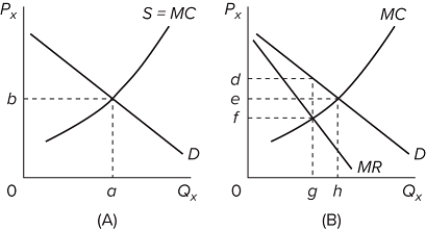 Refer to the diagrams. The price will be _______ and the quantity will be _______ with the industry structure represented by diagram (B)compared to the one represented in (A).
 (Multiple Choice)
4.8/5 (73)
(73) 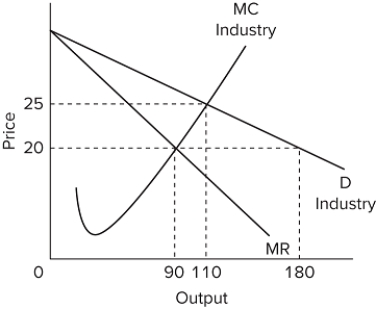 Based on the graph, what is the difference between the purely competitive equilibrium level of output and the pure monopoly equilibrium level of output?
 (Multiple Choice)
4.9/5 (67)
(67) 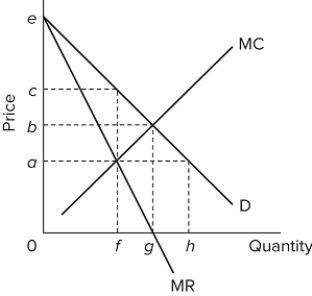 Refer to the diagram for a pure monopolist. Monopoly profit
 (Multiple Choice)
4.9/5 (72)
(72) The data relate to a pure monopolist and the product it produces. What is the profit-maximizing output and price for this monopolist? 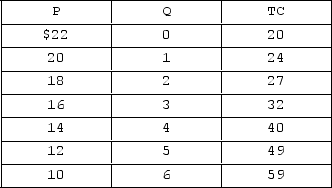
(Multiple Choice)
4.7/5 (89)
(89) Many economists agree that government should deal with monopolists on a case-by-case basis. Which of the following is not a government policy option?
(Multiple Choice)
4.9/5 (77)
(77) In the 1300s, the French government claimed for itself a monopoly over the sale of salt. Over the next few centuries
(Multiple Choice)
4.8/5 (73)
(73) A monopolist can sell 20 toys per day for $8.00 each. To sell 21 toys per day, the price must be cut to $7.00. The marginal revenue of the 21st toy is
(Multiple Choice)
4.9/5 (83)
(83)  Answer the question on the basis of the demand and cost data for a pure monopolist. At the profit-maximizing price and quantity of output, the monopolist will realize profit of
 (Multiple Choice)
4.8/5 (83)
(83) A price-discriminating monopolist will follow a system where
(Multiple Choice)
4.9/5 (82)
(82) How does monopoly compare with pure competition in terms of price, output, and efficiency? Explain.
(Essay)
4.8/5 (67)
(67) Given a linear demand curve, at which combination of price and marginal revenue ( P, MR)is the price elasticity of demand greater than 1?
(Multiple Choice)
4.8/5 (89)
(89)  Refer to the diagram for a nondiscriminating monopolist. If the government regulates the monopolist so that it charges the socially optimal price, the monopolist will produce output Q.
 (True/False)
4.9/5 (77)
(77) 
Filters
- Essay(0)
- Multiple Choice(0)
- Short Answer(0)
- True False(0)
- Matching(0)