



 Chat with AI
Exam 12: Pure Monopoly

Exam 1: Limits, Alternatives, and Choices107 Questions
Exam 2: The Market System and the Circular Flow287 Questions
Exam 3: Demand, Supply, and Market Equilibrium151 Questions
Exam 4: Market Failures Caused by Externalities Asymmetric Information229 Questions
Exam 5: Public Goods, Public Choice, and Government Failure268 Questions
Exam 6: Elasticity399 Questions
Exam 7: Utility Maximization358 Questions
Exam 8: Behavioral Economics311 Questions
Exam 9: Businesses and the Costs of Production445 Questions
Exam 10: Pure Competition in the Short Run342 Questions
Exam 11: Pure Competition in the Long Run250 Questions
Exam 12: Pure Monopoly407 Questions
Exam 13: Monopolistic Competition279 Questions
Exam 14: Oligopoly and Strategic Behavior362 Questions
Exam 15: Technology, RD, and Efficiency309 Questions
Exam 16: The Demand for Resources359 Questions
Exam 17: Wage Determination168 Questions
Exam 18: Rent, Interest, and Profit305 Questions
Exam 19: Natural Resource and Energy Economics337 Questions
Exam 20: Public Finance: Expenditures and Taxes336 Questions
Exam 21: Antitrust Policy and Regulation264 Questions
Exam 22: Agriculture: Economics and Policy265 Questions
Exam 23: Income Inequality, Poverty, and Discrimination324 Questions
Exam 24: Health Care280 Questions
Exam 25: Immigration259 Questions
Exam 26: International Trade347 Questions
Exam 27: The Balance of Payments, Exchange Rates, and Trade Deficits318 Questions
Exam 28: The Economics of Developing Countries277 Questions
Select questions type


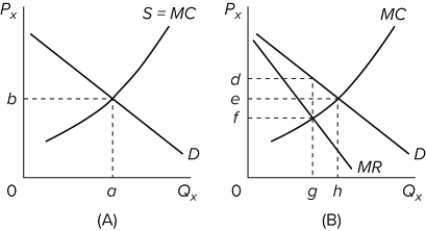 Refer to the diagrams. In diagram (B)the profit-maximizing quantity is
 (Multiple Choice)
4.9/5  (89)
(89) With nonrivalrous consumption, such as in the case of online music and movies, as more consumers buy the product,
(Multiple Choice)
4.8/5 (73)
(73) In the short run a pure monopolist will maximize profits by producing at that level of output where the difference between price and average total cost is at a maximum.
(True/False)
4.9/5 (82)
(82) Electric companies generally practice price discrimination and charge higher prices for electricity used for illumination and lower prices for electricity used for heat. These lower prices for electric heating result primarily from
(Multiple Choice)
4.9/5 (87)
(87) 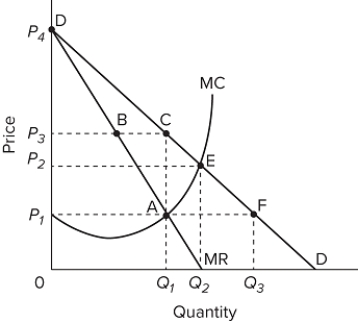 If the industry depicted in this graph were served by a pure monopoly, the price and output quantity would be
 (Multiple Choice)
4.9/5 (94)
(94) A price discriminating pure monopolist will attempt to charge each buyer (or group of buyers)
(Multiple Choice)
4.8/5 (94)
(94) Do you agree or disagree with the statement that: "A monopolist always charges the highest possible price." Explain.
(Essay)
4.9/5 (80)
(80) Which of the following conditions is not required for price discrimination?
(Multiple Choice)
4.8/5 (67)
(67) Answer the question on the basis of the provided demand and cost data for a pure monopolist.  The profit-maximizing monopolist will realize a
 (Multiple Choice)
4.8/5 (70)
(70) 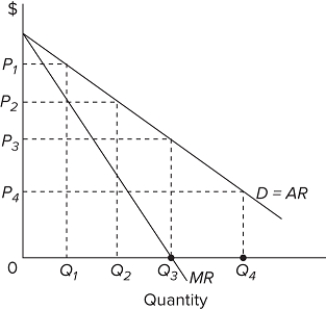 Refer to the graph, which shows the revenue curves for a monopolist. The elastic portion of the demand curve ranges from quantity
 (Multiple Choice)
4.9/5 (65)
(65) Confronted with the same unit cost data, a monopolistic producer will charge
(Multiple Choice)
4.8/5 (74)
(74)  Answer the question on the basis of the demand and cost data for a pure monopolist. The profit-maximizing quantity of output for the monopolist will be
 (Multiple Choice)
4.7/5 (68)
(68) The data relate to a pure monopolist and the product it produces. What is the profit-maximizing output and price for this monopolist? 
(Multiple Choice)
4.9/5 (70)
(70) A pure monopolist's short-run profit-maximizing or loss-minimizing position is such that price
(Multiple Choice)
4.8/5 (90)
(90) 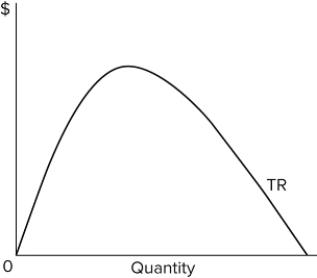 Refer to the graph, which shows a total revenue curve for a monopolist. When the total revenue curve reaches a maximum, marginal revenue is
 (Multiple Choice)
4.8/5 (81)
(81) 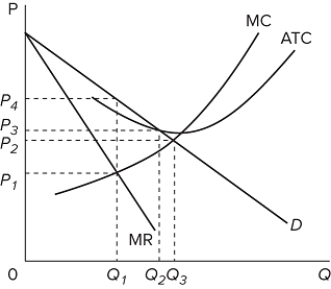 Refer to the graph for a pure monopoly. If the government regulated the monopoly and made it produce the level of output that would achieve allocative efficiency, what price and quantity levels would we observe in the short run?
 (Multiple Choice)
4.9/5 (73)
(73) 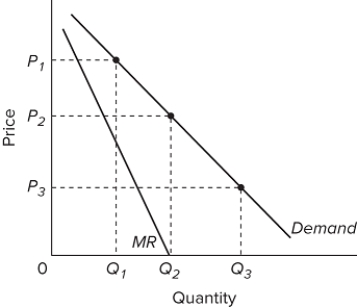 Refer to the graphs of D and MR for a monopolist. We know that to maximize profits the firm will set a price
 (Multiple Choice)
4.8/5 (75)
(75) What are the consequences of price discrimination for a business? What are the consequences for the consumer?
(Essay)
4.9/5 (78)
(78) 
Filters
- Essay(0)
- Multiple Choice(0)
- Short Answer(0)
- True False(0)
- Matching(0)