



 Chat with AI
Exam 12: Pure Monopoly

Exam 1: Limits, Alternatives, and Choices107 Questions
Exam 2: The Market System and the Circular Flow287 Questions
Exam 3: Demand, Supply, and Market Equilibrium151 Questions
Exam 4: Market Failures Caused by Externalities Asymmetric Information229 Questions
Exam 5: Public Goods, Public Choice, and Government Failure268 Questions
Exam 6: Elasticity399 Questions
Exam 7: Utility Maximization358 Questions
Exam 8: Behavioral Economics311 Questions
Exam 9: Businesses and the Costs of Production445 Questions
Exam 10: Pure Competition in the Short Run342 Questions
Exam 11: Pure Competition in the Long Run250 Questions
Exam 12: Pure Monopoly407 Questions
Exam 13: Monopolistic Competition279 Questions
Exam 14: Oligopoly and Strategic Behavior362 Questions
Exam 15: Technology, RD, and Efficiency309 Questions
Exam 16: The Demand for Resources359 Questions
Exam 17: Wage Determination168 Questions
Exam 18: Rent, Interest, and Profit305 Questions
Exam 19: Natural Resource and Energy Economics337 Questions
Exam 20: Public Finance: Expenditures and Taxes336 Questions
Exam 21: Antitrust Policy and Regulation264 Questions
Exam 22: Agriculture: Economics and Policy265 Questions
Exam 23: Income Inequality, Poverty, and Discrimination324 Questions
Exam 24: Health Care280 Questions
Exam 25: Immigration259 Questions
Exam 26: International Trade347 Questions
Exam 27: The Balance of Payments, Exchange Rates, and Trade Deficits318 Questions
Exam 28: The Economics of Developing Countries277 Questions
Select questions type


Suppose that a pure monopolist can sell 20 units of output at $10 per unit and 21 units at $9.75 per unit. The marginal revenue of the 21st unit of output is
(Multiple Choice)
4.8/5  (65)
(65) Suppose that a pure monopolist can sell 9 units of output at $12 per unit and 10 units at $11.50 per unit. For the monopolist to profitably produce and sell the tenth unit of output, its marginal cost must be anywhere at or below
(Multiple Choice)
4.9/5 (68)
(68) The table shows the relationship between output, total costs, and total revenue for a pure monopoly. 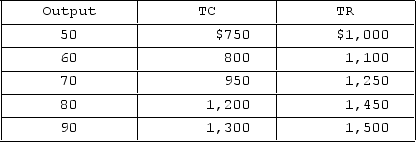 Within which of the following ranges of output will the firm earn maximum economic profits?
 (Multiple Choice)
4.7/5 (90)
(90) In an unregulated monopoly at equilibrium, the output level is higher than the economically efficient level.
(True/False)
4.8/5 (74)
(74) 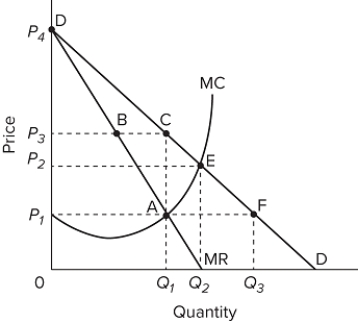 Refer to the provided graph for an industry. If the industry was initially a monopoly, but the monopolist was broken up into a large number of small, purely competitive firms and production cost-curves remained unchanged, then market price and industry output would be
 (Multiple Choice)
4.8/5 (71)
(71) In what ways do the demand schedules for a purely competitive firm and a pure monopolist differ? What significance does this have for the price-output behavior of each?
(Essay)
4.9/5 (70)
(70) 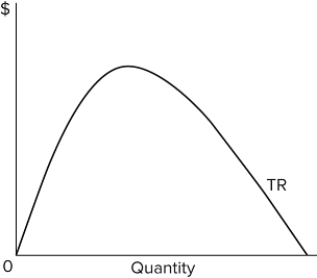 Refer to the graph, which shows a total revenue curve for a monopolist. If total revenue falls as output expands, marginal revenue is
 (Multiple Choice)
4.8/5 (76)
(76) 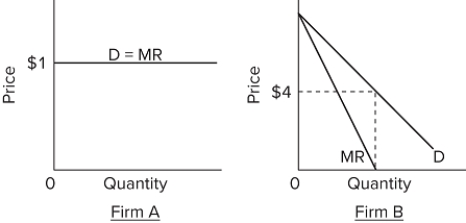 Refer to the diagrams. Firm A is a
Which phrase would be most characteristic of pure monopoly?
(Multiple Choice)
4.8/5 (72)
(72) 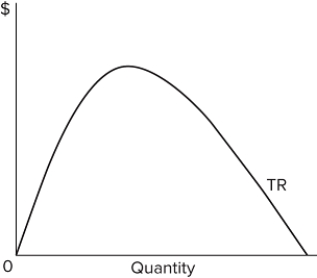 Refer to the graph, which shows a total revenue curve for a monopolist. The firm's marginal revenue curve must be
 (Multiple Choice)
4.9/5 (94)
(94) A monopolist sells 6 units of a product per day at a unit price of $15. If it lowers the price to $14, its total revenue increases by $22. This implies that its sales quantity increases by
(Multiple Choice)
4.8/5 (78)
(78)  Refer to the diagram for a nondiscriminating monopolist. At output Q production will be unprofitable.
 (True/False)
4.8/5 (71)
(71) If a nondiscriminating pure monopolist decides to sell one more unit of output, the marginal revenue associated with that unit will be
(Multiple Choice)
4.9/5 (85)
(85) If profits are maximized (or losses minimized), which of the following conditions is common to both unregulated monopoly and pure competition?
(Multiple Choice)
4.9/5 (69)
(69) Pure monopolists may obtain economic profits in the long run because
(Multiple Choice)
4.9/5 (68)
(68) 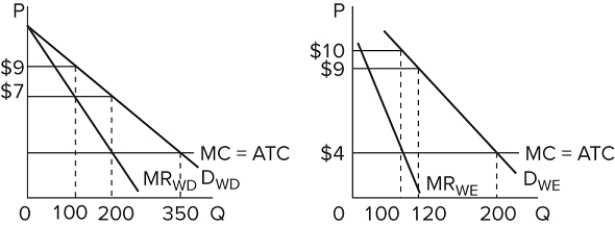 The graphs represent the demand for use of a local golf course for which there is no significant competition. (It has a local monopoly.)P denotes the price of a round of golf, and Q is the quantity of rounds "sold" each day. If the left graph represents the demand during weekdays and the right graph the weekend demand, this profit-maximizing golf course should
 (Multiple Choice)
4.8/5 (78)
(78) "Price maker" means that a monopoly can decide whatever price it wants to, in order to sell a specific given quantity of its product.
(True/False)
4.8/5 (66)
(66) Under which of the following situations would a monopolist increase profits by lowering price (and increasing output)?
(Multiple Choice)
4.9/5 (70)
(70) Under which of the following conditions would a profit-maximizing monopolist necessarily raise price?
(Multiple Choice)
4.8/5 (84)
(84) 
Filters
- Essay(0)
- Multiple Choice(0)
- Short Answer(0)
- True False(0)
- Matching(0)