



 Chat with AI
Exam 12: Pure Monopoly

Exam 1: Limits, Alternatives, and Choices107 Questions
Exam 2: The Market System and the Circular Flow287 Questions
Exam 3: Demand, Supply, and Market Equilibrium151 Questions
Exam 4: Market Failures Caused by Externalities Asymmetric Information229 Questions
Exam 5: Public Goods, Public Choice, and Government Failure268 Questions
Exam 6: Elasticity399 Questions
Exam 7: Utility Maximization358 Questions
Exam 8: Behavioral Economics311 Questions
Exam 9: Businesses and the Costs of Production445 Questions
Exam 10: Pure Competition in the Short Run342 Questions
Exam 11: Pure Competition in the Long Run250 Questions
Exam 12: Pure Monopoly407 Questions
Exam 13: Monopolistic Competition279 Questions
Exam 14: Oligopoly and Strategic Behavior362 Questions
Exam 15: Technology, RD, and Efficiency309 Questions
Exam 16: The Demand for Resources359 Questions
Exam 17: Wage Determination168 Questions
Exam 18: Rent, Interest, and Profit305 Questions
Exam 19: Natural Resource and Energy Economics337 Questions
Exam 20: Public Finance: Expenditures and Taxes336 Questions
Exam 21: Antitrust Policy and Regulation264 Questions
Exam 22: Agriculture: Economics and Policy265 Questions
Exam 23: Income Inequality, Poverty, and Discrimination324 Questions
Exam 24: Health Care280 Questions
Exam 25: Immigration259 Questions
Exam 26: International Trade347 Questions
Exam 27: The Balance of Payments, Exchange Rates, and Trade Deficits318 Questions
Exam 28: The Economics of Developing Countries277 Questions
Select questions type


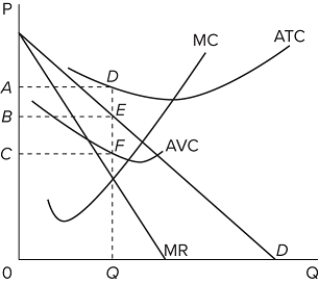 Refer to the graph for a monopolist in short-run equilibrium. This monopolist has total cost equal to area
 (Multiple Choice)
5.0/5  (80)
(80) 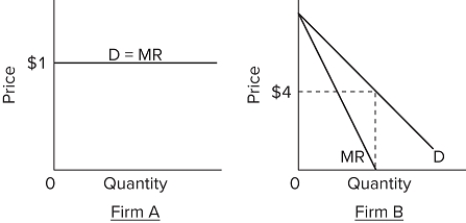 Refer to the diagrams. The demand for Firm B's product is
Answer the question on the basis of the accompanying table, which shows the demand schedule facing a nondiscriminating monopolist. 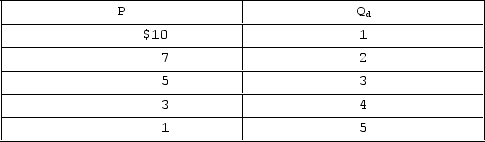 Assume that this monopolist faces zero production costs. The profit-maximizing monopolist will set a price of
 (Multiple Choice)
4.9/5 (79)
(79) In a natural monopoly case, the socially optimal pricing policy rule will often yield a higher price than the fair-return pricing rule.
(True/False)
4.8/5 (81)
(81) Which of the following is not a precondition for price discrimination?
(Multiple Choice)
4.9/5 (75)
(75) For a monopolist, maximum profits will occur when the gap between average revenue (or price)and average cost is biggest.
(True/False)
4.9/5 (73)
(73) 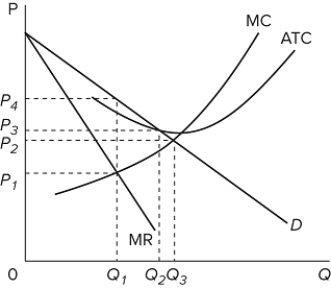 Refer to the graph for a pure monopoly. A profit-maximizing monopolist would set what price and quantity levels in the short run?
 (Multiple Choice)
4.8/5 (80)
(80) What is the meaning of the phrase "dilemma of regulation"?
(Multiple Choice)
4.8/5 (75)
(75) A monopolistic firm has a sales schedule such that it can sell 10 prefabricated garages per week at $10,000 each, but if it restricts its output to 9 per week it can sell these at $11,000 each. The marginal revenue of the 10th unit of sales per week is
(Multiple Choice)
4.9/5 (92)
(92) 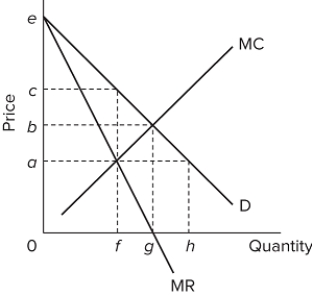 Refer to the diagram for a pure monopolist. Monopoly price will be
 (Multiple Choice)
4.8/5 (66)
(66) Which is a major criticism of a monopoly as a source of allocative inefficiency?
(Multiple Choice)
4.7/5 (78)
(78) The problem with adopting a fair-return pricing policy for a natural monopoly is that
(Multiple Choice)
4.9/5 (82)
(82) 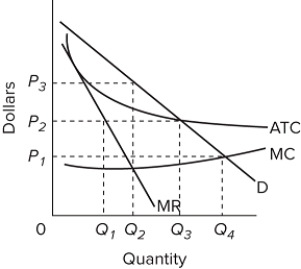 Refer to the diagram for a natural monopolist. If a regulatory commission set a maximum price of P₂, the monopolist would
 (Multiple Choice)
4.7/5 (95)
(95) Which of the following is not a barrier to entry in an industry?
(Multiple Choice)
4.8/5 (69)
(69) 
Filters
- Essay(0)
- Multiple Choice(0)
- Short Answer(0)
- True False(0)
- Matching(0)