



 Chat with AI
Exam 12: Pure Monopoly

Exam 1: Limits, Alternatives, and Choices107 Questions
Exam 2: The Market System and the Circular Flow287 Questions
Exam 3: Demand, Supply, and Market Equilibrium151 Questions
Exam 4: Market Failures Caused by Externalities Asymmetric Information229 Questions
Exam 5: Public Goods, Public Choice, and Government Failure268 Questions
Exam 6: Elasticity399 Questions
Exam 7: Utility Maximization358 Questions
Exam 8: Behavioral Economics311 Questions
Exam 9: Businesses and the Costs of Production445 Questions
Exam 10: Pure Competition in the Short Run342 Questions
Exam 11: Pure Competition in the Long Run250 Questions
Exam 12: Pure Monopoly407 Questions
Exam 13: Monopolistic Competition279 Questions
Exam 14: Oligopoly and Strategic Behavior362 Questions
Exam 15: Technology, RD, and Efficiency309 Questions
Exam 16: The Demand for Resources359 Questions
Exam 17: Wage Determination168 Questions
Exam 18: Rent, Interest, and Profit305 Questions
Exam 19: Natural Resource and Energy Economics337 Questions
Exam 20: Public Finance: Expenditures and Taxes336 Questions
Exam 21: Antitrust Policy and Regulation264 Questions
Exam 22: Agriculture: Economics and Policy265 Questions
Exam 23: Income Inequality, Poverty, and Discrimination324 Questions
Exam 24: Health Care280 Questions
Exam 25: Immigration259 Questions
Exam 26: International Trade347 Questions
Exam 27: The Balance of Payments, Exchange Rates, and Trade Deficits318 Questions
Exam 28: The Economics of Developing Countries277 Questions
Select questions type


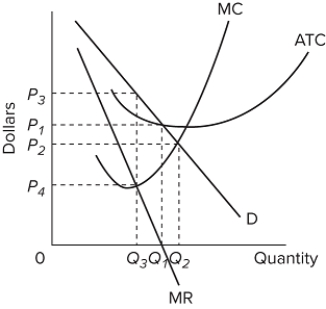 Refer to the diagram for a pure monopolist. If a regulatory commission seeks to achieve the socially optimal allocation of resources to this line of production, it will set a price of
 (Multiple Choice)
4.8/5  (84)
(84) If a pure monopolist is producing more output than the MR = MC output,
(Multiple Choice)
4.8/5 (64)
(64) 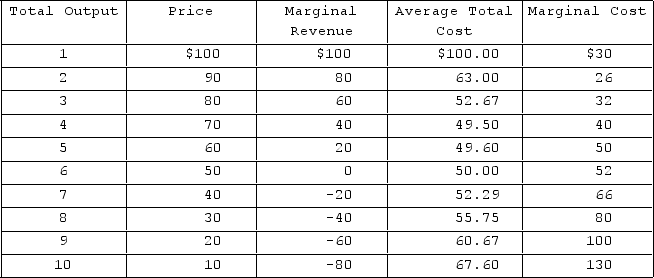 Refer to the data. At its profit-maximizing output, this firm's total revenue will be
 (Multiple Choice)
4.9/5 (78)
(78) 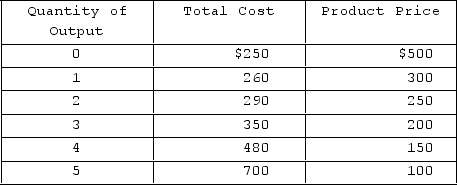 If the profit-maximizing pure monopolist whose information is in the accompanying table is able to price discriminate, charging each customer the price associated with each given level of output, how much profit will the firm earn?
 (Multiple Choice)
4.8/5 (76)
(76) 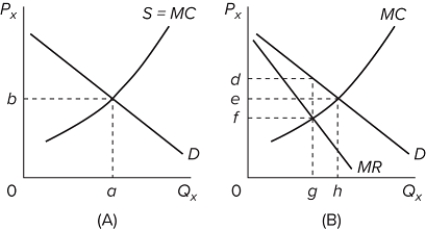 Refer to the diagrams. Diagram (A)represents
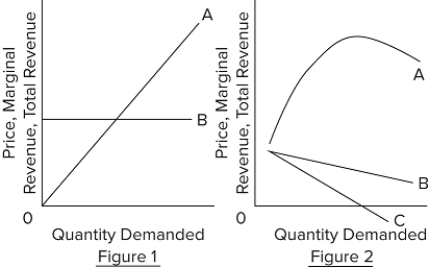 Refer to the two diagrams for individual firms. In Figure 2, line B represents the firm's
 (Multiple Choice)
4.8/5 (87)
(87) If a price-discriminating monopolist sells the same product in two markets but charges a higher price in market X and a lower price in market Y, the pricing difference indicates that demand is
(Multiple Choice)
4.7/5 (78)
(78) A pure monopolist is producing an output such that ATC = $4, P = $5, MC = $2, MR = $3, and AVC = $2.50. This firm is realizing
(Multiple Choice)
4.8/5 (66)
(66) Which of the following statements is true of price discrimination?
(Multiple Choice)
4.7/5 (68)
(68) A pure monopolist is producing an output such that ATC = $9, P = $11, MC = $5, MR = $6, and AVC = $4.50. This firm is realizing
(Multiple Choice)
4.8/5 (74)
(74) One argument for having the government regulate natural monopolies is that without regulation,
(Multiple Choice)
4.8/5 (71)
(71)  Based on the accompanying table, this nondiscriminating pure monopolist should set its price at
 (Multiple Choice)
4.8/5 (83)
(83) 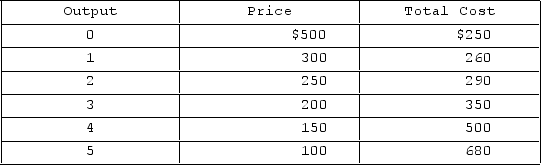 Refer to the demand and cost data for a pure monopolist given in the table. If the monopolist perfectly price-discriminated and sold each unit of the product at the maximum price the buyer of that unit would be willing to pay, and if the monopolist sold 4 units, then total revenue would be
 (Multiple Choice)
4.8/5 (83)
(83) A nondiscriminating pure monopolist is generally viewed as
(Multiple Choice)
4.9/5 (78)
(78) A nondiscriminating monopolist will find that marginal revenue
(Multiple Choice)
4.7/5 (98)
(98) A monopolist sells 6 units of a product per day at a unit price of $15. If it lowers the price to $14, its total revenue increases by $22. This implies that its sales quantity increases by
(Multiple Choice)
4.9/5 (65)
(65) Even though many ballparks practice price discrimination between adults and children in selling tickets, such discrimination is not applied at the concession stands because
(Multiple Choice)
4.9/5 (89)
(89) 
Filters
- Essay(0)
- Multiple Choice(0)
- Short Answer(0)
- True False(0)
- Matching(0)