



 Chat with AI
Exam 12: Pure Monopoly

Exam 1: Limits, Alternatives, and Choices107 Questions
Exam 2: The Market System and the Circular Flow287 Questions
Exam 3: Demand, Supply, and Market Equilibrium151 Questions
Exam 4: Market Failures Caused by Externalities Asymmetric Information229 Questions
Exam 5: Public Goods, Public Choice, and Government Failure268 Questions
Exam 6: Elasticity399 Questions
Exam 7: Utility Maximization358 Questions
Exam 8: Behavioral Economics311 Questions
Exam 9: Businesses and the Costs of Production445 Questions
Exam 10: Pure Competition in the Short Run342 Questions
Exam 11: Pure Competition in the Long Run250 Questions
Exam 12: Pure Monopoly407 Questions
Exam 13: Monopolistic Competition279 Questions
Exam 14: Oligopoly and Strategic Behavior362 Questions
Exam 15: Technology, RD, and Efficiency309 Questions
Exam 16: The Demand for Resources359 Questions
Exam 17: Wage Determination168 Questions
Exam 18: Rent, Interest, and Profit305 Questions
Exam 19: Natural Resource and Energy Economics337 Questions
Exam 20: Public Finance: Expenditures and Taxes336 Questions
Exam 21: Antitrust Policy and Regulation264 Questions
Exam 22: Agriculture: Economics and Policy265 Questions
Exam 23: Income Inequality, Poverty, and Discrimination324 Questions
Exam 24: Health Care280 Questions
Exam 25: Immigration259 Questions
Exam 26: International Trade347 Questions
Exam 27: The Balance of Payments, Exchange Rates, and Trade Deficits318 Questions
Exam 28: The Economics of Developing Countries277 Questions
Select questions type


If a pure monopolist is operating in a range of output where demand is elastic,
(Multiple Choice)
4.9/5  (73)
(73) Assume that a monopolist faces a linear demand curve. If the firm is operating at an output level where marginal revenue is positive, the firm
(Multiple Choice)
4.8/5 (77)
(77) 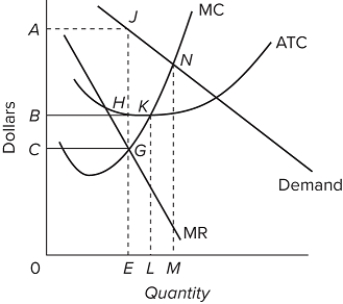 Refer to the diagram. At the profit-maximizing level of output, total revenue will be
 (Multiple Choice)
4.9/5 (75)
(75) 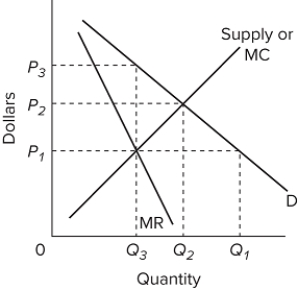 If the industry depicted in the graph comprises only one seller, the profit-maximizing price and quantity will be
 (Multiple Choice)
4.9/5 (87)
(87) Children are charged less than adults for admission to professional baseball games but are charged the same prices as adults at the concession stands. This pricing system occurs because
(Multiple Choice)
4.8/5 (75)
(75) A monopolistic firm has a sales schedule such that it can sell 10 prefabricated garages per week at $10,000 each, but if it restricts its output to 9 per week it can sell these at $11,000 each. The marginal revenue of the 10th unit of sales per week is
(Multiple Choice)
4.8/5 (79)
(79) 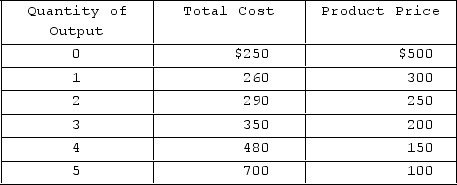 If the profit-maximizing pure monopolist whose information is in the accompanying table is able to price discriminate, charging each customer the price associated with each given level of output, how many units will the firm produce?
 (Multiple Choice)
4.8/5 (78)
(78) In the long-run equilibrium, a monopolist will earn zero economic profits.
(True/False)
4.8/5 (80)
(80) The vertical distance between the horizontal axis and any point on a nondiscriminating monopolist's demand curve measures
(Multiple Choice)
4.7/5 (77)
(77) When the value of a product to each user, including existing users, increases due to an increase in the total number of users-as in the case of Facebook-we refer to this as
(Multiple Choice)
4.8/5 (75)
(75) 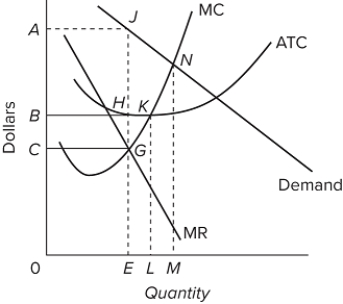 Refer to the diagram. To maximize profits or minimize losses, this firm should produce
 (Multiple Choice)
4.9/5 (73)
(73) Answer the question on the basis of the accompanying table, which shows the demand schedule facing a nondiscriminating monopolist. 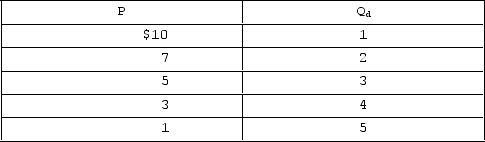 The profit-maximizing monopolist will sell at a price
 (Multiple Choice)
5.0/5 (60)
(60) Price discrimination is not viable if consumers can resell the products they purchase to other consumers.
(True/False)
4.9/5 (83)
(83) 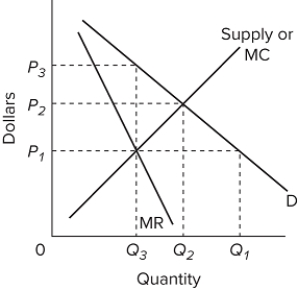 If the industry depicted in the graph is purely monopolistic, the profit-maximizing price and quantity will be
 (Multiple Choice)
4.8/5 (67)
(67) Comparing a pure monopoly and a purely competitive firm with identical costs, we would find in long-run equilibrium that the pure monopolist's
(Multiple Choice)
4.7/5 (77)
(77) If a monopolist's marginal revenue is $3.00 and its marginal cost is $4.50, it will increase its profits by
(Multiple Choice)
5.0/5 (77)
(77) 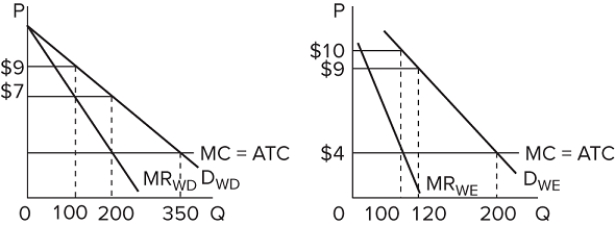 The graphs represent the demand for use of a local golf course for which there is no significant competition. (It has a local monopoly.)P denotes the price of a round of golf, and Q is the quantity of rounds "sold" each day. If the left graph represents the demand during weekdays and the right graph the weekend demand, then over the course of a full seven-day week, this price-discriminating, profit-maximizing golf course should sell a total of
 (Multiple Choice)
4.9/5 (80)
(80) 
Filters
- Essay(0)
- Multiple Choice(0)
- Short Answer(0)
- True False(0)
- Matching(0)