



 Chat with AI
Exam 20: International Trade

Exam 2: The Market System and the Circular Flow274 Questions
Exam 3: Demand, Supply, and Market Equilibrium357 Questions
Exam 4: Market Failures Caused by Externalities Asymmetric Information222 Questions
Exam 5: Public Goods, Public Choice, and Government Failure242 Questions
Exam 6: An Introduction to Macroeconomics243 Questions
Exam 7: Measuring Domestic Output and National Income238 Questions
Exam 8: Economic Growth274 Questions
Exam 9: Business Cycles, Unemployment, and Inflation298 Questions
Exam 10: Basic Macroeconomic Relationships233 Questions
Exam 11: The Aggregate Expenditures Model126 Questions
Exam 12: Aggregate Demand and Aggregate Supply320 Questions
Exam 13: Fiscal Policy, Deficits, and Debt401 Questions
Exam 14: Money, Banking, and Financial Institutions265 Questions
Exam 15: Money Creation285 Questions
Exam 16: Interest Rates and Monetary Policy405 Questions
Exam 17: Financial Economics356 Questions
Exam 18: Extending the Analysis of Aggregate Supply268 Questions
Exam 19: Current Issues in Macro Theory and Policy279 Questions
Exam 20: International Trade339 Questions
Exam 21: The Balance of Payments, Exchange Rates, and Trade Deficits315 Questions
Exam 22: The Economics of Developing Countries269 Questions
Select questions type


"The nation needs to prevent foreign nations from selling their excess goods in our nation at a price below cost so we can save American firms." This quotation would be most closely associated with
Which protectionist argument?
(Multiple Choice)
4.7/5  (88)
(88) Wine Machines Brazil 30 10 Poland 10 10 The accompanying table gives maximum-output alternatives for Brazil and Poland. It can be seen that if the two nations open up trade with each other, then
(Multiple Choice)
4.9/5 (82)
(82) An excise tax that is applied to an imported product that is not at all produced domestically is called a(n)
(Multiple Choice)
4.9/5 (72)
(72) 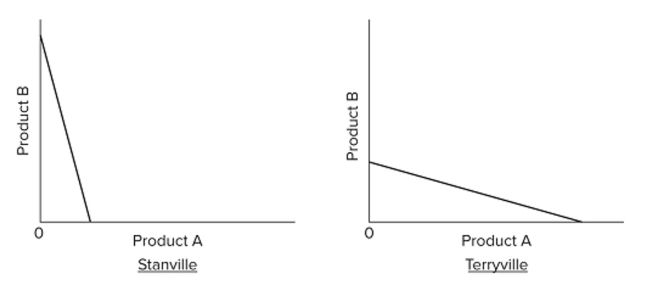 Refer to the graphs. Terryville has a comparative advantage in producing
 (Multiple Choice)
4.7/5 (83)
(83) Benefits from international trade are based on differences in the following areas, except
(Multiple Choice)
4.8/5 (76)
(76) Whenever a foreign producer is selling a product like steel at a lower price than domestic
producers, then dumping is being practiced and must be corrected.
(True/False)
4.8/5 (78)
(78)
Price \ 5.00 200 400 4.00 250 350 3.00 300 300 2.00 350 250 1.00 400 200
The accompanying table gives data for Country . Column 1 of the table is the price of a product. Column 2 is the quantity demanded domestically , and Column 3 is the quantity supplied domestically . If Country opens itself up to international trade and the world-market price of the product is , then Country will
(Multiple Choice)
4.9/5 (90)
(90) The tables give production possibilities data for two countries, Alpha and Beta, which have populations of equal size.
A B C D E Fish (Tons) 80 60 40 20 0 Chips (Tons) 0 5 10 15 20 Beta's production possibilities A B C D E Fish (Tons) 240 180 120 60 0 Chips (Tons) 0 10 20 30 40 The given data show that
(Multiple Choice)
4.9/5 (63)
(63) During the Great Depression, most nations lowered tariffs and abolished import quotas to
encourage the flow of trade.
(True/False)
4.8/5 (86)
(86) The benefits to trading nations based on comparative advantage accrue from
(Multiple Choice)
4.8/5 (61)
(61) In a two-nation, two-good world, which of the following statements is true?
(Multiple Choice)
4.8/5 (90)
(90) 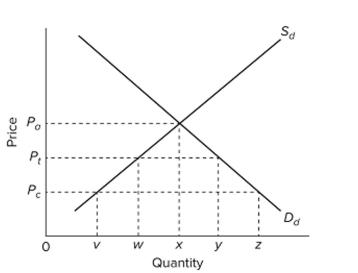 Refer to the diagram, where and
are the domestic supply and demand for a product and
is
The world price of that product. With free trade, that is, assuming no tariff, the outputs produced by
Domestic and foreign producers, respectively, would be
Refer to the diagram, where and
are the domestic supply and demand for a product and
is
The world price of that product. With free trade, that is, assuming no tariff, the outputs produced by
Domestic and foreign producers, respectively, would be (Multiple Choice)
4.9/5 (85)
(85) The law of increasing opportunity costs limits international specialization.
(True/False)
4.7/5 (81)
(81) A nation with abundant capital resources tends to be an exporter of
(Multiple Choice)
4.8/5 (90)
(90) Some people accuse an offshoring firm of "exporting jobs". This activity called offshoring is really equivalent to
(Multiple Choice)
4.8/5 (80)
(80)
Price \ 9.00 250 450 8.00 300 400 7.00 350 350 6.00 400 300
The accompanying table gives data for Country Y. Column 1 is the price of a product. Column 2 is the quantity demanded domestically , and Column 3 is the quantity supplied domestically . At what price will Country export 100 units of the product?
(Multiple Choice)
4.9/5 (74)
(74) Which country has the largest share of total world exports?
(Multiple Choice)
4.8/5 (78)
(78) 
Filters
- Essay(0)
- Multiple Choice(0)
- Short Answer(0)
- True False(0)
- Matching(0)