



 Chat with AI
Exam 20: International Trade

Exam 2: The Market System and the Circular Flow274 Questions
Exam 3: Demand, Supply, and Market Equilibrium357 Questions
Exam 4: Market Failures Caused by Externalities Asymmetric Information222 Questions
Exam 5: Public Goods, Public Choice, and Government Failure242 Questions
Exam 6: An Introduction to Macroeconomics243 Questions
Exam 7: Measuring Domestic Output and National Income238 Questions
Exam 8: Economic Growth274 Questions
Exam 9: Business Cycles, Unemployment, and Inflation298 Questions
Exam 10: Basic Macroeconomic Relationships233 Questions
Exam 11: The Aggregate Expenditures Model126 Questions
Exam 12: Aggregate Demand and Aggregate Supply320 Questions
Exam 13: Fiscal Policy, Deficits, and Debt401 Questions
Exam 14: Money, Banking, and Financial Institutions265 Questions
Exam 15: Money Creation285 Questions
Exam 16: Interest Rates and Monetary Policy405 Questions
Exam 17: Financial Economics356 Questions
Exam 18: Extending the Analysis of Aggregate Supply268 Questions
Exam 19: Current Issues in Macro Theory and Policy279 Questions
Exam 20: International Trade339 Questions
Exam 21: The Balance of Payments, Exchange Rates, and Trade Deficits315 Questions
Exam 22: The Economics of Developing Countries269 Questions
Select questions type


\nobreakspace\nobreakspace\nobreakspace\nobreakspace\nobreakspace\nobreakspace\nobreakspace\nobreakspace\nobreakspace\nobreakspace\nobreakspace\nobreakspace\nobreakspace\nobreakspace\nobreakspace\nobreakspace\nobreakspace\nobreakspace\nobreakspace\nobreakspace\nobreakspace Wat's Production Possibilities Product A B C D E F Rice 750 600 450 300 150 0 Corn 0 50 100 150 200 250 \nobreakspace\nobreakspace\nobreakspace\nobreakspace\nobreakspace\nobreakspace\nobreakspace\nobreakspace\nobreakspace\nobreakspace\nobreakspace\nobreakspace\nobreakspace\nobreakspace\nobreakspace\nobreakspace\nobreakspace\nobreakspace\nobreakspace\nobreakspace\nobreakspace\nobreakspace\nobreakspace\nobreakspace\nobreakspace\nobreakspace\nobreakspace\nobreakspace\nobreakspace\nobreakspace\nobreakspace\nobreakspace\nobreakspace Xat's Production Possibilities Product A B C D E F Rice 2,500 2,000 1,500 1,000 500 0 Corn 0 100 200 300 400 500 The hypothetical nations Wat and Xat have the production possibilities for rice and corn given in the accompanying tables. Which of the following statements about the two nations is correct based on
The principle of comparative advantage?
(Multiple Choice)
4.8/5  (76)
(76) The accompanying table gives domestic supply and demand schedules for a product. Suppose that the world price of the product is $1.
Quantity Supplied (Domestic) Price Quantity Demanded (Domestic) 12 \ 5 2 10 4 4 7 3 7 4 2 11 1 1 16 If the economy was opened to free trade and the world price of $1 prevailed, the price and quantity
Sold of this product would be
(Multiple Choice)
4.9/5 (75)
(75) The accompanying table gives domestic supply and demand schedules for a product. Suppose that the world price of the product is $1.
Quantity Supplied (Domestic) Price Quantity Demanded (Domestic) 12 \ 5 2 10 4 4 7 3 7 4 2 11 1 1 16 With a $1-per-unit tariff, prices (revenue per unit) received by domestic and foreign producers
Respectively will be
(Multiple Choice)
4.8/5 (85)
(85) Which nation had the largest share of world exports in 2018?
(Multiple Choice)
4.7/5 (59)
(59) Quantity Demanded Domestically Price Quantity Supplied Domestically 1,400 \ 10 2,200 1,600 9 2,000 1,800 8 1,800 2,000 7 1,600 2,200 6 1,400 2,400 5 1,200 Refer to the accompanying table for a certain product's market in Econland. If the world price for this product were $6, then Econland would import
(Multiple Choice)
4.9/5 (72)
(72) \nobreakspace\nobreakspace\nobreakspace\nobreakspace\nobreakspace\nobreakspace\nobreakspace\nobreakspace\nobreakspace\nobreakspace\nobreakspace\nobreakspace\nobreakspace\nobreakspace\nobreakspace\nobreakspace\nobreakspace\nobreakspace\nobreakspace\nobreakspace\nobreakspace Wat's Production Possibilities Product A B C D E F Rice 750 600 450 300 150 0 Corn 0 50 100 150 200 250 \nobreakspace\nobreakspace\nobreakspace\nobreakspace\nobreakspace\nobreakspace\nobreakspace\nobreakspace\nobreakspace\nobreakspace\nobreakspace\nobreakspace\nobreakspace\nobreakspace\nobreakspace\nobreakspace\nobreakspace\nobreakspace\nobreakspace\nobreakspace\nobreakspace\nobreakspace\nobreakspace\nobreakspace\nobreakspace\nobreakspace\nobreakspace\nobreakspace\nobreakspace\nobreakspace\nobreakspace\nobreakspace\nobreakspace Xat's Production Possibilities Product A B C D E F Rice 2,500 2,000 1,500 1,000 500 0 Corn 0 100 200 300 400 500 The hypothetical nations Wat and Xat have the production possibilities for rice and corn given in the accompanying tables. The mutually bene?cial terms of trade will be
(Multiple Choice)
4.8/5 (89)
(89) Country A limits other nation's exports to Country A to 1,000 tons of coal annually. This is an example of a(n)
(Multiple Choice)
4.8/5 (81)
(81) If countries A and B produce only either rubber bands or paper clips, their maximum outputs are shown in the accompanying production possibilities schedules.
Country Rubber Bands Paper Clips A 40 80 B 10 40 In country A the opportunity cost of 1 paper clip is
(Multiple Choice)
4.8/5 (79)
(79) In 2018, the United States was the largest exporter in the world.
(True/False)
4.9/5 (94)
(94) When a nation starts opening up to international trade, it will see falling prices for
(Multiple Choice)
4.9/5 (85)
(85) The greatest benefit to an economy from international trade is
(Multiple Choice)
4.9/5 (92)
(92) In which of the following countries did exports account for the biggest percentage of GDP in 2018?
(Multiple Choice)
4.9/5 (75)
(75) 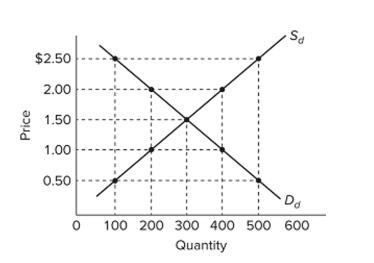 Refer to the graph, which shows the domestic demand and supply curves for a specific product in a hypothetical nation called Econland. If the world price for this product is $2.00, then Econland will
 (Multiple Choice)
4.9/5 (94)
(94) The accompanying table gives domestic supply and demand schedules for a product. Suppose that the world price of the product is $1.
Quantity Supplied (Domestic) Price Quantity Demanded (Domestic) 12 \ 5 2 10 4 4 7 3 7 4 2 11 1 1 16 If this nation were entirely closed to international trade, equilibrium price and quantity would be
(Multiple Choice)
4.7/5 (90)
(90) Which of the U.S. industries below has not seen major shutdowns and layoffs because of free foreign trade?
(Multiple Choice)
5.0/5 (90)
(90) Bastiat's "Petition of the Candlemakers," a classic reading in economics, presents a powerful
argument in favor of protectionism.
(True/False)
4.8/5 (93)
(93)
Price \ 9.00 250 450 8.00 300 400 7.00 350 350 6.00 400 300
The accompanying table gives data for Country Y. Column 1 is the price of a product. Column 2 is the quantity demanded domestically , and Column 3 is the quantity supplied domestically . If the world price of the product is , then Country will
(Multiple Choice)
4.9/5 (78)
(78) Specialization and trade between individuals or between nations leads to
(Multiple Choice)
4.8/5 (65)
(65) A side benefit of international trade is that it links national interests and increases the opportunity
costs of war.
(True/False)
4.8/5 (88)
(88) 
Filters
- Essay(0)
- Multiple Choice(0)
- Short Answer(0)
- True False(0)
- Matching(0)