



 Chat with AI
Exam 20: International Trade

Exam 2: The Market System and the Circular Flow274 Questions
Exam 3: Demand, Supply, and Market Equilibrium357 Questions
Exam 4: Market Failures Caused by Externalities Asymmetric Information222 Questions
Exam 5: Public Goods, Public Choice, and Government Failure242 Questions
Exam 6: An Introduction to Macroeconomics243 Questions
Exam 7: Measuring Domestic Output and National Income238 Questions
Exam 8: Economic Growth274 Questions
Exam 9: Business Cycles, Unemployment, and Inflation298 Questions
Exam 10: Basic Macroeconomic Relationships233 Questions
Exam 11: The Aggregate Expenditures Model126 Questions
Exam 12: Aggregate Demand and Aggregate Supply320 Questions
Exam 13: Fiscal Policy, Deficits, and Debt401 Questions
Exam 14: Money, Banking, and Financial Institutions265 Questions
Exam 15: Money Creation285 Questions
Exam 16: Interest Rates and Monetary Policy405 Questions
Exam 17: Financial Economics356 Questions
Exam 18: Extending the Analysis of Aggregate Supply268 Questions
Exam 19: Current Issues in Macro Theory and Policy279 Questions
Exam 20: International Trade339 Questions
Exam 21: The Balance of Payments, Exchange Rates, and Trade Deficits315 Questions
Exam 22: The Economics of Developing Countries269 Questions
Select questions type


\nobreakspace\nobreakspace\nobreakspace\nobreakspace\nobreakspace\nobreakspace\nobreakspace\nobreakspace\nobreakspace\nobreakspace\nobreakspace\nobreakspace\nobreakspace\nobreakspace\nobreakspace\nobreakspace\nobreakspace\nobreakspace Germany Production Possibilities \nobreakspace\nobreakspace\nobreakspace\nobreakspace\nobreakspace\nobreakspace\nobreakspace\nobreakspace\nobreakspace\nobreakspace\nobreakspace\nobreakspace\nobreakspace\nobreakspace\nobreakspace\nobreakspace\nobreakspace\nobreakspace\nobreakspace\nobreakspace\nobreakspace\nobreakspace\nobreakspace\nobreakspace\nobreakspace\nobreakspace (Production Alternatives) Product A B C D E F Autos 0 4 8 12 16 20 Chemicals 40 32 24 16 8 0 \nobreakspace\nobreakspace\nobreakspace\nobreakspace\nobreakspace\nobreakspace\nobreakspace\nobreakspace\nobreakspace\nobreakspace\nobreakspace\nobreakspace\nobreakspace\nobreakspace\nobreakspace\nobreakspace\nobreakspace\nobreakspace\nobreakspace\nobreakspace\nobreakspace\nobreakspace\nobreakspace U.S. Production Possibilities \nobreakspace\nobreakspace\nobreakspace\nobreakspace\nobreakspace\nobreakspace\nobreakspace\nobreakspace\nobreakspace\nobreakspace\nobreakspace\nobreakspace\nobreakspace\nobreakspace\nobreakspace\nobreakspace\nobreakspace\nobreakspace\nobreakspace\nobreakspace\nobreakspace\nobreakspace\nobreakspace\nobreakspace\nobreakspace\nobreakspace (Production Alternatives) Product A B C D E F Autos 0 3 6 9 12 15 Chemicals 60 48 36 24 12 0 Refer to the accompanying production possibilities tables. Data are in millions of units. Suppose that each nation specialized in producing the product for which it has a comparative advantage and the
Terms of trade were set at 3 units of chemicals for 1 unit of autos. In this case, Germany could obtain
And consume a maximum combination of 8 million units of autos and
(Multiple Choice)
4.8/5  (82)
(82) Tariffs and import quotas meant to increase domestic employment also eliminate domestic jobs in
export industries.
(True/False)
4.9/5 (89)
(89) The tables give production possibilities data for two countries, Alpha and Beta, which have populations of equal size.
A B C D E Fish (Tons) 80 60 40 20 0 Chips (Tons) 0 5 10 15 20 Beta's production possibilities A B C D E Fish (Tons) 240 180 120 60 0 Chips (Tons) 0 10 20 30 40 Assume the production possibilities in Beta double at alternatives A through E, while remaining as
Shown in the table for Alpha. As a result, Beta should
(Multiple Choice)
5.0/5 (69)
(69) The increased-domestic-employment argument for tariff protection holds that
(Multiple Choice)
4.7/5 (83)
(83) Domestic Market For Steel, Alpha P 60 \ 5 10 40 4 20 30 3 30 20 2 40 10 1 50
Domestic Market For Steel, Beta P 80 \ 5 20 70 4 30 60 3 40 50 2 50 40 1 60
The accompanying tables show data for the hypothetical nations of Alpha and Beta. is domestic quantity supplied, and is domestic quantity demanded. Assuming that Alpha and Beta are the only two nations in the world, the equilibrium world price must be lower than because, at ,
(Multiple Choice)
5.0/5 (82)
(82) A natural-resource abundant nation would be expected to export a land-intensive commodity such as
(Multiple Choice)
4.9/5 (77)
(77) 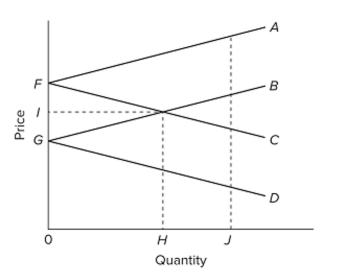 Refer to the diagram, which pertains to two nations and a specific product. Lines FC and GD are
 (Multiple Choice)
4.8/5 (74)
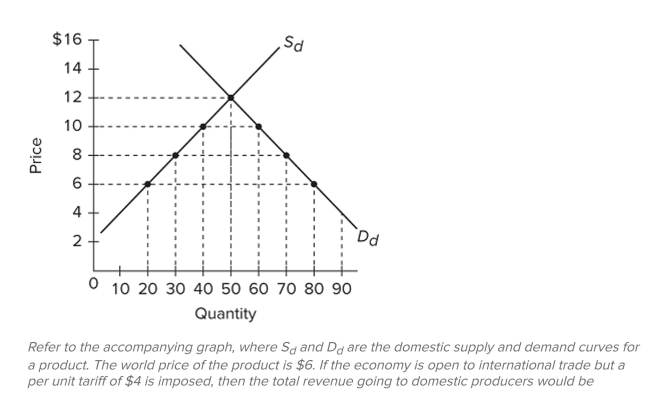
(74) 
Tariffs create larger gains to domestic producers than losses to domestic consumers.
(True/False)
4.8/5 (89)
(89) Which of the following best describes economists' general assessment of the impacts of offshoring?
(Multiple Choice)
4.8/5 (74)
(74) NAFTA established a free-trade area and eliminated trade barriers between
(Multiple Choice)
4.9/5 (99)
(99) Which of the following countries had the smallest share of exports as a percentage of GDP in 2018?
(Multiple Choice)
4.7/5 (73)
(73) In terms of trade volume in the past many years, China has been the largest trading partner of the
United States.
(True/False)
4.8/5 (93)
(93) (Last Word) One main point of Frederic Bastiat's satire is that
(Multiple Choice)
4.8/5 (86)
(86) Machines Wine France 3 1 Germany 1 1 The accompanying table shows the output (either machines or wine) that each unit of input in France and Germany can produce. We see that
(Multiple Choice)
4.8/5 (71)
(71) Domestic Market For Steel, Alpha P 60 \ 5 10 40 4 20 30 3 30 20 2 40 10 1 50
Domestic Market For Steel, Beta P 80 \ 5 20 70 4 30 60 3 40 50 2 50 40 1 60
The accompanying tables show data for the hypothetical nations of Alpha and Beta. is domestic quantity supplied, and is domestic quantity demanded. Assuming that Alpha and Beta are the only two nations in the world, the equilibrium world price must be lower than because, at ,
(Multiple Choice)
4.9/5 (76)
(76) 
Filters
- Essay(0)
- Multiple Choice(0)
- Short Answer(0)
- True False(0)
- Matching(0)