



 Chat with AI
Exam 20: International Trade

Exam 2: The Market System and the Circular Flow274 Questions
Exam 3: Demand, Supply, and Market Equilibrium357 Questions
Exam 4: Market Failures Caused by Externalities Asymmetric Information222 Questions
Exam 5: Public Goods, Public Choice, and Government Failure242 Questions
Exam 6: An Introduction to Macroeconomics243 Questions
Exam 7: Measuring Domestic Output and National Income238 Questions
Exam 8: Economic Growth274 Questions
Exam 9: Business Cycles, Unemployment, and Inflation298 Questions
Exam 10: Basic Macroeconomic Relationships233 Questions
Exam 11: The Aggregate Expenditures Model126 Questions
Exam 12: Aggregate Demand and Aggregate Supply320 Questions
Exam 13: Fiscal Policy, Deficits, and Debt401 Questions
Exam 14: Money, Banking, and Financial Institutions265 Questions
Exam 15: Money Creation285 Questions
Exam 16: Interest Rates and Monetary Policy405 Questions
Exam 17: Financial Economics356 Questions
Exam 18: Extending the Analysis of Aggregate Supply268 Questions
Exam 19: Current Issues in Macro Theory and Policy279 Questions
Exam 20: International Trade339 Questions
Exam 21: The Balance of Payments, Exchange Rates, and Trade Deficits315 Questions
Exam 22: The Economics of Developing Countries269 Questions
Select questions type


In a two-nation, two-good world, if both nations have identical production possibilities curves with constant costs, then one nation would have
(Multiple Choice)
4.9/5  (75)
(75) Which of the following is a likely result of imposing tariffs to increase domestic employment?
(Multiple Choice)
4.9/5 (94)
(94)
P 60 \ 5 10 40 4 20 30 3 30 20 2 40 10 1 50 Domestic Market For Steel, Beta P 80 \ 5 20 70 4 30 60 3 40 50 2 50 40 1 60 The accompanying tables show data for the hypothetical nations of Alpha and Beta. is domestic
Quantity supplied, and
is domestic quantity demanded. The domestic equilibrium prices of steel
In Alpha and Beta are
(Multiple Choice)
4.7/5 (81)
(81) Which of the following is an example of a land-intensive commodity?
(Multiple Choice)
4.9/5 (74)
(74) Which country is the United States' largest trading partner in terms of volume of trade?
(Multiple Choice)
4.9/5 (80)
(80) An excise tax on an imported good that is not produced domestically is called a
(Multiple Choice)
4.9/5 (75)
(75) The following are commonly used arguments for protection against imports, except
(Multiple Choice)
4.9/5 (67)
(67) 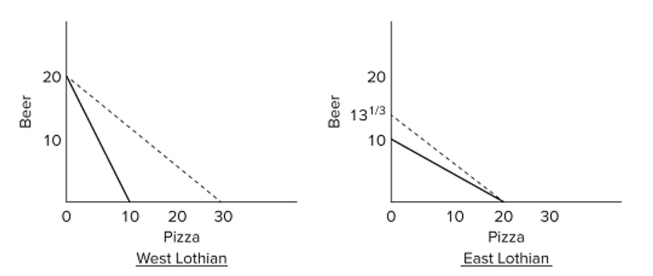 In the accompanying diagrams, solid lines are production possibilities curves, and the dashed lines are trading possibilities curves. The data suggest that
 (Multiple Choice)
4.8/5 (73)
(73) 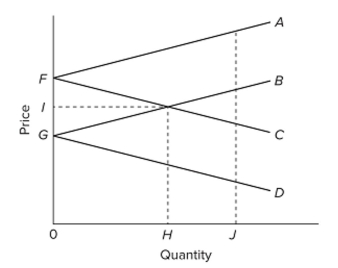 Refer to the diagram, which pertains to two nations and a specific product. The equilibrium world price occurs at
 (Multiple Choice)
4.8/5 (75)
(75) The principal concept behind comparative advantage is that a nation should
(Multiple Choice)
4.7/5 (92)
(92) Economists prefer free trade to tariffs and prefer tariffs to import quotas.
(True/False)
4.9/5 (83)
(83)
Price \ 5.00 200 400 4.00 250 350 3.00 300 300 2.00 350 250 1.00 400 200
The accompanying table gives data for Country . Column 1 of the table is the price of a product. Column 2 is the quantity demanded domestically , and Column 3 is the quantity supplied domestically ). If the world price is , there will be
(Multiple Choice)
4.8/5 (74)
(74) (Consider This) Madison, the CPA, is faster than Mason, the house painter, at both accounting services and painting. This means that
(Multiple Choice)
4.8/5 (86)
(86) Which of the following product groups is a leading export of the United States?
(Multiple Choice)
4.9/5 (84)
(84) The equilibrium world price of a product equates the quantities of exports supplied and imports
demanded.
(True/False)
4.9/5 (70)
(70) The Trade Adjustment Assistance Act of 2002 focused mainly on assisting
(Multiple Choice)
4.9/5 (87)
(87) Quantity Demanded Domestically Price Quantity Supplied Domestically 1,400 \ 10 2,200 1,600 9 2,000 1,800 8 1,800 2,000 7 1,600 2,200 6 1,400 2,400 5 1,200 Refer to the accompanying table for a certain product's market in Econland. If the world price of the product were $6 and a tariff of $1 per unit imported is imposed, then the quantity of output that
Would be supplied domestically would be
(Multiple Choice)
4.7/5 (82)
(82) 
Filters
- Essay(0)
- Multiple Choice(0)
- Short Answer(0)
- True False(0)
- Matching(0)