



 Chat with AI
Exam 20: International Trade

Exam 2: The Market System and the Circular Flow274 Questions
Exam 3: Demand, Supply, and Market Equilibrium357 Questions
Exam 4: Market Failures Caused by Externalities Asymmetric Information222 Questions
Exam 5: Public Goods, Public Choice, and Government Failure242 Questions
Exam 6: An Introduction to Macroeconomics243 Questions
Exam 7: Measuring Domestic Output and National Income238 Questions
Exam 8: Economic Growth274 Questions
Exam 9: Business Cycles, Unemployment, and Inflation298 Questions
Exam 10: Basic Macroeconomic Relationships233 Questions
Exam 11: The Aggregate Expenditures Model126 Questions
Exam 12: Aggregate Demand and Aggregate Supply320 Questions
Exam 13: Fiscal Policy, Deficits, and Debt401 Questions
Exam 14: Money, Banking, and Financial Institutions265 Questions
Exam 15: Money Creation285 Questions
Exam 16: Interest Rates and Monetary Policy405 Questions
Exam 17: Financial Economics356 Questions
Exam 18: Extending the Analysis of Aggregate Supply268 Questions
Exam 19: Current Issues in Macro Theory and Policy279 Questions
Exam 20: International Trade339 Questions
Exam 21: The Balance of Payments, Exchange Rates, and Trade Deficits315 Questions
Exam 22: The Economics of Developing Countries269 Questions
Select questions type


A B C D E Fish (Tons) 80 60 40 20 0 Chips (Tons) 0 5 10 15 20 Beta's production possibilities A B C D E Fish (Tons) 240 180 120 60 0 Chips (Tons) 0 10 20 30 40 The tables give production possibilities data for two countries, Alpha and Beta, which have populations of equal size. Beta
(Multiple Choice)
4.7/5  (95)
(95) Critics of the World Trade Organization (WTO) say that liberalized world trade does all of the following except
(Multiple Choice)
4.9/5 (67)
(67) In a two-nation, two-good world, if one nation is more efficient in producing both goods than the
other nation, then the more-efficient nation cannot gain from trading with the other nation.
(True/False)
4.8/5 (87)
(87) Countries engaged in international trade specialize in production based on
(Multiple Choice)
5.0/5 (79)
(79) The Smoot-Hawley Tariff Act of 1930 is notorious for which of the following reasons?
(Multiple Choice)
5.0/5 (76)
(76) Quantity Demanded Domestically Price Quantity Supplied Domestically 1,400 \ 10 2,200 1,600 9 2,000 1,800 8 1,800 2,000 7 1,600 2,200 6 1,400 2,400 5 1,200 Refer to the accompanying table for a certain product's market in Econland. If the world price of the product were $6 and a tariff of $1 per unit were applied to imports of the product, then the tariff
Would generate government revenues of
(Multiple Choice)
4.8/5 (64)
(64) If two nations specialize according to their respective comparative advantage, and then trade with
each other, both nations can consume output-combinations that are beyond their production
possibilities curves.
(True/False)
4.9/5 (74)
(74) The World Trade Organization was established by the United States to force other nations to open
their markets to U.S. goods.
(True/False)
4.8/5 (91)
(91) How can supply and demand analysis be used to explain the equilibrium price and quantity of
exports and imports for aluminum when there is trade between two nations (e.g., the United States
and Canada)?
(Essay)
4.9/5 (64)
(64) 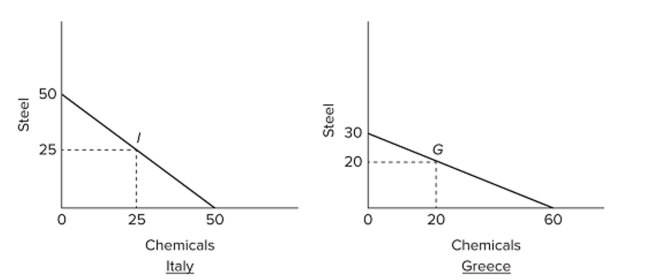 Suppose the world economy is composed of just two countries: Italy and Greece. Each can produce steel or chemicals, but at different levels of economic efficiency. The production possibilities curves
For the two countries are shown in the graphs. The assumption made about the domestic production
Opportunity costs in both countries is that they are
Suppose the world economy is composed of just two countries: Italy and Greece. Each can produce steel or chemicals, but at different levels of economic efficiency. The production possibilities curves
For the two countries are shown in the graphs. The assumption made about the domestic production
Opportunity costs in both countries is that they are (Multiple Choice)
4.8/5 (78)
(78) Quantity Demanded Domestically Price Quantity Supplied Domestically 1,400 \ 10 2,200 1,600 9 2,000 1,800 8 1,800 2,000 7 1,600 2,200 6 1,400 2,400 5 1,200 Refer to the accompanying table for a certain product's market in Econland. If the world price of the product were $6 and an import quota of 400 units were imposed on the product, then the
Equilibrium price in Econland would be
(Multiple Choice)
5.0/5 (88)
(88) What is one of the major shortcomings of using tariffs or quotas to "save American jobs"?
(Multiple Choice)
4.8/5 (70)
(70) Which of the following is a valid counterargument to the call for higher tariffs to save U.S. jobs?
(Multiple Choice)
4.9/5 (92)
(92) Which of the following products is a leading import of the United States?
(Multiple Choice)
4.8/5 (88)
(88) Which is a valid counterargument to the infant industry argument for protective tariffs?
(Multiple Choice)
4.8/5 (76)
(76) The United States can be classified as an "open" economy in that foreign trade accounts for more
than 50 percent of its GDP.
(True/False)
4.9/5 (72)
(72) Which of the following was not one of the principles on which the General Agreement on Tariffs and Trade (GATT) was established?
(Multiple Choice)
4.8/5 (81)
(81) 
Filters
- Essay(0)
- Multiple Choice(0)
- Short Answer(0)
- True False(0)
- Matching(0)