



 Chat with AI
Exam 20: International Trade

Exam 2: The Market System and the Circular Flow274 Questions
Exam 3: Demand, Supply, and Market Equilibrium357 Questions
Exam 4: Market Failures Caused by Externalities Asymmetric Information222 Questions
Exam 5: Public Goods, Public Choice, and Government Failure242 Questions
Exam 6: An Introduction to Macroeconomics243 Questions
Exam 7: Measuring Domestic Output and National Income238 Questions
Exam 8: Economic Growth274 Questions
Exam 9: Business Cycles, Unemployment, and Inflation298 Questions
Exam 10: Basic Macroeconomic Relationships233 Questions
Exam 11: The Aggregate Expenditures Model126 Questions
Exam 12: Aggregate Demand and Aggregate Supply320 Questions
Exam 13: Fiscal Policy, Deficits, and Debt401 Questions
Exam 14: Money, Banking, and Financial Institutions265 Questions
Exam 15: Money Creation285 Questions
Exam 16: Interest Rates and Monetary Policy405 Questions
Exam 17: Financial Economics356 Questions
Exam 18: Extending the Analysis of Aggregate Supply268 Questions
Exam 19: Current Issues in Macro Theory and Policy279 Questions
Exam 20: International Trade339 Questions
Exam 21: The Balance of Payments, Exchange Rates, and Trade Deficits315 Questions
Exam 22: The Economics of Developing Countries269 Questions
Select questions type


It is impossible for a nation to have a comparative advantage in producing everything.
(True/False)
4.9/5  (82)
(82) Evaluate the validity of the argument that a new industry (infant industry) in a nation needs
protection from foreign competition if it is to establish itself.
(Essay)
4.9/5 (72)
(72) 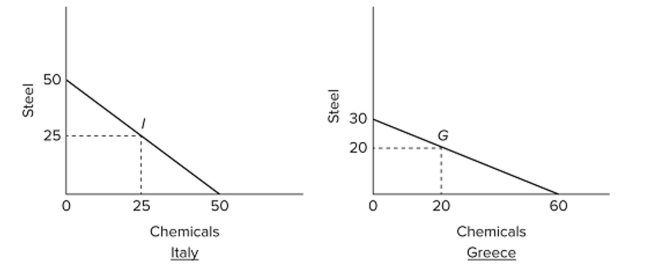 Suppose the world economy is composed of just two countries: Italy and Greece. Each can produce steel or chemicals, but at different levels of economic efficiency. The production possibilities curves
For the two countries are shown in the graphs. Assume that prior to specialization and trade, Italy
And Greece preferred points I and G on their respective production possibilities curves. As a result
Of complete specialization according to comparative advantage, the resulting gains in total output
Will be
Suppose the world economy is composed of just two countries: Italy and Greece. Each can produce steel or chemicals, but at different levels of economic efficiency. The production possibilities curves
For the two countries are shown in the graphs. Assume that prior to specialization and trade, Italy
And Greece preferred points I and G on their respective production possibilities curves. As a result
Of complete specialization according to comparative advantage, the resulting gains in total output
Will be (Multiple Choice)
4.9/5 (78)
(78) The domestic opportunity cost of producing a television in the United States is 20 bushels of wheat. In Korea, the domestic opportunity cost of producing a television is 10 bushels of wheat. In this case,
(Multiple Choice)
5.0/5 (72)
(72) 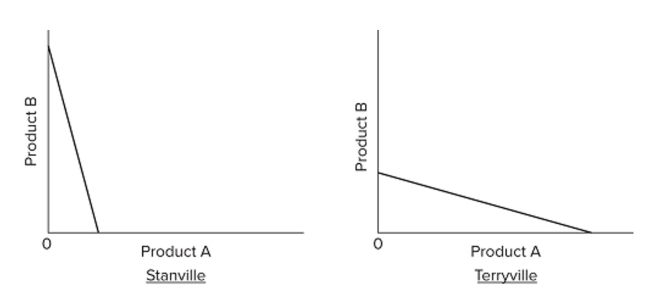 Refer to the graphs. Stanville has a comparative advantage in producing
 (Multiple Choice)
4.8/5 (85)
(85) What is the eurozone? How has the euro benefited the countries that have adopted it?
(Essay)
4.9/5 (85)
(85) In the real world, specialization is rarely complete because
(Multiple Choice)
4.9/5 (75)
(75) 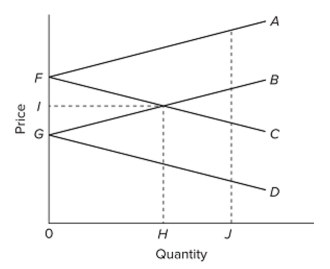 Refer to the diagram, which pertains to two nations and a specific product. The equilibrium level of exports and imports occurs at
 (Multiple Choice)
4.7/5 (77)
(77)
Price \ 5.00 200 400 4.00 250 350 3.00 300 300 2.00 350 250 1.00 400 200
The accompanying table gives data for Country . Column 1 of the table is the price of a product. Column 2 is the quantity demanded domestically , and Column 3 is the quantity supplied domestically . If Country opens itself up to international trade, at what world price will it begin importing some units of the product?
(Multiple Choice)
4.9/5 (85)
(85)
P 60 \ 5 10 40 4 20 30 3 30 20 2 40 10 1 50 Domestic Market For Steel, Beta P 80 \ 5 20 70 4 30 60 3 40 50 2 50 40 1 60 The accompanying tables show data for the hypothetical nations of Alpha and Beta. is domestic
Quantity supplied, and
is domestic quantity demanded. At a world price of $5,
(Multiple Choice)
4.7/5 (81)
(81) If Nations Quirk and Turk only produce aluminum or oil, the accompanying table shows the maximum output of each nation.
Nations Aluminum Oil Quirk 20 40 Turk 30 90 Which one of the following terms of trade is most likely to produce mutually bene?cial exchange
Between the two nations?
(Multiple Choice)
4.9/5 (74)
(74) If demand for a product is increasing, an import tariff is less restrictive than an import quota.
(True/False)
4.8/5 (73)
(73) If country A can produce both goods X and Y more efficiently, that is, with smaller absolute amounts of resources, than can country B,
(Multiple Choice)
4.8/5 (73)
(73) With constant costs in production, specialization tends to proceed to complete specialization, but
with increasing costs, specialization will not be complete.
(True/False)
4.8/5 (86)
(86) Suppose the United States eliminates high tariffs on German bicycles. As a result, we would expect
(Multiple Choice)
4.9/5 (74)
(74) Tariffs and import quotas would benefit the following groups, except
(Multiple Choice)
4.8/5 (79)
(79) The accompanying table gives domestic supply and demand schedules for a product. Suppose that the world price of the product is $1.
Quantity Supplied (Domestic) Price Quantity Demanded (Domestic) 12 \ 5 2 10 4 4 7 3 7 4 2 11 1 1 16 The total amount of revenue collected from a $1-per-unit tariff on this product will be
(Multiple Choice)
4.8/5 (86)
(86) 
Filters
- Essay(0)
- Multiple Choice(0)
- Short Answer(0)
- True False(0)
- Matching(0)