



 Chat with AI
Exam 20: International Trade

Exam 2: The Market System and the Circular Flow274 Questions
Exam 3: Demand, Supply, and Market Equilibrium357 Questions
Exam 4: Market Failures Caused by Externalities Asymmetric Information222 Questions
Exam 5: Public Goods, Public Choice, and Government Failure242 Questions
Exam 6: An Introduction to Macroeconomics243 Questions
Exam 7: Measuring Domestic Output and National Income238 Questions
Exam 8: Economic Growth274 Questions
Exam 9: Business Cycles, Unemployment, and Inflation298 Questions
Exam 10: Basic Macroeconomic Relationships233 Questions
Exam 11: The Aggregate Expenditures Model126 Questions
Exam 12: Aggregate Demand and Aggregate Supply320 Questions
Exam 13: Fiscal Policy, Deficits, and Debt401 Questions
Exam 14: Money, Banking, and Financial Institutions265 Questions
Exam 15: Money Creation285 Questions
Exam 16: Interest Rates and Monetary Policy405 Questions
Exam 17: Financial Economics356 Questions
Exam 18: Extending the Analysis of Aggregate Supply268 Questions
Exam 19: Current Issues in Macro Theory and Policy279 Questions
Exam 20: International Trade339 Questions
Exam 21: The Balance of Payments, Exchange Rates, and Trade Deficits315 Questions
Exam 22: The Economics of Developing Countries269 Questions
Select questions type


The accompanying table gives domestic supply and demand schedules for a product. Suppose that the world price of the product is $1.
Quantity Supplied (Domestic) Price Quantity Demanded (Domestic) 12 \ 5 2 10 4 4 7 3 7 4 2 11 1 1 16 With a $1-per-unit tariff, the quantities sold by foreign and domestic producers, respectively, will be
(Multiple Choice)
4.8/5  (74)
(74) Assume that a VER (voluntary export restraint) is imposed on an imported product. The difference between the domestic price and the world price is captured by
(Multiple Choice)
4.9/5 (87)
(87) Assume that by devoting all its resources to the production of X, nation Alpha can produce 20 units
of X. By devoting all its resources to Y, Alpha can produce 30Y. Comparable figures for nation Beta
are 60X and 40Y. There is no basis for trade between Alpha and Beta, because Beta has an
absolute advantage in the production of both goods.
(True/False)
4.7/5 (81)
(81) Nation Alpha has a comparative advantage in product X, and nation Beta has a comparative advantage in product Y. Trade in the two products will only benefit the two nations if
(Multiple Choice)
5.0/5 (76)
(76) Which of the following is a valid counterargument against using tariffs to protect high wages from cheap foreign labor?
(Multiple Choice)
4.7/5 (79)
(79) If a nation's labor can produce more of a good compared to labor in another nation, then we say
that the first nation has a comparative advantage in producing that good.
(True/False)
4.9/5 (81)
(81) 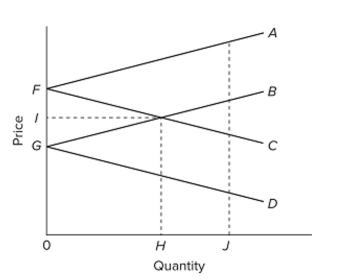 Refer to the diagram pertaining to two nations and a specific product. Lines FA and GB are
 (Multiple Choice)
4.9/5 (85)
(85) What other economic process needs to accompany international trade, for nations to benefit from such trade?
(Multiple Choice)
4.8/5 (71)
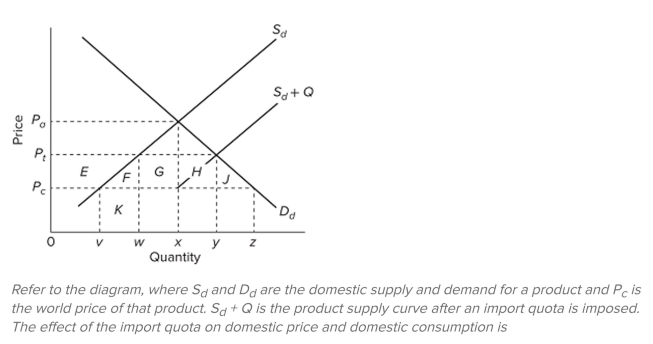
(71) 
In Germany, one worker can produce either one cuckoo clock or one beer mug. In Taiwan, one worker can produce either two cuckoo clocks or three beer mugs. Who has the comparative
Advantage in each good?
(Multiple Choice)
4.8/5 (94)
(94) A nation will import a particular product if the world price is less than the domestic price.
(True/False)
4.9/5 (76)
(76) 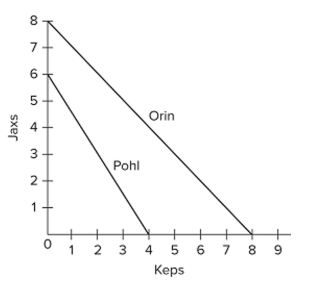 The graph shows the production possibilities curves for two hypothetical nations, Orin and Pohl, which each make two hypothetical products, jaxs and keps. Which of the following statements is
Correct?
The graph shows the production possibilities curves for two hypothetical nations, Orin and Pohl, which each make two hypothetical products, jaxs and keps. Which of the following statements is
Correct? (Multiple Choice)
4.7/5 (68)
(68) Suppose the United States sets a limit on the number of tons of sugar that can be imported each year. This is an example of a(n)
(Multiple Choice)
4.9/5 (90)
(90) The tables give production possibilities data for two countries, Alpha and Beta, which have populations of equal size.
A B C D E Fish (Tons) 80 60 40 20 0 Chips (Tons) 0 5 10 15 20 Beta's production possibilities A B C D E Fish (Tons) 240 180 120 60 0 Chips (Tons) 0 10 20 30 40 Suppose that before specialization and trade, Alpha chose production alternative C and Beta chose
Production alternative B. After specialization and trade, the gains will be
(Multiple Choice)
4.8/5 (76)
(76) Common arguments often raised to present the case for protectionism include the following, except
(Multiple Choice)
4.9/5 (74)
(74) Suppose the domestic price (no-international-trade price) of copper is $1.20 a pound in the United States while the world price is $1.00 a pound. Assuming no transportation costs, the United States
Will
(Multiple Choice)
4.8/5 (89)
(89) Specialization and trade based on comparative advantage allow nations to attain the following results, except
(Multiple Choice)
4.8/5 (75)
(75) How will the difference between the world price and the domestic price of a good encourage
exports and imports?
(Essay)
4.9/5 (87)
(87) Trade protection in most instances transfers wealth from consumers to domestic producers and
government.
(True/False)
4.9/5 (79)
(79) 
Filters
- Essay(0)
- Multiple Choice(0)
- Short Answer(0)
- True False(0)
- Matching(0)