



 Chat with AI
Exam 20: International Trade

Exam 2: The Market System and the Circular Flow274 Questions
Exam 3: Demand, Supply, and Market Equilibrium357 Questions
Exam 4: Market Failures Caused by Externalities Asymmetric Information222 Questions
Exam 5: Public Goods, Public Choice, and Government Failure242 Questions
Exam 6: An Introduction to Macroeconomics243 Questions
Exam 7: Measuring Domestic Output and National Income238 Questions
Exam 8: Economic Growth274 Questions
Exam 9: Business Cycles, Unemployment, and Inflation298 Questions
Exam 10: Basic Macroeconomic Relationships233 Questions
Exam 11: The Aggregate Expenditures Model126 Questions
Exam 12: Aggregate Demand and Aggregate Supply320 Questions
Exam 13: Fiscal Policy, Deficits, and Debt401 Questions
Exam 14: Money, Banking, and Financial Institutions265 Questions
Exam 15: Money Creation285 Questions
Exam 16: Interest Rates and Monetary Policy405 Questions
Exam 17: Financial Economics356 Questions
Exam 18: Extending the Analysis of Aggregate Supply268 Questions
Exam 19: Current Issues in Macro Theory and Policy279 Questions
Exam 20: International Trade339 Questions
Exam 21: The Balance of Payments, Exchange Rates, and Trade Deficits315 Questions
Exam 22: The Economics of Developing Countries269 Questions
Select questions type


If a nation agrees to set an upper limit on the total amount of a product that it exports to another nation, then this situation would be an example of
(Multiple Choice)
4.9/5  (85)
(85) 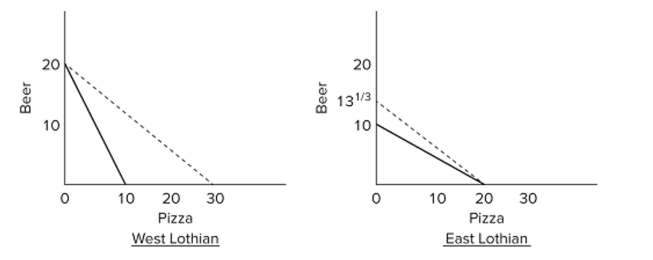 In the accompanying diagrams, solid lines are production possibilities curves, and the dashed lines are trading possibilities curves. The trading possibilities curves imply that
 (Multiple Choice)
4.8/5 (74)
(74) U.S. exports of goods and services (on a national income account basis) are about
(Multiple Choice)
4.9/5 (77)
(77) 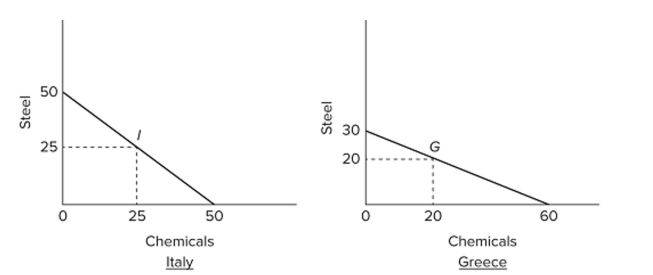 Suppose the world economy is composed of just two countries: Italy and Greece. Each can produce steel or chemicals, but at different levels of economic efficiency. The production possibilities curves
For the two countries are shown in the graphs. If Italy and Greece open up trade with each other,
Which of the following terms of trade is mutually beneficial?
Suppose the world economy is composed of just two countries: Italy and Greece. Each can produce steel or chemicals, but at different levels of economic efficiency. The production possibilities curves
For the two countries are shown in the graphs. If Italy and Greece open up trade with each other,
Which of the following terms of trade is mutually beneficial? (Multiple Choice)
4.8/5 (76)
(76) The use of tariffs and quotas for trade protection results in
(Multiple Choice)
4.9/5 (81)
(81) From an economic perspective, studies of the costs of trade barriers show that they
(Multiple Choice)
4.9/5 (86)
(86) Globalization of resource markets has resulted in the business practice of offshoring, which involves
(Multiple Choice)
4.8/5 (88)
(88) Assume that a tariff is imposed on an imported product. The difference between the domestic price and the world price is captured by
(Multiple Choice)
4.9/5 (85)
(85) In the past, Canada has agreed to set an upper limit on the total amount of softwood lumber sold to the United States. This is an example of a(n)
(Multiple Choice)
4.8/5 (79)
(79) The terms of trade will favor a larger nation over a smaller nation.
(True/False)
4.8/5 (88)
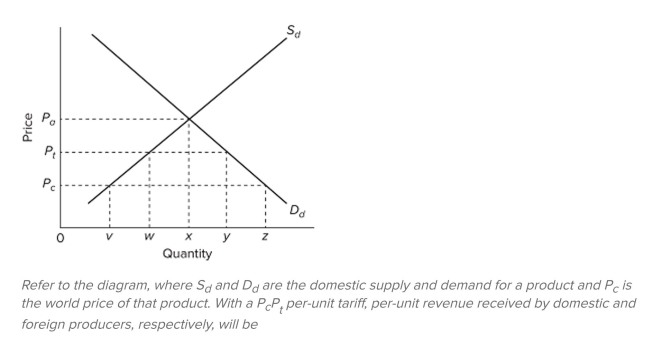
(88) 
Assume that by devoting all its resources to the production of X, nation Alpha can produce 20 units
of X. By devoting all its resources to Y, Alpha can produce 30Y. Comparable figures for nation Beta
are 60X and 40Y. Alpha would prefer terms of trade at, or close to, 1X = 2/3Y.
(True/False)
4.8/5 (92)
(92) If a nation imposes a tariff on an imported product, then the nation will experience a(n)
(Multiple Choice)
4.9/5 (94)
(94) If two nations have straight-line production possibilities curves,
(Multiple Choice)
4.7/5 (71)
(71) In a two-nation model, the equilibrium world price will occur where
(Multiple Choice)
4.9/5 (98)
(98) The production possibilities for country X are either 6,000 bushels of soybeans or 10,000 bushels of wheat. The production possibilities for country Y are either 2,000 bushels of soybeans or 4,000
Bushels of wheat. Which of the following is true?
(Multiple Choice)
4.8/5 (72)
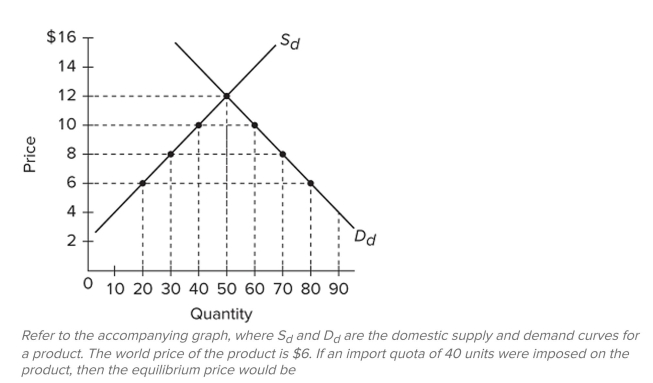
(72) 

Filters
- Essay(0)
- Multiple Choice(0)
- Short Answer(0)
- True False(0)
- Matching(0)