



 Chat with AI
Exam 3: Alkenes and Alkynes: the Nature of Organic Reactions

Exam 1: Structure and Bonding:acids and Bases41 Questions
Exam 2: Alkanes: the Nature of Organic Compounds44 Questions
Exam 3: Alkenes and Alkynes: the Nature of Organic Reactions40 Questions
Exam 4: Reactions of Alkenes and Alkynes44 Questions
Exam 5: Aromatic Compounds52 Questions
Exam 6: Sterechemistry at Tetrahedral Centers39 Questions
Exam 7: Organohalides: Nucleophilic Substitutions and Eliminations40 Questions
Exam 8: Alcohols, Phenols, Ethers, and Their Sulfur Analogs36 Questions
Exam 9: Aldehydes and Ketones: Nucleophilic Addition Reactions32 Questions
Exam 10: Carboxylic Acids and Derivatives: Nucleophilic Acyl Substitution Reactions63 Questions
Exam 11: Carbonyl Alpha-Substitution Reactions and Condensation Reactions38 Questions
Exam 12: Amines32 Questions
Exam 13: Structure Determination65 Questions
Exam 14: Biomolecules: Carbohydrates48 Questions
Exam 15: Biomolecules: Amino Acids, Peptides, and Proteins50 Questions
Exam 16: Biomolecules: Lipids and Nucleic Acids50 Questions
Exam 17: The Organic Chemistry of Metabolic Pathways40 Questions
Select questions type


Instructions: Assign E or Z configurations to each alkene below.
-Assign: 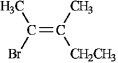
(Short Answer)
4.9/5  (75)
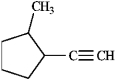
(75) The following group is a substituent on a molecule. What is an accepted IUPAC name for this group? 
(Multiple Choice)
4.7/5 (67)
(67) Instructions: Provide names for each structure below. Be sure to include the cis,trans or E,Z designations where applicable.
-Name and designate: 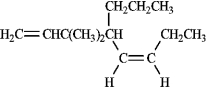
(Essay)
4.9/5 (67)
(67) Instructions: Pent-2-ene is an example of a disubstituted alkene. Use this alkene to answer the following question(s).  -Refer to instructions. Circle the isomer of pent-2-ene that is most stable.
 (Essay)
4.8/5 (72)
(72) Instructions: Add curved arrows to the following reaction(s) to indicate the flow of electrons in each.
-Indicate flow: 
(Essay)
4.7/5 (79)
(79) Instructions: Draw structures corresponding to each name below.
-Draw:
(3E)-3,7-dimethylocta-1,3,6-triene
(Essay)
4.9/5 (75)
(75) Instructions: The reaction below is commonly used as a laboratory preparation of cyclohexene. Use this reaction to answer the following question(s). 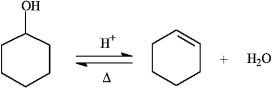 -Refer to instructions. The forward and reverse reactions are classified, respectively, as:
 (Multiple Choice)
4.7/5 (65)
(65) 
Instructions: Classify each structure below as a nucleophile or electrophile, and briefly explain your choice.
-Classify and explain:
azide 
(Essay)
4.9/5 (90)
(90) Instructions: Provide names for each structure below. Be sure to include the cis,trans or E,Z designations where applicable.
-Name and designate: 
(Short Answer)
4.8/5 (79)
(79) Instructions: In the reaction below:
a)Label the nucleophile (Nu) and the electrophile (E).
b)Draw arrows on the structures showing electron flow in the reaction.
-Label and indicate flow: 
(Short Answer)
4.8/5 (69)
(69) 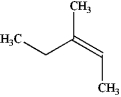
Match each definition to one of the terms below.
-A reaction that involves a species with an unpaired electron.
(Multiple Choice)
4.7/5 (77)
(77) Instructions: Identify and label the nucleophile and electrophile in each reaction below.
-Identify and label: 
(Essay)
4.8/5 (72)
(72) Instructions: Identify and label the nucleophile and electrophile in each reaction below.
-Identify and label: 
(Essay)
4.8/5 (77)
(77) Predict the product of the following reaction of Prostaglandin H2 by interpreting the flow of electrons as indicated by the curved arrows. 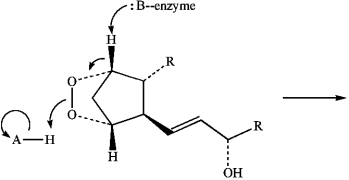
(Essay)
5.0/5 (61)
(61) Instructions: Pent-2-ene is an example of a disubstituted alkene. Use this alkene to answer the following question(s).
-Refer to instructions. Draw the cis and trans isomers of pent-2-ene and label them.
-Refer to instructions. Draw the cis and trans isomers of pent-2-ene and label them. (Essay)
4.8/5 (86)
(86) Instructions: Identify the functional groups present in each compound below, and predict the direction of polarity in each.
-Identify and predict:
mustard gas Cl-CH2CH2-CH2CH2-Cl
(Essay)
4.9/5 (77)
(77) Match each definition to one of the terms below.
-A species that lies at an energy maximum during an individual step in a reaction.
(Multiple Choice)
4.9/5 (69)
(69) Choose substituents X and Y (listed in order below) for the following compound so as to make a Z isomer. 
(Multiple Choice)
4.9/5 (79)
(79) 
Filters
- Essay(0)
- Multiple Choice(0)
- Short Answer(0)
- True False(0)
- Matching(0)