



 Chat with AI
Exam 7: Organohalides: Nucleophilic Substitutions and Eliminations

Exam 1: Structure and Bonding:acids and Bases41 Questions
Exam 2: Alkanes: the Nature of Organic Compounds44 Questions
Exam 3: Alkenes and Alkynes: the Nature of Organic Reactions40 Questions
Exam 4: Reactions of Alkenes and Alkynes44 Questions
Exam 5: Aromatic Compounds52 Questions
Exam 6: Sterechemistry at Tetrahedral Centers39 Questions
Exam 7: Organohalides: Nucleophilic Substitutions and Eliminations40 Questions
Exam 8: Alcohols, Phenols, Ethers, and Their Sulfur Analogs36 Questions
Exam 9: Aldehydes and Ketones: Nucleophilic Addition Reactions32 Questions
Exam 10: Carboxylic Acids and Derivatives: Nucleophilic Acyl Substitution Reactions63 Questions
Exam 11: Carbonyl Alpha-Substitution Reactions and Condensation Reactions38 Questions
Exam 12: Amines32 Questions
Exam 13: Structure Determination65 Questions
Exam 14: Biomolecules: Carbohydrates48 Questions
Exam 15: Biomolecules: Amino Acids, Peptides, and Proteins50 Questions
Exam 16: Biomolecules: Lipids and Nucleic Acids50 Questions
Exam 17: The Organic Chemistry of Metabolic Pathways40 Questions
Select questions type


Instructions: Consider the reaction below to answer the following question(s).
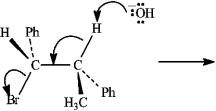 -Refer to instructions. Write the product that results from the indicated electron flow in the reaction, showing any resulting stereochemistry
 (Essay)
4.8/5  (82)
(82) Which mechanism is favored by the reaction of a tertiary alkyl chloride with ethanol?
(Multiple Choice)
4.9/5 (66)
(66) Instructions: Consider the reaction below to answer the following question(s).
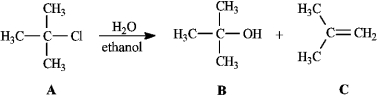 -Refer to instructions. Compound B is the:
 (Multiple Choice)
4.8/5 (85)
(85) Which of the following represents the transition state of the SN2 reaction between methyl iodide and ammonia?
(Multiple Choice)
4.9/5 (75)
(75) Instructions:
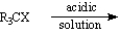
For each substrate below, choose which reaction type is favored. Place the letter of the reaction type in the blank above the substrate.
-Refer to Instructions.
_____ 
(Multiple Choice)
4.7/5 (97)
(97) What is the rate law for the E2 reaction of an alkyl halide (RX) with sodium ethoxide (NaOEt) in ethanol solvent (EtOH)?
(Multiple Choice)
4.9/5 (75)
(75) Instructions:
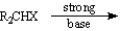
For each substrate below, choose which reaction type is favored. Place the letter of the reaction type in the blank above the substrate.
-Refer to Instructions.
_____ 
(Multiple Choice)
4.9/5 (74)
(74) Propose a synthesis of the following compound from the given starting material and any inorganic reagents necessary. 
(Essay)
4.9/5 (91)
(91) Halving the concentration of hydroxide in these reactions:
A)causes the reaction mechanism to change
B)halves the rate of reaction
C)has no effect on the rate of reaction
D)doubles the rate of reaction
(Essay)
4.8/5 (77)
(77) Instructions: For each question, draw a structure corresponding to the given name.
-Draw:
trans-1-sec-butyl-3-chlorocyclohexane
(Essay)
5.0/5 (75)
(75) Instructions: Provide a IUPAC name for each of the following alkyl halides.
-Name: 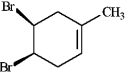
(Short Answer)
4.9/5 (85)
(85) Instructions: Consider the reaction below to answer the following question(s).
-Refer to instructions. Draw a Newman projection of the reactive conformation of the starting material.
-Refer to instructions. Draw a Newman projection of the reactive conformation of the starting material. (Essay)
4.9/5 (87)
(87) Draw all the monochlorination products of methylcyclopentane (ignore stereoisomers).
(Essay)
4.8/5 (78)
(78) Consider the reactions below to answer the following questions.
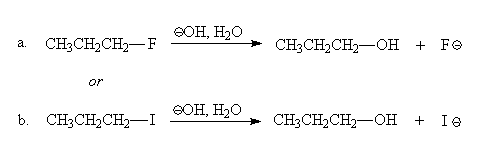 -The mechanism for these reactions is:
 (Multiple Choice)
4.8/5 (90)
(90) Instructions: Consider the pair of reactions below to answer the following question(s).
a.  or
b.
 -Refer to instructions. The nucleophile in these reactions is:
or
b.
-Refer to instructions. The nucleophile in these reactions is: (Multiple Choice)
4.9/5 (73)
(73) Instructions: Circle the correct response in each set below.
-Refer to instructions. The least reactive compound in an SN1 reaction. 
(Essay)
4.9/5 (71)
(71) Instructions: For each question, provide structures for the reactants, intermediates, or products, as indicated. Draw the structures in the boxes provided.
-Draw: 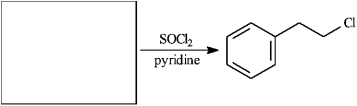
(Essay)
4.8/5 (71)
(71) Instructions: Provide a IUPAC name for each of the following alkyl halides.
-Name: 
(Short Answer)
4.9/5 (85)
(85) Which of the following statements about an SN1 reaction is true?
(Multiple Choice)
4.9/5 (70)
(70) Instructions: Provide a IUPAC name for each of the following alkyl halides.
-Name:
The solvents: CCl4 and CH2Cl2
(Short Answer)
4.8/5 (77)
(77) 
Filters
- Essay(0)
- Multiple Choice(0)
- Short Answer(0)
- True False(0)
- Matching(0)