



 Chat with AI
Exam 19: Labor and Entrepreneurship: the Human Inputs

Exam 1: What Is Economics254 Questions
Exam 2: The Economony: Myth and Reality184 Questions
Exam 3: The Fundamental Economic Problem: Scarcity and Choice278 Questions
Exam 4: Supply and Demand: an Initial Look297 Questions
Exam 5: Consumer Choice: Individual and Market Demand213 Questions
Exam 6: Demand and Elasticity247 Questions
Exam 7: Production, Inputs, and Cost: Building Blocks for Supply Analysis246 Questions
Exam 8: Output, Price, and Profit: the Importance of Marginal Analysis232 Questions
Exam 9: The Financial Markets and the Economy: the Tail That Wags the Dog225 Questions
Exam 10: The Firm and the Industry Under Perfect Competition219 Questions
Exam 11: The Case for Free Markets: the Price System251 Questions
Exam 12: Monopoly236 Questions
Exam 13: Between Competition and Monopoly248 Questions
Exam 14: Limiting Market Power: Antitrust and Regulation152 Questions
Exam 15: The Shortcomings of Free Markets210 Questions
Exam 16: The Economics of the Environment, and Natural Resources218 Questions
Exam 17: Taxation and Resource Allocation218 Questions
Exam 18: Pricing the Factors of Production230 Questions
Exam 19: Labor and Entrepreneurship: the Human Inputs267 Questions
Exam 20: Poverty, Inequality, and Discrimination167 Questions
Exam 21: An Introduction to Macroeconomics212 Questions
Exam 22: The Goals of Macroeconomic Policy212 Questions
Exam 23: Economic Growth: Theory and Policy226 Questions
Exam 24: Aggregate Demand and the Powerful Consumer216 Questions
Exam 25: Demand-Side Equilibrium: Unemployment or Inflation215 Questions
Exam 26: Bringing in the Supply Side: Unemployment and Inflation228 Questions
Exam 27: Managing Aggregate Demand: Fiscal Policy207 Questions
Exam 28: Money and the Banking System222 Questions
Exam 29: Monetary Policy: Conventional and Unconventional208 Questions
Exam 30: The Financial Crisis and the Great Recession64 Questions
Exam 31: The Debate Over Monetary and Fiscal Policy216 Questions
Exam 32: Budget Deficits in the Short and Long Run214 Questions
Exam 33: The Trade-Off Between Inflation and Unemployment218 Questions
Exam 34: International Trade and Comparative Advantage215 Questions
Exam 35: The International Monetary System: Order or Disorder216 Questions
Exam 36: Exchange Rates and the Macroeconomy215 Questions
Exam 37: Contemporary Issues in the Useconomy23 Questions
Select questions type


A relatively high wage is predicted to be enjoyed by workers where the
(Multiple Choice)
4.9/5  (90)
(90) For which of the following workers would the substitution effect be more likely to outweigh the income effect of an increase in wage?
(Multiple Choice)
4.9/5 (84)
(84) Which economist created the theory of creative destruction?
(Multiple Choice)
4.8/5 (91)
(91) It required less labor time to buy a college education in 1995 than it did in 1965.
(True/False)
4.8/5 (82)
(82) For which of the following workers would the income effect be more likely to outweigh the substitution effect of an increase in wage?
(Multiple Choice)
4.9/5 (69)
(69) A change in wages creates a substitution and income effect on the quantity of labor supplied.
(True/False)
4.7/5 (92)
(92) Explain the concept of "creative destruction" by innovation.Does it ensure positive economic profits in the long run?
(Essay)
4.8/5 (81)
(81) Labor union membership, as a percent of workers, has steadily declined over the last several decades.
(True/False)
4.8/5 (81)
(81) A person's decision to supply a certain amount of labor in a week is simultaneously a decision to consume a certain amount of leisure per week.
(True/False)
4.7/5 (76)
(76) The impact of an increase in oil prices stemming from the growth of demand is probably going to ____ the wages of petroleum engineers.
(Multiple Choice)
4.9/5 (81)
(81) How do modern markets differ from other economic systems in their capacity to produce "growth miracles"?
(Essay)
4.8/5 (88)
(88) Figure 20-4 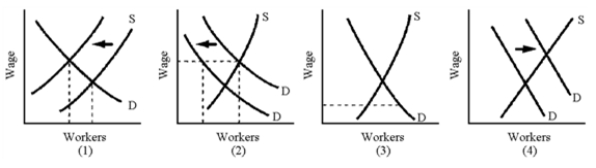 -In Figure 20-4, which panel depicts a union suffering unemployment during a recession rather than allowing the wage to fall?
 (Multiple Choice)
4.8/5 (85)
(85) In 1972, a very controversial study asserted that income differences among individuals did not depend on genetic differences in reasoning ability, or differences between schools, or family background.Moreover, the effects of level of schooling are much less than previously understood.After controlling for all of these background variables, much of the variation in earnings appeared to be random.From this analysis, one might reach the very controversial conclusion that earnings depended to a very great extent on
(Multiple Choice)
4.9/5 (85)
(85) Union membership in the United States has fallen compared to what it was in the 1950s.
(True/False)
5.0/5 (85)
(85) One of the most significant developments in labor supply in recent times is the increase in the labor force participation of married women.
(True/False)
4.9/5 (83)
(83) Figure 20-1 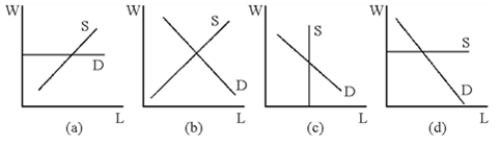 -Which of the diagrams in Figure 20-1 shows the situation of an individual firm that hires labor in a perfectly competitive market?
 (Multiple Choice)
4.9/5 (68)
(68) 
Filters
- Essay(0)
- Multiple Choice(0)
- Short Answer(0)
- True False(0)
- Matching(0)