



 Chat with AI
Exam 12: Monopoly

Exam 1: What Is Economics254 Questions
Exam 2: The Economony: Myth and Reality184 Questions
Exam 3: The Fundamental Economic Problem: Scarcity and Choice278 Questions
Exam 4: Supply and Demand: an Initial Look297 Questions
Exam 5: Consumer Choice: Individual and Market Demand213 Questions
Exam 6: Demand and Elasticity247 Questions
Exam 7: Production, Inputs, and Cost: Building Blocks for Supply Analysis246 Questions
Exam 8: Output, Price, and Profit: the Importance of Marginal Analysis232 Questions
Exam 9: The Financial Markets and the Economy: the Tail That Wags the Dog225 Questions
Exam 10: The Firm and the Industry Under Perfect Competition219 Questions
Exam 11: The Case for Free Markets: the Price System251 Questions
Exam 12: Monopoly236 Questions
Exam 13: Between Competition and Monopoly248 Questions
Exam 14: Limiting Market Power: Antitrust and Regulation152 Questions
Exam 15: The Shortcomings of Free Markets210 Questions
Exam 16: The Economics of the Environment, and Natural Resources218 Questions
Exam 17: Taxation and Resource Allocation218 Questions
Exam 18: Pricing the Factors of Production230 Questions
Exam 19: Labor and Entrepreneurship: the Human Inputs267 Questions
Exam 20: Poverty, Inequality, and Discrimination167 Questions
Exam 21: An Introduction to Macroeconomics212 Questions
Exam 22: The Goals of Macroeconomic Policy212 Questions
Exam 23: Economic Growth: Theory and Policy226 Questions
Exam 24: Aggregate Demand and the Powerful Consumer216 Questions
Exam 25: Demand-Side Equilibrium: Unemployment or Inflation215 Questions
Exam 26: Bringing in the Supply Side: Unemployment and Inflation228 Questions
Exam 27: Managing Aggregate Demand: Fiscal Policy207 Questions
Exam 28: Money and the Banking System222 Questions
Exam 29: Monetary Policy: Conventional and Unconventional208 Questions
Exam 30: The Financial Crisis and the Great Recession64 Questions
Exam 31: The Debate Over Monetary and Fiscal Policy216 Questions
Exam 32: Budget Deficits in the Short and Long Run214 Questions
Exam 33: The Trade-Off Between Inflation and Unemployment218 Questions
Exam 34: International Trade and Comparative Advantage215 Questions
Exam 35: The International Monetary System: Order or Disorder216 Questions
Exam 36: Exchange Rates and the Macroeconomy215 Questions
Exam 37: Contemporary Issues in the Useconomy23 Questions
Select questions type


The software industry has traits in common with monopoly markets.

Free
(True/False)
4.9/5  (95)
(95) Correct Answer: Verified
True
Compared to a perfectly competitive industry, a monopoly produces a smaller output and charges a higher price.
Free
(True/False)
4.9/5 (70)
(70) Correct Answer:Verified
VerifiedTrue
Figure 11-1 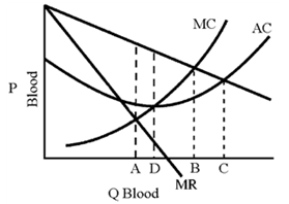 -The Red Cross is virtually the only operator of blood banks in the United States.In Figure 11-1 are the demand and supply curves facing the Red Cross blood bank.If it were to operate like a profit-maximizing business, how many units of blood would it sell?
Free
(Multiple Choice)
4.8/5 (85)
(85) Correct Answer:Verified
VerifiedA
The presence of large sunk costs often serves as a naturally imposed barrier to entry.
(True/False)
4.9/5 (84)
(84) A monopolist is willing to lose some customers by charging higher prices, since this results in higher profits.
(True/False)
4.8/5 (57)
(57) In perfect competition P = MR, but in monopoly P > MR.Why? Substantiate this statement with an example.
(Essay)
4.9/5 (89)
(89) Pure monopoly is not studied because of its descriptive realism, but because it is a stepping stone toward more realistic models.
(True/False)
4.8/5 (88)
(88) The two basic reasons why a monopoly exists are barriers to entry and cost advantages.
(True/False)
4.7/5 (86)
(86) Monopolies are always large firms with great economies of scale.
(True/False)
4.8/5 (80)
(80) Control of a scarce resource or input can serve as an entry barrier.
(True/False)
4.7/5 (86)
(86) The monopoly's ability to restrict output results in lower profits than other types of firms.
(True/False)
4.8/5 (74)
(74) Which of these would NOT be a factor that would permit the existence of monopoly power?
(Multiple Choice)
4.8/5 (71)
(71) Table 11-1  -Table 11-1 shows demand and total cost schedules for the monopolist Monopoliteria.Monopoliteria's profit-maximizing price per unit in dollars is
 (Multiple Choice)
4.9/5 (82)
(82) Economists consider price discrimination to always be undesirable.
(True/False)
4.9/5 (93)
(93) 
Filters
- Essay(0)
- Multiple Choice(0)
- Short Answer(0)
- True False(0)
- Matching(0)