



 Chat with AI
Exam 12: Monopoly

Exam 1: What Is Economics254 Questions
Exam 2: The Economony: Myth and Reality184 Questions
Exam 3: The Fundamental Economic Problem: Scarcity and Choice278 Questions
Exam 4: Supply and Demand: an Initial Look297 Questions
Exam 5: Consumer Choice: Individual and Market Demand213 Questions
Exam 6: Demand and Elasticity247 Questions
Exam 7: Production, Inputs, and Cost: Building Blocks for Supply Analysis246 Questions
Exam 8: Output, Price, and Profit: the Importance of Marginal Analysis232 Questions
Exam 9: The Financial Markets and the Economy: the Tail That Wags the Dog225 Questions
Exam 10: The Firm and the Industry Under Perfect Competition219 Questions
Exam 11: The Case for Free Markets: the Price System251 Questions
Exam 12: Monopoly236 Questions
Exam 13: Between Competition and Monopoly248 Questions
Exam 14: Limiting Market Power: Antitrust and Regulation152 Questions
Exam 15: The Shortcomings of Free Markets210 Questions
Exam 16: The Economics of the Environment, and Natural Resources218 Questions
Exam 17: Taxation and Resource Allocation218 Questions
Exam 18: Pricing the Factors of Production230 Questions
Exam 19: Labor and Entrepreneurship: the Human Inputs267 Questions
Exam 20: Poverty, Inequality, and Discrimination167 Questions
Exam 21: An Introduction to Macroeconomics212 Questions
Exam 22: The Goals of Macroeconomic Policy212 Questions
Exam 23: Economic Growth: Theory and Policy226 Questions
Exam 24: Aggregate Demand and the Powerful Consumer216 Questions
Exam 25: Demand-Side Equilibrium: Unemployment or Inflation215 Questions
Exam 26: Bringing in the Supply Side: Unemployment and Inflation228 Questions
Exam 27: Managing Aggregate Demand: Fiscal Policy207 Questions
Exam 28: Money and the Banking System222 Questions
Exam 29: Monetary Policy: Conventional and Unconventional208 Questions
Exam 30: The Financial Crisis and the Great Recession64 Questions
Exam 31: The Debate Over Monetary and Fiscal Policy216 Questions
Exam 32: Budget Deficits in the Short and Long Run214 Questions
Exam 33: The Trade-Off Between Inflation and Unemployment218 Questions
Exam 34: International Trade and Comparative Advantage215 Questions
Exam 35: The International Monetary System: Order or Disorder216 Questions
Exam 36: Exchange Rates and the Macroeconomy215 Questions
Exam 37: Contemporary Issues in the Useconomy23 Questions
Select questions type


A monopolist will increase output to the point where MR equals MC and not beyond.
(True/False)
5.0/5  (80)
(80) Figure 11-5 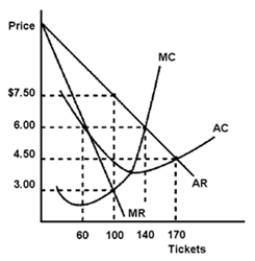 -Crown Theater is the only movie theater in the city.Its cost and revenue curves are shown in Figure 11-5.Monopolist Crown Theater would set the price of its tickets at
 (Multiple Choice)
5.0/5 (80)
(80) Figure 11-6 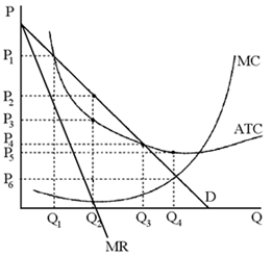 -The profit-maximizing monopolist in Figure 11-6 will produce ____ units of output.
 (Multiple Choice)
4.8/5 (64)
(64) "Intel Inside" accompanies virtually all IBM-compatible computers.Intel manufactures the i3, i5 and i7 chips that are a key component of personal computers.Does Intel have a monopoly?
(Essay)
4.8/5 (79)
(79) The ability to keep rivals out of the market is the recipe for creating and maintaining a monopoly.
(True/False)
4.9/5 (85)
(85) 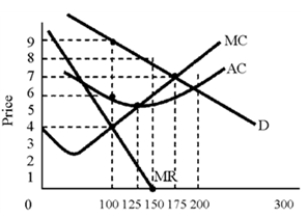 -Monopolists may in the long run
Table 11-2 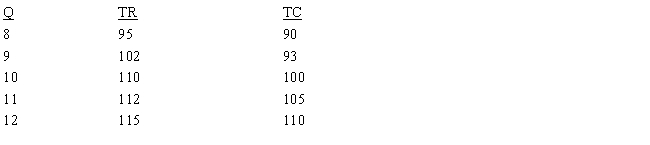
-In Table 11-2, marginal revenue at the profit-maximizing output is how much?
-In Table 11-2, marginal revenue at the profit-maximizing output is how much? (Multiple Choice)
4.9/5 (84)
(84) A natural monopoly is characterized by the fact that its average costs increase rather than decrease when its output expands.
(True/False)
4.9/5 (74)
(74) Figure 11-3 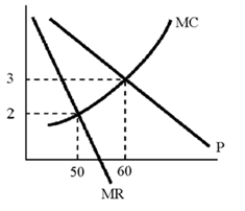 -Using the graph in Figure 11-3, the profit-maximizing monopolist will charge a price
 (Multiple Choice)
4.7/5 (79)
(79) Figure 11-2 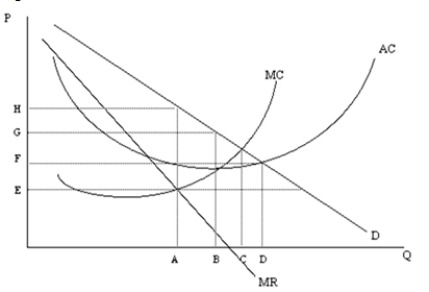 -Since a monopoly faces a downward-sloping demand curve,
 (Multiple Choice)
4.9/5 (89)
(89) In the long run, profit-maximizing monopolists facing a downward-sloping demand curve
(Multiple Choice)
4.8/5 (79)
(79) Which of the following is true for a profit-maximizing competitive firm in the long run but not a monopolist?
(Multiple Choice)
4.9/5 (74)
(74) A price-discriminating firm will always maximize profit by following the condition that
(Multiple Choice)
4.9/5 (66)
(66) In cases of natural monopolies, society would be better off with many firms competing with each other.
(True/False)
4.9/5 (88)
(88) For natural monopoly markets, government regulators frequently encourage competition among a number of firms.
(True/False)
4.7/5 (68)
(68) Figure 11-4 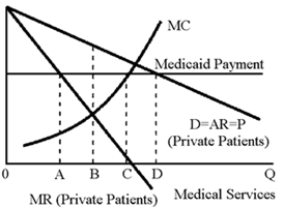 -Physicians have two types of patients: private patients who pay directly or with insurance, and Medicaid patients whose care is paid for by the state.Physicians must lower prices to attract more private patients, but they can add unlimited Medicaid patients at a constant price.The situation facing Dr.Casey is depicted in Figure 11-4.Units of medical service (say, number of patients × number of visits) are measured on the horizontal axis.How many units of medical service will Dr.Casey deliver to Medicaid patients?
 (Multiple Choice)
4.7/5 (85)
(85) Monopoly firms may lead to higher costs than perfectly competitive firms.
(True/False)
4.8/5 (98)
(98) 
Filters
- Essay(0)
- Multiple Choice(0)
- Short Answer(0)
- True False(0)
- Matching(0)