



 Chat with AI
Exam 12: Monopoly

Exam 1: What Is Economics254 Questions
Exam 2: The Economony: Myth and Reality184 Questions
Exam 3: The Fundamental Economic Problem: Scarcity and Choice278 Questions
Exam 4: Supply and Demand: an Initial Look297 Questions
Exam 5: Consumer Choice: Individual and Market Demand213 Questions
Exam 6: Demand and Elasticity247 Questions
Exam 7: Production, Inputs, and Cost: Building Blocks for Supply Analysis246 Questions
Exam 8: Output, Price, and Profit: the Importance of Marginal Analysis232 Questions
Exam 9: The Financial Markets and the Economy: the Tail That Wags the Dog225 Questions
Exam 10: The Firm and the Industry Under Perfect Competition219 Questions
Exam 11: The Case for Free Markets: the Price System251 Questions
Exam 12: Monopoly236 Questions
Exam 13: Between Competition and Monopoly248 Questions
Exam 14: Limiting Market Power: Antitrust and Regulation152 Questions
Exam 15: The Shortcomings of Free Markets210 Questions
Exam 16: The Economics of the Environment, and Natural Resources218 Questions
Exam 17: Taxation and Resource Allocation218 Questions
Exam 18: Pricing the Factors of Production230 Questions
Exam 19: Labor and Entrepreneurship: the Human Inputs267 Questions
Exam 20: Poverty, Inequality, and Discrimination167 Questions
Exam 21: An Introduction to Macroeconomics212 Questions
Exam 22: The Goals of Macroeconomic Policy212 Questions
Exam 23: Economic Growth: Theory and Policy226 Questions
Exam 24: Aggregate Demand and the Powerful Consumer216 Questions
Exam 25: Demand-Side Equilibrium: Unemployment or Inflation215 Questions
Exam 26: Bringing in the Supply Side: Unemployment and Inflation228 Questions
Exam 27: Managing Aggregate Demand: Fiscal Policy207 Questions
Exam 28: Money and the Banking System222 Questions
Exam 29: Monetary Policy: Conventional and Unconventional208 Questions
Exam 30: The Financial Crisis and the Great Recession64 Questions
Exam 31: The Debate Over Monetary and Fiscal Policy216 Questions
Exam 32: Budget Deficits in the Short and Long Run214 Questions
Exam 33: The Trade-Off Between Inflation and Unemployment218 Questions
Exam 34: International Trade and Comparative Advantage215 Questions
Exam 35: The International Monetary System: Order or Disorder216 Questions
Exam 36: Exchange Rates and the Macroeconomy215 Questions
Exam 37: Contemporary Issues in the Useconomy23 Questions
Select questions type


Figure 11-3 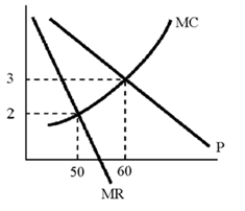 -In Figure 11-3, which of the following is true, whether or not the monopolist is maximizing profits?
 (Multiple Choice)
5.0/5  (75)
(75) When a patent expires, the firm holding the patent is able to maintain its monopoly control over the market.
(True/False)
4.9/5 (81)
(81) Table 11-2 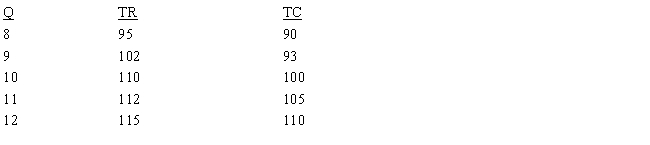
-In Table 11-2, the price at the profit-maximizing output is how much?
-In Table 11-2, the price at the profit-maximizing output is how much? (Multiple Choice)
4.8/5 (68)
(68) Figure 11-9 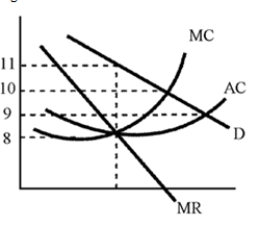 -In Figure 11-9, which of the following is true?
 (Multiple Choice)
4.8/5 (82)
(82) At a given output level, a monopolist earns a profit only if the
(Multiple Choice)
4.9/5 (83)
(83) The marginal revenue curve for a monopolist is always below the demand curve.
(True/False)
4.9/5 (74)
(74) Since a monopolist has a unique product, it makes no sense for the firm to advertise.
(True/False)
4.8/5 (81)
(81) A similarity between monopoly and perfect competition is that both types of firms are able to earn economic profits in the short run.
(True/False)
4.9/5 (76)
(76) Explain the source of monopoly power for DeBeers' Diamond Mine in South Africa, Microsoft (owned by Bill Gates), the American Medical Association (which licenses doctors), Polaroid's Instant Picture Cameras, USAir (which owns virtually all the gates at the airport in Charlotte, North Carolina), and electric utilities.
(Essay)
4.7/5 (81)
(81) A natural monopoly is one that deliberately erects entry barriers.
(True/False)
4.8/5 (78)
(78) Figure 11-5 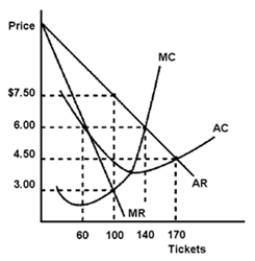 -In Figure 11-5, Crown Theater, a monopolist movie theater, has chosen the profit-maximizing output.At this output level, the value of MR is what value?
 (Multiple Choice)
4.8/5 (72)
(72) It is possible that if a monopoly is broken up, the cost of production for that product could increase.
(True/False)
4.9/5 (76)
(76) A major difference between a monopoly and perfect competition is that monopolies can earn an economic profit in the long run and a perfectly competitive firm cannot.
(True/False)
4.9/5 (71)
(71) Adam Smith believed that monopoly is the most efficient market structure.
(True/False)
5.0/5 (78)
(78) The ability to control a scarce resource or input is a characteristic of perfect competition.
(True/False)
4.7/5 (79)
(79) Which of the following observations concerning price discrimination is true?
(Multiple Choice)
4.8/5 (78)
(78) 
Filters
- Essay(0)
- Multiple Choice(0)
- Short Answer(0)
- True False(0)
- Matching(0)