



 Chat with AI
Exam 26: Bringing in the Supply Side: Unemployment and Inflation

Exam 1: What Is Economics254 Questions
Exam 2: The Economony: Myth and Reality184 Questions
Exam 3: The Fundamental Economic Problem: Scarcity and Choice278 Questions
Exam 4: Supply and Demand: an Initial Look297 Questions
Exam 5: Consumer Choice: Individual and Market Demand213 Questions
Exam 6: Demand and Elasticity247 Questions
Exam 7: Production, Inputs, and Cost: Building Blocks for Supply Analysis246 Questions
Exam 8: Output, Price, and Profit: the Importance of Marginal Analysis232 Questions
Exam 9: The Financial Markets and the Economy: the Tail That Wags the Dog225 Questions
Exam 10: The Firm and the Industry Under Perfect Competition219 Questions
Exam 11: The Case for Free Markets: the Price System251 Questions
Exam 12: Monopoly236 Questions
Exam 13: Between Competition and Monopoly248 Questions
Exam 14: Limiting Market Power: Antitrust and Regulation152 Questions
Exam 15: The Shortcomings of Free Markets210 Questions
Exam 16: The Economics of the Environment, and Natural Resources218 Questions
Exam 17: Taxation and Resource Allocation218 Questions
Exam 18: Pricing the Factors of Production230 Questions
Exam 19: Labor and Entrepreneurship: the Human Inputs267 Questions
Exam 20: Poverty, Inequality, and Discrimination167 Questions
Exam 21: An Introduction to Macroeconomics212 Questions
Exam 22: The Goals of Macroeconomic Policy212 Questions
Exam 23: Economic Growth: Theory and Policy226 Questions
Exam 24: Aggregate Demand and the Powerful Consumer216 Questions
Exam 25: Demand-Side Equilibrium: Unemployment or Inflation215 Questions
Exam 26: Bringing in the Supply Side: Unemployment and Inflation228 Questions
Exam 27: Managing Aggregate Demand: Fiscal Policy207 Questions
Exam 28: Money and the Banking System222 Questions
Exam 29: Monetary Policy: Conventional and Unconventional208 Questions
Exam 30: The Financial Crisis and the Great Recession64 Questions
Exam 31: The Debate Over Monetary and Fiscal Policy216 Questions
Exam 32: Budget Deficits in the Short and Long Run214 Questions
Exam 33: The Trade-Off Between Inflation and Unemployment218 Questions
Exam 34: International Trade and Comparative Advantage215 Questions
Exam 35: The International Monetary System: Order or Disorder216 Questions
Exam 36: Exchange Rates and the Macroeconomy215 Questions
Exam 37: Contemporary Issues in the Useconomy23 Questions
Select questions type


The main reason that firms adjust their output when the price level changes is that

Free
(Multiple Choice)
4.7/5  (81)
(81) Correct Answer: Verified
C
Stagflation is the conjunction of
Free
(Multiple Choice)
4.8/5 (63)
(63) Correct Answer:Verified
VerifiedB
Like the supply curve for individual goods and services, the aggregate supply curve slopes upward and to the right.
Free
(True/False)
4.9/5 (92)
(92) Correct Answer:Verified
VerifiedTrue
Part of the normal aftermath of a period of excessive aggregate demand is
(Multiple Choice)
4.7/5 (72)
(72) The relationship between the price level and the quantity of real GDP supplied is
(Multiple Choice)
4.8/5 (76)
(76) An economic boom that creates an inflationary gap is usually followed later by
(Multiple Choice)
4.9/5 (79)
(79) Which of the following events will lead to an inward shift of the aggregate supply curve?
(Multiple Choice)
4.8/5 (78)
(78) A decrease in the nominal wage will cause the aggregate supply curve to
(Multiple Choice)
4.8/5 (86)
(86) Higher wages mean higher production costs and lower profits at any given selling price.
(True/False)
4.8/5 (75)
(75) Recessionary gaps are associated with output below potential and high unemployment rates.
(True/False)
4.8/5 (79)
(79) A recession can be expected to reduce inflation in the economy if the recession is caused by a(n)
(Multiple Choice)
4.9/5 (69)
(69) Educational reforms that result in improved reading and math skills of high school graduates as they enter the labor force would do what to the aggregate supply curve?
(Multiple Choice)
4.9/5 (85)
(85) Figure 10-6
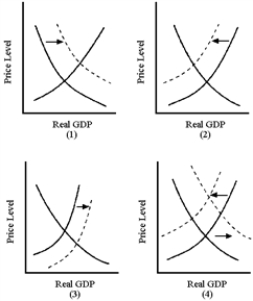 -In Figure 10-6, which graph best illustrates an autonomous increase in consumption spending?
 (Multiple Choice)
4.8/5 (77)
(77) The aggregate supply curve is shifted to the right (outward) by a decrease in the price of any input to the production process.
(True/False)
4.8/5 (64)
(64) Over time, aggregate demand and aggregate supply grow by the same amount.
(True/False)
4.8/5 (62)
(62) Assume an economy with an upward-sloping aggregate supply curve and an MPC of 0.80.An increase in investment spending of $50 billion will most likely increase total income by
(Multiple Choice)
4.9/5 (78)
(78) The Japanese economy has been consistently weak throughout the 1990s.This has caused a slight deflation, illustrating the
(Multiple Choice)
4.9/5 (72)
(72) 
Filters
- Essay(0)
- Multiple Choice(0)
- Short Answer(0)
- True False(0)
- Matching(0)