



 Chat with AI
Exam 25: Demand-Side Equilibrium: Unemployment or Inflation

Exam 1: What Is Economics254 Questions
Exam 2: The Economony: Myth and Reality184 Questions
Exam 3: The Fundamental Economic Problem: Scarcity and Choice278 Questions
Exam 4: Supply and Demand: an Initial Look297 Questions
Exam 5: Consumer Choice: Individual and Market Demand213 Questions
Exam 6: Demand and Elasticity247 Questions
Exam 7: Production, Inputs, and Cost: Building Blocks for Supply Analysis246 Questions
Exam 8: Output, Price, and Profit: the Importance of Marginal Analysis232 Questions
Exam 9: The Financial Markets and the Economy: the Tail That Wags the Dog225 Questions
Exam 10: The Firm and the Industry Under Perfect Competition219 Questions
Exam 11: The Case for Free Markets: the Price System251 Questions
Exam 12: Monopoly236 Questions
Exam 13: Between Competition and Monopoly248 Questions
Exam 14: Limiting Market Power: Antitrust and Regulation152 Questions
Exam 15: The Shortcomings of Free Markets210 Questions
Exam 16: The Economics of the Environment, and Natural Resources218 Questions
Exam 17: Taxation and Resource Allocation218 Questions
Exam 18: Pricing the Factors of Production230 Questions
Exam 19: Labor and Entrepreneurship: the Human Inputs267 Questions
Exam 20: Poverty, Inequality, and Discrimination167 Questions
Exam 21: An Introduction to Macroeconomics212 Questions
Exam 22: The Goals of Macroeconomic Policy212 Questions
Exam 23: Economic Growth: Theory and Policy226 Questions
Exam 24: Aggregate Demand and the Powerful Consumer216 Questions
Exam 25: Demand-Side Equilibrium: Unemployment or Inflation215 Questions
Exam 26: Bringing in the Supply Side: Unemployment and Inflation228 Questions
Exam 27: Managing Aggregate Demand: Fiscal Policy207 Questions
Exam 28: Money and the Banking System222 Questions
Exam 29: Monetary Policy: Conventional and Unconventional208 Questions
Exam 30: The Financial Crisis and the Great Recession64 Questions
Exam 31: The Debate Over Monetary and Fiscal Policy216 Questions
Exam 32: Budget Deficits in the Short and Long Run214 Questions
Exam 33: The Trade-Off Between Inflation and Unemployment218 Questions
Exam 34: International Trade and Comparative Advantage215 Questions
Exam 35: The International Monetary System: Order or Disorder216 Questions
Exam 36: Exchange Rates and the Macroeconomy215 Questions
Exam 37: Contemporary Issues in the Useconomy23 Questions
Select questions type


The slope of the aggregate demand curve illustrates that as the price level rises,

Free
(Multiple Choice)
4.8/5  (60)
(60) Correct Answer: Verified
A
When the price level in the United States rises, then net exports should
Free
(Multiple Choice)
4.9/5 (78)
(78) Correct Answer:Verified
VerifiedC
Why do booms and recessions tend to be transmitted across national borders?
Free
(Essay)
4.9/5 (65)
(65) Correct Answer:Verified
VerifiedThe GDPs of the major economies are linked by trade.A boom in one country tends to raise its imports and hence push up exports and GDP in other countries.Similarly, a recession in one country tends to pull down GDP in other countries.Suppose a boom abroad raises GDPs in foreign countries.With rising incomes, foreigners will buy more American goods, which means that U.S.exports will increase.But an increase in our exports will, via the multiplier, raise GDP in the United States.By this mechanism, rapid economic growth abroad contributes to rapid economic growth here.The same mechanism also operates in reverse.
In a market economy, the decisions about what to produce and how much of each good or service to produce are made by
(Multiple Choice)
4.9/5 (84)
(84) Assume that the MPC is 0.75, and investment spending rises by $25 billion.How much will real GDP change?
(Multiple Choice)
5.0/5 (83)
(83) Figure 9-3
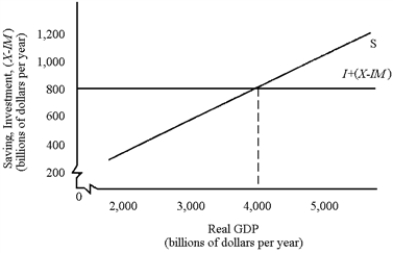 -In Figure 9-3, at $5,000 billion GDP, inventories will be
 (Multiple Choice)
4.7/5 (69)
(69) Injections to the circular flow model include saving, taxes, exports, and investment.
(True/False)
4.7/5 (70)
(70) Table 9-1 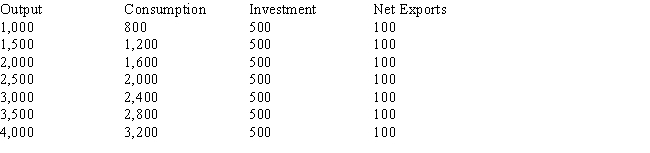
-In Table 9-1, inventories are being depleted as long as output is below
-In Table 9-1, inventories are being depleted as long as output is below (Multiple Choice)
4.8/5 (83)
(83) In a capitalist market economy, the decision to save is made by the same people who make the major investment decisions.
(True/False)
4.7/5 (82)
(82) In a simple macroeconomic model, only one component of expenditures is allowed to change:
(Multiple Choice)
4.8/5 (86)
(86) The slope of the aggregate demand curve illustrates that real GDP demanded will increase when
(Multiple Choice)
4.8/5 (91)
(91) An expenditure schedule model with no government sector shows the relationship between
(Multiple Choice)
4.8/5 (86)
(86) Figure 9-4
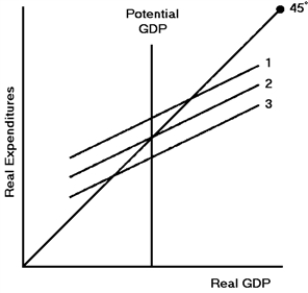 -In Figure 9-4, which expenditure level will cause an inflationary gap?
 (Multiple Choice)
4.9/5 (73)
(73) An increase in the U.S.price level (foreign prices held constant) will cause a leftward shift in the aggregate demand curve.
(True/False)
4.7/5 (87)
(87) 
Filters
- Essay(0)
- Multiple Choice(0)
- Short Answer(0)
- True False(0)
- Matching(0)