



 Chat with AI
Exam 25: Demand-Side Equilibrium: Unemployment or Inflation

Exam 1: What Is Economics254 Questions
Exam 2: The Economony: Myth and Reality184 Questions
Exam 3: The Fundamental Economic Problem: Scarcity and Choice278 Questions
Exam 4: Supply and Demand: an Initial Look297 Questions
Exam 5: Consumer Choice: Individual and Market Demand213 Questions
Exam 6: Demand and Elasticity247 Questions
Exam 7: Production, Inputs, and Cost: Building Blocks for Supply Analysis246 Questions
Exam 8: Output, Price, and Profit: the Importance of Marginal Analysis232 Questions
Exam 9: The Financial Markets and the Economy: the Tail That Wags the Dog225 Questions
Exam 10: The Firm and the Industry Under Perfect Competition219 Questions
Exam 11: The Case for Free Markets: the Price System251 Questions
Exam 12: Monopoly236 Questions
Exam 13: Between Competition and Monopoly248 Questions
Exam 14: Limiting Market Power: Antitrust and Regulation152 Questions
Exam 15: The Shortcomings of Free Markets210 Questions
Exam 16: The Economics of the Environment, and Natural Resources218 Questions
Exam 17: Taxation and Resource Allocation218 Questions
Exam 18: Pricing the Factors of Production230 Questions
Exam 19: Labor and Entrepreneurship: the Human Inputs267 Questions
Exam 20: Poverty, Inequality, and Discrimination167 Questions
Exam 21: An Introduction to Macroeconomics212 Questions
Exam 22: The Goals of Macroeconomic Policy212 Questions
Exam 23: Economic Growth: Theory and Policy226 Questions
Exam 24: Aggregate Demand and the Powerful Consumer216 Questions
Exam 25: Demand-Side Equilibrium: Unemployment or Inflation215 Questions
Exam 26: Bringing in the Supply Side: Unemployment and Inflation228 Questions
Exam 27: Managing Aggregate Demand: Fiscal Policy207 Questions
Exam 28: Money and the Banking System222 Questions
Exam 29: Monetary Policy: Conventional and Unconventional208 Questions
Exam 30: The Financial Crisis and the Great Recession64 Questions
Exam 31: The Debate Over Monetary and Fiscal Policy216 Questions
Exam 32: Budget Deficits in the Short and Long Run214 Questions
Exam 33: The Trade-Off Between Inflation and Unemployment218 Questions
Exam 34: International Trade and Comparative Advantage215 Questions
Exam 35: The International Monetary System: Order or Disorder216 Questions
Exam 36: Exchange Rates and the Macroeconomy215 Questions
Exam 37: Contemporary Issues in the Useconomy23 Questions
Select questions type


Where does equilibrium occur in an income expenditure diagram? What would be the effect if production is at either on the left or right side of the equilibrium point?
(Essay)
4.8/5  (61)
(61) Businesses in the United States cut their investment projects by $30 billion.If the MPC is 2, what will be the impact on the national income (Y)?
(Multiple Choice)
4.7/5 (70)
(70) Differentiate between an induced increase in consumption and an autonomous increase in consumption.How are they represented on a graph?
(Essay)
4.9/5 (78)
(78) If the government increases defense spending by $1 billion and the MPC is 0.8, how much additional spending will occur in the third "round" of spending?
(Multiple Choice)
4.7/5 (75)
(75) Using the standard 45° line diagram, how does a decrease in investment spending effect the expenditure schedule?
(Multiple Choice)
5.0/5 (90)
(90) The basic reason for the multiplier effect is that when you spend money,
(Multiple Choice)
4.9/5 (82)
(82) In the 2007-2009 period, the expenditure level in the United States intersected the 45° line below potential GDP, causing
(Multiple Choice)
4.9/5 (80)
(80) If investment spending depends on GDP, this is called induced investment.
(True/False)
4.9/5 (79)
(79) Using the saving-investment approach, which of the following describes an equilibrium condition of GDP?
(Multiple Choice)
4.8/5 (77)
(77) As the multiplier process works through time, the size of the multiplier effect becomes
(Multiple Choice)
4.9/5 (85)
(85) The main examples of macroeconomic coordination failures are
(Multiple Choice)
4.7/5 (74)
(74) Assume that the MPC is 0.80 and investment rises by $50 million.How much additional saving will this generate in the second round of spending?
(Multiple Choice)
4.9/5 (78)
(78) If the price level rises, the effect on the expenditure schedule and equilibrium real GDP is to
(Multiple Choice)
4.9/5 (92)
(92) An expenditure schedule shows the relationship between GDP and total output.
(True/False)
4.9/5 (82)
(82) When equilibrium GDP falls below potential GDP, an inflationary gap exists.
(True/False)
5.0/5 (72)
(72) If the multiplier is 4 and real GDP increases by $520 billion, the increase in investment spending must have been
(Multiple Choice)
4.9/5 (79)
(79) To avoid a coordination failure, the intentions of savers and investors must be both
(Multiple Choice)
4.9/5 (90)
(90) Figure 9-5
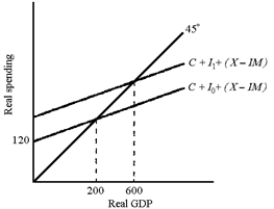 -If the shift in the C + I + (X − IM) in Figure 9-5 was caused by a 80 dollar increase in investment, then the multiplier is
 (Multiple Choice)
4.9/5 (77)
(77) 
Filters
- Essay(0)
- Multiple Choice(0)
- Short Answer(0)
- True False(0)
- Matching(0)