



 Chat with AI
Exam 34: International Trade and Comparative Advantage

Exam 1: What Is Economics254 Questions
Exam 2: The Economony: Myth and Reality184 Questions
Exam 3: The Fundamental Economic Problem: Scarcity and Choice278 Questions
Exam 4: Supply and Demand: an Initial Look297 Questions
Exam 5: Consumer Choice: Individual and Market Demand213 Questions
Exam 6: Demand and Elasticity247 Questions
Exam 7: Production, Inputs, and Cost: Building Blocks for Supply Analysis246 Questions
Exam 8: Output, Price, and Profit: the Importance of Marginal Analysis232 Questions
Exam 9: The Financial Markets and the Economy: the Tail That Wags the Dog225 Questions
Exam 10: The Firm and the Industry Under Perfect Competition219 Questions
Exam 11: The Case for Free Markets: the Price System251 Questions
Exam 12: Monopoly236 Questions
Exam 13: Between Competition and Monopoly248 Questions
Exam 14: Limiting Market Power: Antitrust and Regulation152 Questions
Exam 15: The Shortcomings of Free Markets210 Questions
Exam 16: The Economics of the Environment, and Natural Resources218 Questions
Exam 17: Taxation and Resource Allocation218 Questions
Exam 18: Pricing the Factors of Production230 Questions
Exam 19: Labor and Entrepreneurship: the Human Inputs267 Questions
Exam 20: Poverty, Inequality, and Discrimination167 Questions
Exam 21: An Introduction to Macroeconomics212 Questions
Exam 22: The Goals of Macroeconomic Policy212 Questions
Exam 23: Economic Growth: Theory and Policy226 Questions
Exam 24: Aggregate Demand and the Powerful Consumer216 Questions
Exam 25: Demand-Side Equilibrium: Unemployment or Inflation215 Questions
Exam 26: Bringing in the Supply Side: Unemployment and Inflation228 Questions
Exam 27: Managing Aggregate Demand: Fiscal Policy207 Questions
Exam 28: Money and the Banking System222 Questions
Exam 29: Monetary Policy: Conventional and Unconventional208 Questions
Exam 30: The Financial Crisis and the Great Recession64 Questions
Exam 31: The Debate Over Monetary and Fiscal Policy216 Questions
Exam 32: Budget Deficits in the Short and Long Run214 Questions
Exam 33: The Trade-Off Between Inflation and Unemployment218 Questions
Exam 34: International Trade and Comparative Advantage215 Questions
Exam 35: The International Monetary System: Order or Disorder216 Questions
Exam 36: Exchange Rates and the Macroeconomy215 Questions
Exam 37: Contemporary Issues in the Useconomy23 Questions
Select questions type


Comparative advantage, not absolute advantage, determines the decision to specialize in production.

Free
(True/False)
4.8/5  (93)
(93) Correct Answer: Verified
True
What would be the output combination for two products A and B on the production possibility frontier, if a country uses its entire resources for producing A?
Free
(Multiple Choice)
5.0/5 (68)
(68) Correct Answer:Verified
VerifiedA
The estimated cost of automobile jobs saved due to limitations on foreign autos is $105,000 per job.Why is there a cost to saving jobs through protectionism?
Free
(Essay)
4.8/5 (78)
(78) Correct Answer:Verified
VerifiedWhen foreign cars are limited, consumers pay more for cars.In addition, the United States devotes too many resources to car production instead of more resources being transferred to where workers would be most productive.
Dumping is a trade practice in which countries sell goods in a foreign market at cheaper prices than the goods can be produced domestically.
(True/False)
4.7/5 (60)
(60) Table 34-3
Output Per Unit Labor Input
Cotton
Wheat
Egypt
10
2
United States
20
20
-The data in Table 34-3 indicate that the United States has
(Multiple Choice)
4.9/5 (73)
(73) A quota specifies the maximum amount of a good that is permitted into the country from abroad per unit of time.
(True/False)
4.7/5 (85)
(85) Suppose that Captain Canada can produce 100 hockey sticks or 10 gallons of maple syrup in a typical work week, while Captain Germany can produce 90 hockey sticks or 10 gallons of maple syrup in a typical work week.From these numbers, we can conclude
(Multiple Choice)
5.0/5 (79)
(79) Table 34-4
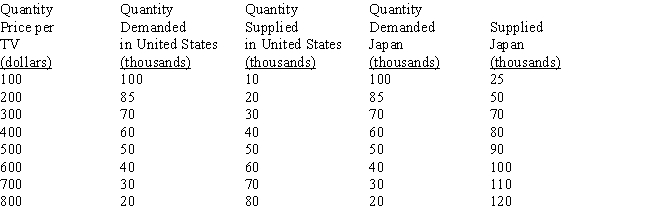 -Table 34-4 presents the demand and supply schedules for television sets in Japan and the United States.If there is no trade between these countries, what are the equilibrium price and quantity in the United States?
 (Multiple Choice)
4.9/5 (89)
(89) Suppose that the United States can make 15 cars or 20 bottles of wine with one year's worth of labor.France can make 10 cars or 18 bottles of wine with one year's worth of labor.From these numbers, we can conclude that
(Multiple Choice)
4.8/5 (79)
(79) Figure 34-4
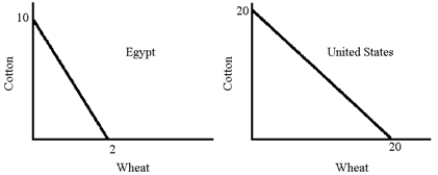 -In Figure 34-4, the opportunity cost of a unit of wheat in terms of cotton is
 (Multiple Choice)
4.8/5 (84)
(84) Figure 34-9
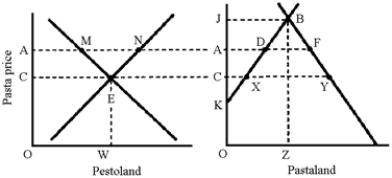 -In Figure 34-9, Pestoland exports pasta to Pastaland.Equilibrium will occur when
 (Multiple Choice)
4.8/5 (76)
(76) If the United States imposed a 25 percent tariff on imports of minivans, the effect would be to
(Multiple Choice)
4.8/5 (89)
(89) What are the two approaches followed by the U.S.government to ease the burden on the victims of free trade?
(Essay)
4.8/5 (77)
(77) When other nations Orient "dump" products on the U.S.market, they
(Multiple Choice)
4.8/5 (70)
(70) Figure 34-7
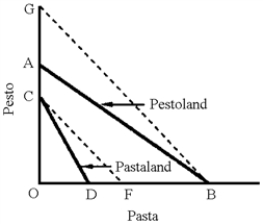 -In Figure 34-7, CF has the same slope as BG.AB and CD are the production possibilities of Pestoland and Pastaland, respectively.If both countries are given the opportunity to trade at prices indicated by CF,
 (Multiple Choice)
4.8/5 (92)
(92) William Safire argues that a unilateral free trade policy is a disaster if
(Multiple Choice)
4.8/5 (90)
(90) Table 34-4
-Table 34-4 presents the demand and supply schedules for television sets in Japan and the United States.If there is no trade between these countries, what are the equilibrium price and quantity in Japan?
-Table 34-4 presents the demand and supply schedules for television sets in Japan and the United States.If there is no trade between these countries, what are the equilibrium price and quantity in Japan? (Multiple Choice)
4.8/5 (86)
(86) If a country begins to import more of a commodity, one can normally expect the price of the commodity to
(Multiple Choice)
4.8/5 (69)
(69) The principle of comparative advantage states that countries should specialize in the production of goods for which they have a lower opportunity cost of production than their trading partners.
(True/False)
4.9/5 (77)
(77) 
Filters
- Essay(0)
- Multiple Choice(0)
- Short Answer(0)
- True False(0)
- Matching(0)