



 Chat with AI
Exam 34: International Trade and Comparative Advantage

Exam 1: What Is Economics254 Questions
Exam 2: The Economony: Myth and Reality184 Questions
Exam 3: The Fundamental Economic Problem: Scarcity and Choice278 Questions
Exam 4: Supply and Demand: an Initial Look297 Questions
Exam 5: Consumer Choice: Individual and Market Demand213 Questions
Exam 6: Demand and Elasticity247 Questions
Exam 7: Production, Inputs, and Cost: Building Blocks for Supply Analysis246 Questions
Exam 8: Output, Price, and Profit: the Importance of Marginal Analysis232 Questions
Exam 9: The Financial Markets and the Economy: the Tail That Wags the Dog225 Questions
Exam 10: The Firm and the Industry Under Perfect Competition219 Questions
Exam 11: The Case for Free Markets: the Price System251 Questions
Exam 12: Monopoly236 Questions
Exam 13: Between Competition and Monopoly248 Questions
Exam 14: Limiting Market Power: Antitrust and Regulation152 Questions
Exam 15: The Shortcomings of Free Markets210 Questions
Exam 16: The Economics of the Environment, and Natural Resources218 Questions
Exam 17: Taxation and Resource Allocation218 Questions
Exam 18: Pricing the Factors of Production230 Questions
Exam 19: Labor and Entrepreneurship: the Human Inputs267 Questions
Exam 20: Poverty, Inequality, and Discrimination167 Questions
Exam 21: An Introduction to Macroeconomics212 Questions
Exam 22: The Goals of Macroeconomic Policy212 Questions
Exam 23: Economic Growth: Theory and Policy226 Questions
Exam 24: Aggregate Demand and the Powerful Consumer216 Questions
Exam 25: Demand-Side Equilibrium: Unemployment or Inflation215 Questions
Exam 26: Bringing in the Supply Side: Unemployment and Inflation228 Questions
Exam 27: Managing Aggregate Demand: Fiscal Policy207 Questions
Exam 28: Money and the Banking System222 Questions
Exam 29: Monetary Policy: Conventional and Unconventional208 Questions
Exam 30: The Financial Crisis and the Great Recession64 Questions
Exam 31: The Debate Over Monetary and Fiscal Policy216 Questions
Exam 32: Budget Deficits in the Short and Long Run214 Questions
Exam 33: The Trade-Off Between Inflation and Unemployment218 Questions
Exam 34: International Trade and Comparative Advantage215 Questions
Exam 35: The International Monetary System: Order or Disorder216 Questions
Exam 36: Exchange Rates and the Macroeconomy215 Questions
Exam 37: Contemporary Issues in the Useconomy23 Questions
Select questions type


A nation can gain from imposing a tariff on imports if it forces exporting countries
(Multiple Choice)
5.0/5  (70)
(70) Figure 34-5
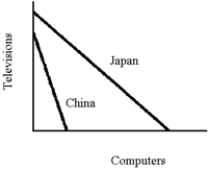 -From the graph in Figure 34-5 (curves show output per unit of labor input), one can infer that
 (Multiple Choice)
4.9/5 (96)
(96) Table 34-4
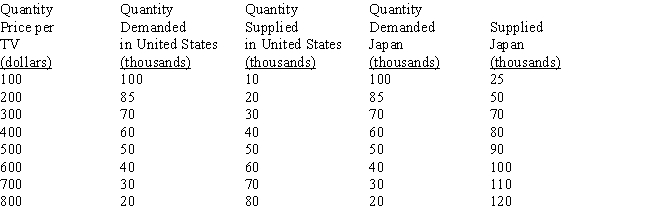 -Table 34-4 presents the demand and supply schedules for television sets in Japan and the United States.If Japan and the United States trade with each other, what will be the equilibrium price in the world market for television sets?
 (Multiple Choice)
4.8/5 (79)
(79) Among the impediments to the international mobility of capital are
(Multiple Choice)
4.8/5 (81)
(81) The trade philosophy of the Clinton administration is best characterized as
(Multiple Choice)
4.9/5 (80)
(80) The following table shows the units of output a worker can produce per month in country A and country B.  The opportunity cost of a unit of electronics in Country B is
 (Multiple Choice)
4.8/5 (88)
(88) If two countries voluntarily trade two goods with one another, the rate of exchange between the goods must fall in between the price ratios that would prevail in the two countries in the absence of trade.
(True/False)
4.7/5 (79)
(79) Voluntary exchange is based on the principle that all parties must gain from trade.
(True/False)
4.8/5 (91)
(91) How does the imposition of a tariff reduce the price of imports?
(Multiple Choice)
5.0/5 (85)
(85) Opening trade between a nation that has "cheap labor" and one that has "expensive labor" will
(Multiple Choice)
4.8/5 (84)
(84) Compare and contrast the effects of a quota and a tariff on imports.Be sure to include both short-run and long-run effects in your answer.
(Essay)
4.8/5 (72)
(72) Table 34-4
-Table 34-4 presents the demand and supply schedules for television sets in Japan and the United States.If the United States and Japan decide to trade with each other, what will happen to the output of television sets in Japan?
-Table 34-4 presents the demand and supply schedules for television sets in Japan and the United States.If the United States and Japan decide to trade with each other, what will happen to the output of television sets in Japan? (Multiple Choice)
4.9/5 (83)
(83) "Free trade benefits one country at another country's expense." Evaluate this statement using economic analysis.
(Essay)
4.8/5 (81)
(81) Trade adjustment assistance in the United States began in 1962.The program
(Multiple Choice)
4.8/5 (80)
(80) Why is comparative advantage rather than absolute advantage the basis for trade?
(Essay)
4.8/5 (66)
(66) Talented people who are best at everything have a comparative advantage in the production of everything.
(True/False)
4.9/5 (81)
(81) 
Filters
- Essay(0)
- Multiple Choice(0)
- Short Answer(0)
- True False(0)
- Matching(0)