



 Chat with AI
Exam 34: International Trade and Comparative Advantage

Exam 1: What Is Economics254 Questions
Exam 2: The Economony: Myth and Reality184 Questions
Exam 3: The Fundamental Economic Problem: Scarcity and Choice278 Questions
Exam 4: Supply and Demand: an Initial Look297 Questions
Exam 5: Consumer Choice: Individual and Market Demand213 Questions
Exam 6: Demand and Elasticity247 Questions
Exam 7: Production, Inputs, and Cost: Building Blocks for Supply Analysis246 Questions
Exam 8: Output, Price, and Profit: the Importance of Marginal Analysis232 Questions
Exam 9: The Financial Markets and the Economy: the Tail That Wags the Dog225 Questions
Exam 10: The Firm and the Industry Under Perfect Competition219 Questions
Exam 11: The Case for Free Markets: the Price System251 Questions
Exam 12: Monopoly236 Questions
Exam 13: Between Competition and Monopoly248 Questions
Exam 14: Limiting Market Power: Antitrust and Regulation152 Questions
Exam 15: The Shortcomings of Free Markets210 Questions
Exam 16: The Economics of the Environment, and Natural Resources218 Questions
Exam 17: Taxation and Resource Allocation218 Questions
Exam 18: Pricing the Factors of Production230 Questions
Exam 19: Labor and Entrepreneurship: the Human Inputs267 Questions
Exam 20: Poverty, Inequality, and Discrimination167 Questions
Exam 21: An Introduction to Macroeconomics212 Questions
Exam 22: The Goals of Macroeconomic Policy212 Questions
Exam 23: Economic Growth: Theory and Policy226 Questions
Exam 24: Aggregate Demand and the Powerful Consumer216 Questions
Exam 25: Demand-Side Equilibrium: Unemployment or Inflation215 Questions
Exam 26: Bringing in the Supply Side: Unemployment and Inflation228 Questions
Exam 27: Managing Aggregate Demand: Fiscal Policy207 Questions
Exam 28: Money and the Banking System222 Questions
Exam 29: Monetary Policy: Conventional and Unconventional208 Questions
Exam 30: The Financial Crisis and the Great Recession64 Questions
Exam 31: The Debate Over Monetary and Fiscal Policy216 Questions
Exam 32: Budget Deficits in the Short and Long Run214 Questions
Exam 33: The Trade-Off Between Inflation and Unemployment218 Questions
Exam 34: International Trade and Comparative Advantage215 Questions
Exam 35: The International Monetary System: Order or Disorder216 Questions
Exam 36: Exchange Rates and the Macroeconomy215 Questions
Exam 37: Contemporary Issues in the Useconomy23 Questions
Select questions type


Colombia produces coffee with less labor and land than any other country; it therefore surely has
(Multiple Choice)
4.9/5  (91)
(91) A tariff is a tax on imports imposed by the country that is importing the goods.
(True/False)
4.8/5 (72)
(72) Figure 34-9
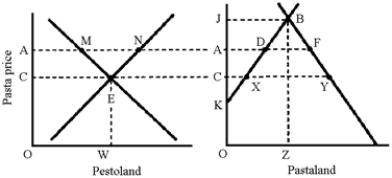 -In Figure 34-9, at price OC total quantity demanded exceeds quantity supplied and price will rise to
 (Multiple Choice)
4.9/5 (83)
(83) Comparing international trade with trade among the different states of the United States shows that
(Multiple Choice)
5.0/5 (84)
(84) Are there impediments to international movement of labor and capital?
(Multiple Choice)
4.9/5 (82)
(82) If Japan imposes a quota on imports of rice, the effect will be
(Multiple Choice)
4.8/5 (64)
(64) If a nation does not have an absolute advantage in producing anything, it
(Multiple Choice)
4.8/5 (86)
(86) Unequal distribution of resources is one of the main reasons for international trade.
(True/False)
4.9/5 (81)
(81) A program of protection that results in preserving jobs in certain industries
(Multiple Choice)
5.0/5 (79)
(79) An export subsidy is a payment by the government to exporters to permit them to charge lower prices.
(True/False)
4.9/5 (80)
(80) ____ is a doctrine that holds that exports are good for a country, whereas imports are harmful.
(Multiple Choice)
5.0/5 (88)
(88) If the supply curve of a commodity is upward sloping, and the producing country begins to export more in a pure free trade system, the domestic price of the commodity will
(Multiple Choice)
4.9/5 (94)
(94) Is it possible for a country to have an absolute disadvantage and a comparative advantage in the production of a good?
(Multiple Choice)
4.9/5 (84)
(84) Self-sufficiency is the best way to increase one's material welfare.
(True/False)
4.9/5 (80)
(80) Even though international trade is more complicated, supply and demand are still at the center of the price determination mechanism.
(True/False)
4.9/5 (76)
(76) Trade adjustment assistance provides special unemployment benefits, loans, retraining programs, and other aid to workers and firms that are harmed by foreign competition.
(True/False)
4.9/5 (75)
(75) What is an export subsidy? Discuss some of the recent examples where such subsidies were controversial.
(Essay)
4.9/5 (87)
(87) Quebec is capable of producing 10 pallets of wood shingles or 8 barrels of maple syrup with a unit of labor.Vermont is capable of producing 12 pallets of wood shingles or 12 barrels of maple syrup with a unit of labor.Assume that this is typical of the labor force as a whole.Which location has the absolute advantage and which has the comparative advantage, in the production of each good? Can these locations reap gains from trade?
(Essay)
4.8/5 (82)
(82) An import quota will ordinarily raise the price of the good in the importing country.
(True/False)
4.8/5 (65)
(65) 
Filters
- Essay(0)
- Multiple Choice(0)
- Short Answer(0)
- True False(0)
- Matching(0)