



 Chat with AI
Exam 19: Labor and Entrepreneurship: the Human Inputs

Exam 1: What Is Economics254 Questions
Exam 2: The Economony: Myth and Reality184 Questions
Exam 3: The Fundamental Economic Problem: Scarcity and Choice278 Questions
Exam 4: Supply and Demand: an Initial Look297 Questions
Exam 5: Consumer Choice: Individual and Market Demand213 Questions
Exam 6: Demand and Elasticity247 Questions
Exam 7: Production, Inputs, and Cost: Building Blocks for Supply Analysis246 Questions
Exam 8: Output, Price, and Profit: the Importance of Marginal Analysis232 Questions
Exam 9: The Financial Markets and the Economy: the Tail That Wags the Dog225 Questions
Exam 10: The Firm and the Industry Under Perfect Competition219 Questions
Exam 11: The Case for Free Markets: the Price System251 Questions
Exam 12: Monopoly236 Questions
Exam 13: Between Competition and Monopoly248 Questions
Exam 14: Limiting Market Power: Antitrust and Regulation152 Questions
Exam 15: The Shortcomings of Free Markets210 Questions
Exam 16: The Economics of the Environment, and Natural Resources218 Questions
Exam 17: Taxation and Resource Allocation218 Questions
Exam 18: Pricing the Factors of Production230 Questions
Exam 19: Labor and Entrepreneurship: the Human Inputs267 Questions
Exam 20: Poverty, Inequality, and Discrimination167 Questions
Exam 21: An Introduction to Macroeconomics212 Questions
Exam 22: The Goals of Macroeconomic Policy212 Questions
Exam 23: Economic Growth: Theory and Policy226 Questions
Exam 24: Aggregate Demand and the Powerful Consumer216 Questions
Exam 25: Demand-Side Equilibrium: Unemployment or Inflation215 Questions
Exam 26: Bringing in the Supply Side: Unemployment and Inflation228 Questions
Exam 27: Managing Aggregate Demand: Fiscal Policy207 Questions
Exam 28: Money and the Banking System222 Questions
Exam 29: Monetary Policy: Conventional and Unconventional208 Questions
Exam 30: The Financial Crisis and the Great Recession64 Questions
Exam 31: The Debate Over Monetary and Fiscal Policy216 Questions
Exam 32: Budget Deficits in the Short and Long Run214 Questions
Exam 33: The Trade-Off Between Inflation and Unemployment218 Questions
Exam 34: International Trade and Comparative Advantage215 Questions
Exam 35: The International Monetary System: Order or Disorder216 Questions
Exam 36: Exchange Rates and the Macroeconomy215 Questions
Exam 37: Contemporary Issues in the Useconomy23 Questions
Select questions type


A monopsony is a market situation in which there is only one buyer.
(True/False)
4.8/5  (76)
(76) Capitalism is an economic system in which the production process is controlled primarily by private firms operating in markets.
(True/False)
4.8/5 (89)
(89) Figure 20-4 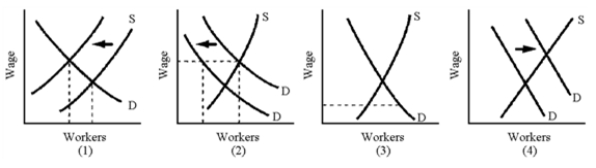 -The consensus among researchers is that union workers earn 15 percent more than otherwise identical nonunion workers.This means unions have probably raised wages
 (Multiple Choice)
4.8/5 (82)
(82) Increases in education are analogous to investments in capital.
(True/False)
4.9/5 (82)
(82) It is possible to analyze education decisions in a manner similar to the decision to acquire more
(Multiple Choice)
4.8/5 (94)
(94) The argument that the minimum wage law has significantly increased teenage unemployment is not supported by recent statistical analysis.
(True/False)
4.9/5 (87)
(87) Which of the following is not an argument that has been made to explain high unemployment among teenagers?
(Multiple Choice)
4.8/5 (85)
(85) A labor union can increase wages by exercising market power on behalf of workers.
(True/False)
4.9/5 (84)
(84) The American Bar Association administers the bar examinations that prospective lawyers must pass before being allowed to practice law.The legal requirement to pass this test before practicing law allows the Bar Association to act as a
(Multiple Choice)
4.7/5 (80)
(80) Figure 20-1 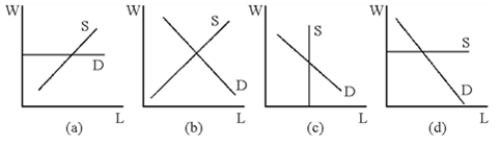 -Which of the following would not be true of a competitive labor market?
 (Multiple Choice)
4.9/5 (75)
(75) A bilateral monopoly is a market situation in which there is only one buyer and only one seller.
(True/False)
4.7/5 (75)
(75) The real minimum wage has increased significantly over the last 40 years.
(True/False)
4.9/5 (65)
(65) Statistical studies in the United States have reached the conclusion that for low-income workers
(Multiple Choice)
4.7/5 (81)
(81) The number of persons who could become lawyers or surgeons is potentially quite large, yet these two groups earn fairly high incomes.One of the main reasons why they do is the
(Multiple Choice)
4.7/5 (90)
(90) 
Filters
- Essay(0)
- Multiple Choice(0)
- Short Answer(0)
- True False(0)
- Matching(0)