



 Chat with AI
Exam 19: Labor and Entrepreneurship: the Human Inputs

Exam 1: What Is Economics254 Questions
Exam 2: The Economony: Myth and Reality184 Questions
Exam 3: The Fundamental Economic Problem: Scarcity and Choice278 Questions
Exam 4: Supply and Demand: an Initial Look297 Questions
Exam 5: Consumer Choice: Individual and Market Demand213 Questions
Exam 6: Demand and Elasticity247 Questions
Exam 7: Production, Inputs, and Cost: Building Blocks for Supply Analysis246 Questions
Exam 8: Output, Price, and Profit: the Importance of Marginal Analysis232 Questions
Exam 9: The Financial Markets and the Economy: the Tail That Wags the Dog225 Questions
Exam 10: The Firm and the Industry Under Perfect Competition219 Questions
Exam 11: The Case for Free Markets: the Price System251 Questions
Exam 12: Monopoly236 Questions
Exam 13: Between Competition and Monopoly248 Questions
Exam 14: Limiting Market Power: Antitrust and Regulation152 Questions
Exam 15: The Shortcomings of Free Markets210 Questions
Exam 16: The Economics of the Environment, and Natural Resources218 Questions
Exam 17: Taxation and Resource Allocation218 Questions
Exam 18: Pricing the Factors of Production230 Questions
Exam 19: Labor and Entrepreneurship: the Human Inputs267 Questions
Exam 20: Poverty, Inequality, and Discrimination167 Questions
Exam 21: An Introduction to Macroeconomics212 Questions
Exam 22: The Goals of Macroeconomic Policy212 Questions
Exam 23: Economic Growth: Theory and Policy226 Questions
Exam 24: Aggregate Demand and the Powerful Consumer216 Questions
Exam 25: Demand-Side Equilibrium: Unemployment or Inflation215 Questions
Exam 26: Bringing in the Supply Side: Unemployment and Inflation228 Questions
Exam 27: Managing Aggregate Demand: Fiscal Policy207 Questions
Exam 28: Money and the Banking System222 Questions
Exam 29: Monetary Policy: Conventional and Unconventional208 Questions
Exam 30: The Financial Crisis and the Great Recession64 Questions
Exam 31: The Debate Over Monetary and Fiscal Policy216 Questions
Exam 32: Budget Deficits in the Short and Long Run214 Questions
Exam 33: The Trade-Off Between Inflation and Unemployment218 Questions
Exam 34: International Trade and Comparative Advantage215 Questions
Exam 35: The International Monetary System: Order or Disorder216 Questions
Exam 36: Exchange Rates and the Macroeconomy215 Questions
Exam 37: Contemporary Issues in the Useconomy23 Questions
Select questions type


If an individual possesses an ability that others cannot acquire, payment to that individual is
(Multiple Choice)
4.9/5  (84)
(84) Which of the following is not a reason unions became much less effective in the 1990s?
(Multiple Choice)
4.7/5 (84)
(84) The marginal revenue product is the extra revenue the firm receives by hiring one additional unit of input.
(True/False)
5.0/5 (80)
(80) Innovative firms face competition much more quickly than they did 100 years ago.
(True/False)
4.8/5 (82)
(82) What percentage of American workers now belong to labor unions?
(Multiple Choice)
4.9/5 (79)
(79) One implication of human capital theory is that college graduates should earn substantially less than high school graduates.
(True/False)
4.9/5 (70)
(70) Explain what is meant when it is said that the demand for labor is a derived demand.
(Essay)
4.8/5 (81)
(81) The income effect of higher wages leads workers to want to work more.
(True/False)
4.9/5 (81)
(81) Explain the theory of investment in human capital and the specific role that education plays in the theory.
(Essay)
4.8/5 (71)
(71) Which of the following is not true for the wages of professional athletes?
(Multiple Choice)
4.8/5 (77)
(77) If wages decrease and workers choose to work more hours or more shifts, their behavior is evidence of
(Multiple Choice)
4.7/5 (82)
(82) Which of the following is not a reason workers in American industry are more productive than those in many other countries? because of
(Multiple Choice)
4.9/5 (87)
(87) Figure 20-3 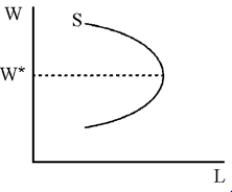 -Figure 20-3 shows a worker's backward-bending supply curve of labor.Which of the following statements is correct?
 (Multiple Choice)
4.9/5 (84)
(84) Which of the following does not affect the marginal physical product of labor?
(Multiple Choice)
4.9/5 (73)
(73) Recent studies have shown increases in the minimum wage have significantly reduced employment of teenagers.
(True/False)
5.0/5 (83)
(83) The substitution effect is thought to dominate the behavior of low-wage workers.
(True/False)
4.8/5 (83)
(83) 
Filters
- Essay(0)
- Multiple Choice(0)
- Short Answer(0)
- True False(0)
- Matching(0)