



 Chat with AI
Exam 19: Labor and Entrepreneurship: the Human Inputs

Exam 1: What Is Economics254 Questions
Exam 2: The Economony: Myth and Reality184 Questions
Exam 3: The Fundamental Economic Problem: Scarcity and Choice278 Questions
Exam 4: Supply and Demand: an Initial Look297 Questions
Exam 5: Consumer Choice: Individual and Market Demand213 Questions
Exam 6: Demand and Elasticity247 Questions
Exam 7: Production, Inputs, and Cost: Building Blocks for Supply Analysis246 Questions
Exam 8: Output, Price, and Profit: the Importance of Marginal Analysis232 Questions
Exam 9: The Financial Markets and the Economy: the Tail That Wags the Dog225 Questions
Exam 10: The Firm and the Industry Under Perfect Competition219 Questions
Exam 11: The Case for Free Markets: the Price System251 Questions
Exam 12: Monopoly236 Questions
Exam 13: Between Competition and Monopoly248 Questions
Exam 14: Limiting Market Power: Antitrust and Regulation152 Questions
Exam 15: The Shortcomings of Free Markets210 Questions
Exam 16: The Economics of the Environment, and Natural Resources218 Questions
Exam 17: Taxation and Resource Allocation218 Questions
Exam 18: Pricing the Factors of Production230 Questions
Exam 19: Labor and Entrepreneurship: the Human Inputs267 Questions
Exam 20: Poverty, Inequality, and Discrimination167 Questions
Exam 21: An Introduction to Macroeconomics212 Questions
Exam 22: The Goals of Macroeconomic Policy212 Questions
Exam 23: Economic Growth: Theory and Policy226 Questions
Exam 24: Aggregate Demand and the Powerful Consumer216 Questions
Exam 25: Demand-Side Equilibrium: Unemployment or Inflation215 Questions
Exam 26: Bringing in the Supply Side: Unemployment and Inflation228 Questions
Exam 27: Managing Aggregate Demand: Fiscal Policy207 Questions
Exam 28: Money and the Banking System222 Questions
Exam 29: Monetary Policy: Conventional and Unconventional208 Questions
Exam 30: The Financial Crisis and the Great Recession64 Questions
Exam 31: The Debate Over Monetary and Fiscal Policy216 Questions
Exam 32: Budget Deficits in the Short and Long Run214 Questions
Exam 33: The Trade-Off Between Inflation and Unemployment218 Questions
Exam 34: International Trade and Comparative Advantage215 Questions
Exam 35: The International Monetary System: Order or Disorder216 Questions
Exam 36: Exchange Rates and the Macroeconomy215 Questions
Exam 37: Contemporary Issues in the Useconomy23 Questions
Select questions type


Average hours worked per week have ____ since the early 1900s.
(Multiple Choice)
4.7/5  (71)
(71) Cannon Mills used to be virtually the only employer in Kannapolis, North Carolina.What is the name for a single hirer of labor, and how do wages and the number of jobs available compare to a competitive labor market?
(Essay)
4.9/5 (76)
(76) Those who view education as a sorting mechanism emphasize that employers value the
(Multiple Choice)
4.8/5 (76)
(76) In which of the following scenarios would the income effect be most likely to be greater than the substitution effect?
(Multiple Choice)
4.9/5 (73)
(73) At existing wage rates, hospitals face a shortage of registered nurses (RNs).Some studies have suggested that an increase in RN wages will actually reduce the hours supplied by existing RNs, making it more difficult for hospitals to find RNs.Which of the following is likely the cause of these findings?
(Multiple Choice)
4.9/5 (86)
(86) Money spent on college tuition is considered human capital by economists.
(True/False)
5.0/5 (79)
(79) P = MC is a recipe for financial loss in an innovative firm established by an innovative entrepreneur.Explain.
(Essay)
4.9/5 (69)
(69) Teenage unemployment rates tend to be a little lower than the overall unemployment rate.
(True/False)
4.7/5 (85)
(85) Historically, revolutionary inventions and innovations have come from
(Multiple Choice)
4.7/5 (79)
(79) Wages are comparatively low in markets where demand for labor is high and supply is low.
(True/False)
4.9/5 (80)
(80) Wage negotiations in baseball can fit the bilateral monopoly situation when a star player negotiates with an owner.Explain how collective bargaining would be used in wage negotiations and the role of player strikes.
(Essay)
4.8/5 (83)
(83) After Hurricane Katrina, construction wages in New Orleans rose partly because of the loss of a working population.
(True/False)
4.9/5 (85)
(85) The demand for labor is a derived demand.Employers hire workers until the
(Multiple Choice)
4.7/5 (83)
(83) Briefly explain Schumpeter's model of innovation.Why does an innovator's economic profit eventually reduce to zero?
(Essay)
4.8/5 (81)
(81) Figure 20-4 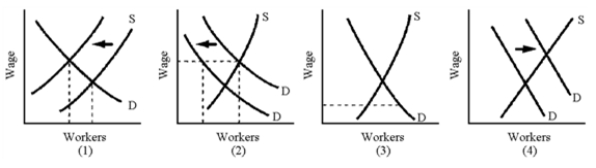 -In Figure 20-4, which panel shows the impact of union efforts to have goods produced in Asia excluded from the U.S.market?
 (Multiple Choice)
4.9/5 (78)
(78) Discuss the historic increases and decreases in unionism in the United States and how it affects current labor relations today.
(Essay)
4.8/5 (83)
(83) Figure 20-3 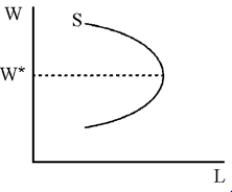 -As hourly wages have risen in the United States in the twentieth century, the number of hours of labor supplied by most wage workers has
 (Multiple Choice)
4.9/5 (82)
(82) 
Filters
- Essay(0)
- Multiple Choice(0)
- Short Answer(0)
- True False(0)
- Matching(0)