



 Chat with AI
Exam 3: Cell Biology

Exam 1: The Human Organism120 Questions
Exam 2: The Chemical Basis of Life168 Questions
Exam 3: Cell Biology227 Questions
Exam 4: Tissues174 Questions
Exam 5: Integumentary System152 Questions
Exam 6: Skeletal System: Bones and Bone Tissue176 Questions
Exam 7: Skeletal System: Gross Anatomy173 Questions
Exam 8: Joints and Movement126 Questions
Exam 9: Muscular System: Histology and Physiology200 Questions
Exam 10: Muscular System: Gross Anatomy140 Questions
Exam 11: Functional Organization of Nervous Tissue171 Questions
Exam 12: Spinal Cord and Spinal Nerves124 Questions
Exam 13: Brain and Cranial Nerves158 Questions
Exam 14: Integration of Nervous System Functions142 Questions
Exam 15: The Special Senses198 Questions
Exam 16: Autonomic Nervous System109 Questions
Exam 17: Functional Organization of the Endocrine System83 Questions
Exam 18: Endocrine Glands167 Questions
Exam 19: Cardiovascular System: Blood148 Questions
Exam 20: Cardiovascular System: the Heart139 Questions
Exam 21: Cardiovascular System: Blood Vessels and Circulation234 Questions
Exam 22: Lymphatic System and Immunity174 Questions
Exam 23: Respiratory System175 Questions
Exam 24: Digestive System253 Questions
Exam 25: Nutrition, Metabolism, and Temperature Regulation168 Questions
Exam 26: Urinary System159 Questions
Exam 27: Water, Electrolyte, and Acid-Based Balance108 Questions
Exam 28: Reproductive System160 Questions
Exam 29: Development, Growth, Aging, and Genetics187 Questions
Select questions type


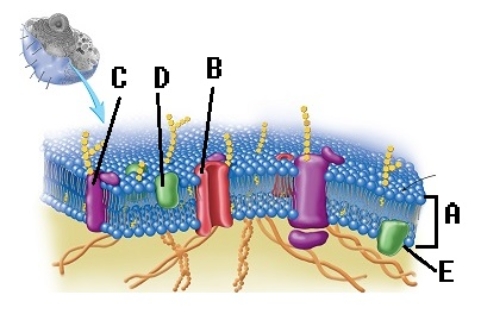 -What structure does "D" represent on the diagram of the plasma membrane?
 (Multiple Choice)
4.9/5  (80)
(80) The _____________ contains the genetic information of the cell.
(Multiple Choice)
5.0/5 (89)
(89) The organelle that protects cells from the damaging effects of medications and toxins is the
(Multiple Choice)
4.9/5 (81)
(81) What term dealing with cancer means "not inclined to spread or become worse'?
(Multiple Choice)
4.9/5 (75)
(75) The structural and functional unit of all living organisms is the
(Multiple Choice)
4.8/5 (81)
(81) The presence of a cellular clock, presence of "death genes" and damage to DNA or mitochondria are all theories of _____.
(Multiple Choice)
5.0/5 (73)
(73) The movement of a substance from an area of high concentration to an area of less concentration is called
(Multiple Choice)
4.9/5 (78)
(78) If a 0.9% NaCl (saline) solution is isotonic to a cell, then a solution of 3.5% NaCl would be
(Multiple Choice)
4.9/5 (85)
(85) When a sperm cell comes into contact with an egg cell, there is a change in the electrical charge across the plasma membrane and various channel proteins close. These channels would be called
(Multiple Choice)
4.8/5 (72)
(72) A cell that produces many proteins for secretion would have large numbers of
(Multiple Choice)
4.8/5 (81)
(81) A runner produced hypotonic sweat while running a marathon in hot weather. After the race, he drank large volumes of water. As a result of the water intake, his body cells will
(Multiple Choice)
4.9/5 (77)
(77) Which of the following cell organelles does not contain microtubules?
(Multiple Choice)
4.9/5 (81)
(81) Communication between cells occurs when chemical messengers from one cell bind to _____ on another cell.
(Multiple Choice)
4.8/5 (79)
(79) In which part of the cell cycle do chromosomes align along the equator?
(Multiple Choice)
4.8/5 (64)
(64) Cyanide stops the production of ATP. Which of the following processes would be affected?
(Multiple Choice)
4.8/5 (62)
(62) Skeletal muscle cells need large numbers of _______ to make the many proteins they contain.
(Multiple Choice)
4.8/5 (67)
(67) Solution A contains 5 grams of sugar per liter while solution B contains 2 grams of sugar per liter. The solutions are separated by a selectively permeable membrane. If the solvent in both solutions is water, predict in which direction most of the water molecules will move.
(Multiple Choice)
4.9/5 (73)
(73) 
Filters
- Essay(0)
- Multiple Choice(0)
- Short Answer(0)
- True False(0)
- Matching(0)