



 Chat with AI
Exam 3: Cell Biology

Exam 1: The Human Organism120 Questions
Exam 2: The Chemical Basis of Life168 Questions
Exam 3: Cell Biology227 Questions
Exam 4: Tissues174 Questions
Exam 5: Integumentary System152 Questions
Exam 6: Skeletal System: Bones and Bone Tissue176 Questions
Exam 7: Skeletal System: Gross Anatomy173 Questions
Exam 8: Joints and Movement126 Questions
Exam 9: Muscular System: Histology and Physiology200 Questions
Exam 10: Muscular System: Gross Anatomy140 Questions
Exam 11: Functional Organization of Nervous Tissue171 Questions
Exam 12: Spinal Cord and Spinal Nerves124 Questions
Exam 13: Brain and Cranial Nerves158 Questions
Exam 14: Integration of Nervous System Functions142 Questions
Exam 15: The Special Senses198 Questions
Exam 16: Autonomic Nervous System109 Questions
Exam 17: Functional Organization of the Endocrine System83 Questions
Exam 18: Endocrine Glands167 Questions
Exam 19: Cardiovascular System: Blood148 Questions
Exam 20: Cardiovascular System: the Heart139 Questions
Exam 21: Cardiovascular System: Blood Vessels and Circulation234 Questions
Exam 22: Lymphatic System and Immunity174 Questions
Exam 23: Respiratory System175 Questions
Exam 24: Digestive System253 Questions
Exam 25: Nutrition, Metabolism, and Temperature Regulation168 Questions
Exam 26: Urinary System159 Questions
Exam 27: Water, Electrolyte, and Acid-Based Balance108 Questions
Exam 28: Reproductive System160 Questions
Exam 29: Development, Growth, Aging, and Genetics187 Questions
Select questions type


Which molecule determines the fluidity of the plasma membrane?
(Multiple Choice)
5.0/5  (85)
(85) What type of membrane proteins have an exposed site on the outer cell surface that can attach to a ligand?
(Multiple Choice)
4.9/5 (75)
(75) If a toxic drug inhibited mRNA synthesis, which of the following would be most directly affected?
(Multiple Choice)
4.9/5 (77)
(77) A toxic drug destroyed the Golgi apparatus. This would affect
(Multiple Choice)
4.7/5 (83)
(83) In _______, ions or molecules move in opposite directions.
(Multiple Choice)
4.8/5 (76)
(76) Certain cells in the liver ingest bacteria and debris from damaged cells by a process called
(Multiple Choice)
4.8/5 (85)
(85) 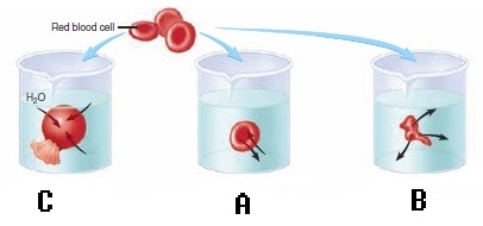 -Red blood cells (RBCs) have been placed in three different solutions: hypotonic, hypertonic, isotonic. What is the condition of the RBC in solution "B"?
 (Multiple Choice)
4.9/5 (83)
(83) In order to study in detail the anatomy of internal cell parts, it would be best to use
(Multiple Choice)
4.9/5 (85)
(85) Large molecules move across cell membrane with the help or assistance of protein carriers. This type of transport is generically called _______.
(Multiple Choice)
4.7/5 (84)
(84) According to the most current model of the plasma membrane,
(Multiple Choice)
4.7/5 (87)
(87)
-Red blood cells (RBCs) have been placed in three different solutions: hypotonic, hypertonic, isotonic. What is solution "B" relative to the RBC?
-Red blood cells (RBCs) have been placed in three different solutions: hypotonic, hypertonic, isotonic. What is solution "B" relative to the RBC? (Multiple Choice)
4.8/5 (74)
(74) 
Filters
- Essay(0)
- Multiple Choice(0)
- Short Answer(0)
- True False(0)
- Matching(0)