



 Chat with AI
Exam 29: The Working Plant

Exam 1: Introduction: Biology Today50 Questions
Exam 2: Essential Chemistry for Biology46 Questions
Exam 3: The Molecules of Life49 Questions
Exam 4: A Tour of the Cell52 Questions
Exam 5: The Working Cell52 Questions
Exam 6: Cellular Respiration: Obtaining Energy from Food51 Questions
Exam 7: Photosynthesis: Using Light to Make Food53 Questions
Exam 8: Cellular Reproduction: Cells from Cells51 Questions
Exam 9: Patterns of Inheritance49 Questions
Exam 10: The Structure and Function of DNA53 Questions
Exam 11: How Genes Are Controlled49 Questions
Exam 12: DNA Technology50 Questions
Exam 13: How Populations Evolve50 Questions
Exam 14: How Biological Diversity Evolves46 Questions
Exam 15: The Evolution of Microbial Life58 Questions
Exam 16: The Evolution of Plants and Fungi53 Questions
Exam 17: The Evolution of Animals58 Questions
Exam 18: An Introduction to Ecology and the Biosphere53 Questions
Exam 19: Population Ecology47 Questions
Exam 20: Communities and Ecosystems52 Questions
Exam 21: Unifying Concepts of Animal Structure and Function49 Questions
Exam 22: Nutrition and Digestion57 Questions
Exam 23: Circulation and Respiration61 Questions
Exam 24: The Body's Defenses57 Questions
Exam 25: Hormones52 Questions
Exam 26: Reproduction and Development53 Questions
Exam 27: Nervous, Sensory, and Locomotor Systems62 Questions
Exam 28: The Life of a Flowering Plant68 Questions
Exam 29: The Working Plant57 Questions
Select questions type


Which of the following best describes the mechanism that causes stomata to open?
(Multiple Choice)
4.7/5  (91)
(91) Which of the following supplies water and minerals to a typical plant?
(Multiple Choice)
4.7/5 (67)
(67) 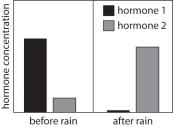 -A scientist finds seeds of an unknown plant on top of the soil in a desert.She measures the concentration of two hormones in these seeds.After it rains,she collects more of these seeds,and finds that the concentration of the two hormones has changed.A graph of her results is shown above.If the scientist returns to the desert to collect more seeds,a few days later,what should she observe?
 (Multiple Choice)
4.9/5 (71)
(71) Which of the following convert atmospheric nitrogen to ammonium?
(Multiple Choice)
4.8/5 (69)
(69) The figure below shows plants originally grown in the dark,and then a light is added on one side only (arrow).Predict the response of the plants to the addition of the light source. 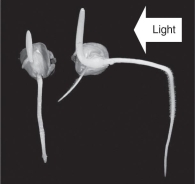
(Multiple Choice)
4.9/5 (94)
(94) Oats are eaten by humans as oatmeal or rolled oats,and as feed for livestock such as cattle.In order for an oat plant to make the part we eat (the seed),it must flower and be pollinated.Typically,oat plants flower when days are lengthening (i.e.,late spring to early summer).What is the best classification for oat plants?
(Multiple Choice)
4.9/5 (77)
(77) Which of the following explains how phloem sap moves within a plant?
(Multiple Choice)
4.9/5 (72)
(72) Transpiration pulls water up a plant because of two mechanisms: ________ describes water molecules sticking together and ________ describes water molecules sticking to the walls of the xylem.
(Multiple Choice)
4.9/5 (83)
(83) Which of the following hormones promotes fruit ripening and dropping of leaves?
(Multiple Choice)
4.8/5 (69)
(69) Which of the following best describes night-neutral plants?
(Multiple Choice)
4.8/5 (90)
(90) Trace the flow of a water molecule that is used during photosynthesis.
(Multiple Choice)
5.0/5 (93)
(93) Early in the spring,cherry trees produce flowers,even before their leaves develop,by using sugars that were stored in their roots the previous year.While cherry flowers are developing,we would expect the phloem pressure near flowers to be ________,and ________ near root storage cells.
(Multiple Choice)
4.8/5 (71)
(71) Which of the following best describe(s)the dependencies of most flowering plants? I)Many depend on insects or other animals for pollination.
II)Many depend on insects or other animals for seed dispersal.
III)Many depend on fungi to help them acquire nutrients.
(Multiple Choice)
5.0/5 (81)
(81) Which of the following BEST describes the essential difference between plant and animal nutrition?
(Multiple Choice)
4.9/5 (78)
(78) Which of the following best describes the opening and closing of the stomata in most plants?
(Multiple Choice)
4.8/5 (83)
(83) 
Filters
- Essay(0)
- Multiple Choice(0)
- Short Answer(0)
- True False(0)
- Matching(0)