



 Chat with AI
Exam 1: Introduction: Biology Today

Exam 1: Introduction: Biology Today50 Questions
Exam 2: Essential Chemistry for Biology46 Questions
Exam 3: The Molecules of Life49 Questions
Exam 4: A Tour of the Cell52 Questions
Exam 5: The Working Cell52 Questions
Exam 6: Cellular Respiration: Obtaining Energy from Food51 Questions
Exam 7: Photosynthesis: Using Light to Make Food53 Questions
Exam 8: Cellular Reproduction: Cells from Cells51 Questions
Exam 9: Patterns of Inheritance49 Questions
Exam 10: The Structure and Function of DNA53 Questions
Exam 11: How Genes Are Controlled49 Questions
Exam 12: DNA Technology50 Questions
Exam 13: How Populations Evolve50 Questions
Exam 14: How Biological Diversity Evolves46 Questions
Exam 15: The Evolution of Microbial Life58 Questions
Exam 16: The Evolution of Plants and Fungi53 Questions
Exam 17: The Evolution of Animals58 Questions
Exam 18: An Introduction to Ecology and the Biosphere53 Questions
Exam 19: Population Ecology47 Questions
Exam 20: Communities and Ecosystems52 Questions
Exam 21: Unifying Concepts of Animal Structure and Function49 Questions
Exam 22: Nutrition and Digestion57 Questions
Exam 23: Circulation and Respiration61 Questions
Exam 24: The Body's Defenses57 Questions
Exam 25: Hormones52 Questions
Exam 26: Reproduction and Development53 Questions
Exam 27: Nervous, Sensory, and Locomotor Systems62 Questions
Exam 28: The Life of a Flowering Plant68 Questions
Exam 29: The Working Plant57 Questions
Select questions type


Scenario Questions
Please use the following information to answer the following question(s).
The collared lizard is a species found in the Desert Southwest. Male collared lizards show considerable color variation, ranging from brightly colored to a very dull pattern. Your goal is to determine the function, if any, of male color patterns in collared lizards, using the scientific method. Your tentative explanation is that male color plays a role in attracting females for mating purposes. You predict that females will preferentially choose brightly colored males over dull-colored ones. To test your prediction, you observed the interactions of female collared lizards with their male counterparts. You selected males that were the same age and size, and that differed only in their coloration pattern. You placed equal numbers of the two types of male lizards, bright and dull, in aquariums, along with one female lizard per aquarium. Out of 350 aquariums observed, the female chose to mate with the brightly colored male 277 times, and the dull-colored male 70 times. In three instances, the females did not mate with either type.
Create a bar graph of your data, plotting the type of male (dull or brightly colored) on the x-axis. On the y-axis, plot the frequency with which each type of male was chosen by females. Using this graph, answer the following questions.
-Which of the following is the hypothesis of this case study?

Free
(Multiple Choice)
4.9/5  (79)
(79) Correct Answer: Verified
C
Which of the following are the proper components of the scientific method?
Free
(Multiple Choice)
4.9/5 (83)
(83) Correct Answer:Verified
VerifiedC
In the process of evolution by natural selection illustrated in the accompanying figure,which of the following is the mechanism or agent of natural selection? 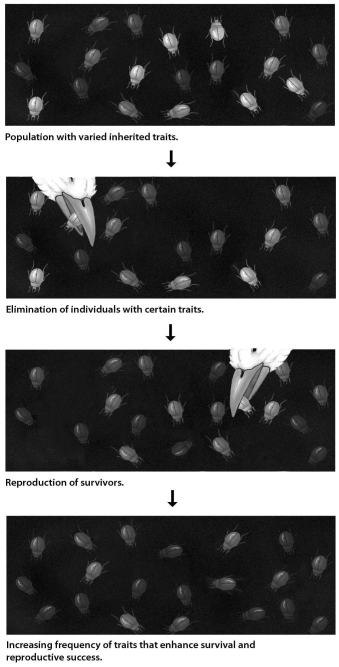
Free
(Multiple Choice)
4.8/5 (87)
(87) Correct Answer:Verified
VerifiedC
Relative to prokaryotic cells,eukaryotic cells are usually ________.
(Multiple Choice)
4.8/5 (75)
(75) Regulation in biological systems depends on feedback,which is an example of information flow.When diabetes destroys insulin-producing cells,what information flow is disrupted?
(Multiple Choice)
4.7/5 (74)
(74) Which of the following structures can perform all the activities required for life?
(Multiple Choice)
4.8/5 (87)
(87) Information flow in biological systems is necessary for negative or regulative feedback to operate.Which of these examples does NOT involve flow of information providing feedback?
(Multiple Choice)
4.9/5 (85)
(85) You try to start your car,but it does not start.Which of these is a prediction?
(Multiple Choice)
4.8/5 (80)
(80) Scenario Questions
Please use the following information to answer the following question(s).
The collared lizard is a species found in the Desert Southwest. Male collared lizards show considerable color variation, ranging from brightly colored to a very dull pattern. Your goal is to determine the function, if any, of male color patterns in collared lizards, using the scientific method. Your tentative explanation is that male color plays a role in attracting females for mating purposes. You predict that females will preferentially choose brightly colored males over dull-colored ones. To test your prediction, you observed the interactions of female collared lizards with their male counterparts. You selected males that were the same age and size, and that differed only in their coloration pattern. You placed equal numbers of the two types of male lizards, bright and dull, in aquariums, along with one female lizard per aquarium. Out of 350 aquariums observed, the female chose to mate with the brightly colored male 277 times, and the dull-colored male 70 times. In three instances, the females did not mate with either type.
Create a bar graph of your data, plotting the type of male (dull or brightly colored) on the x-axis. On the y-axis, plot the frequency with which each type of male was chosen by females. Using this graph, answer the following questions.
-Is it reasonable to conclude (i.e.,is it supported by the data)that female collared lizards prefer more brightly colored male lizards over dull-colored males?
(Multiple Choice)
4.9/5 (81)
(81) Which of these results would you predict to occur if climate change results in increased warming global temperatures?
(Multiple Choice)
4.8/5 (72)
(72) Scenario Questions
Please use the following information to answer the following question(s).
The collared lizard is a species found in the Desert Southwest. Male collared lizards show considerable color variation, ranging from brightly colored to a very dull pattern. Your goal is to determine the function, if any, of male color patterns in collared lizards, using the scientific method. Your tentative explanation is that male color plays a role in attracting females for mating purposes. You predict that females will preferentially choose brightly colored males over dull-colored ones. To test your prediction, you observed the interactions of female collared lizards with their male counterparts. You selected males that were the same age and size, and that differed only in their coloration pattern. You placed equal numbers of the two types of male lizards, bright and dull, in aquariums, along with one female lizard per aquarium. Out of 350 aquariums observed, the female chose to mate with the brightly colored male 277 times, and the dull-colored male 70 times. In three instances, the females did not mate with either type.
Create a bar graph of your data, plotting the type of male (dull or brightly colored) on the x-axis. On the y-axis, plot the frequency with which each type of male was chosen by females. Using this graph, answer the following questions.
-Which of the following conclusions can be drawn from the data?
(Multiple Choice)
4.9/5 (74)
(74) Scenario Questions
Please use the following information to answer the following question(s).
The collared lizard is a species found in the Desert Southwest. Male collared lizards show considerable color variation, ranging from brightly colored to a very dull pattern. Your goal is to determine the function, if any, of male color patterns in collared lizards, using the scientific method. Your tentative explanation is that male color plays a role in attracting females for mating purposes. You predict that females will preferentially choose brightly colored males over dull-colored ones. To test your prediction, you observed the interactions of female collared lizards with their male counterparts. You selected males that were the same age and size, and that differed only in their coloration pattern. You placed equal numbers of the two types of male lizards, bright and dull, in aquariums, along with one female lizard per aquarium. Out of 350 aquariums observed, the female chose to mate with the brightly colored male 277 times, and the dull-colored male 70 times. In three instances, the females did not mate with either type.
Create a bar graph of your data, plotting the type of male (dull or brightly colored) on the x-axis. On the y-axis, plot the frequency with which each type of male was chosen by females. Using this graph, answer the following questions.
-If the proportion of brightly colored male lizards increased steadily in future generations,this would ________.
(Multiple Choice)
4.9/5 (84)
(84) You try to start your car,but it does not start.Which of these is a hypothesis?
(Multiple Choice)
4.9/5 (92)
(92) What name is given to the functional compartments of a cell?
(Multiple Choice)
4.7/5 (77)
(77) Over a span of two decades,scientists measured changes in the beak size of a population of Galápagos ground finches.This ________.
(Multiple Choice)
4.9/5 (81)
(81) 
Filters
- Essay(0)
- Multiple Choice(0)
- Short Answer(0)
- True False(0)
- Matching(0)