



 Chat with AI
Exam 2: Essential Chemistry for Biology

Exam 1: Introduction: Biology Today50 Questions
Exam 2: Essential Chemistry for Biology46 Questions
Exam 3: The Molecules of Life49 Questions
Exam 4: A Tour of the Cell52 Questions
Exam 5: The Working Cell52 Questions
Exam 6: Cellular Respiration: Obtaining Energy from Food51 Questions
Exam 7: Photosynthesis: Using Light to Make Food53 Questions
Exam 8: Cellular Reproduction: Cells from Cells51 Questions
Exam 9: Patterns of Inheritance49 Questions
Exam 10: The Structure and Function of DNA53 Questions
Exam 11: How Genes Are Controlled49 Questions
Exam 12: DNA Technology50 Questions
Exam 13: How Populations Evolve50 Questions
Exam 14: How Biological Diversity Evolves46 Questions
Exam 15: The Evolution of Microbial Life58 Questions
Exam 16: The Evolution of Plants and Fungi53 Questions
Exam 17: The Evolution of Animals58 Questions
Exam 18: An Introduction to Ecology and the Biosphere53 Questions
Exam 19: Population Ecology47 Questions
Exam 20: Communities and Ecosystems52 Questions
Exam 21: Unifying Concepts of Animal Structure and Function49 Questions
Exam 22: Nutrition and Digestion57 Questions
Exam 23: Circulation and Respiration61 Questions
Exam 24: The Body's Defenses57 Questions
Exam 25: Hormones52 Questions
Exam 26: Reproduction and Development53 Questions
Exam 27: Nervous, Sensory, and Locomotor Systems62 Questions
Exam 28: The Life of a Flowering Plant68 Questions
Exam 29: The Working Plant57 Questions
Select questions type


Human body cells are approximately ________ water.

Free
(Multiple Choice)
4.9/5  (93)
(93) Correct Answer: Verified
D
Relative to a pH of 6,a pH of 4 has a ________.
Free
(Multiple Choice)
4.8/5 (82)
(82) Correct Answer:Verified
VerifiedB
How do radioactive isotopes differ from isotopes?
Free
(Multiple Choice)
4.9/5 (73)
(73) Correct Answer:Verified
VerifiedD
Please read the following scenario to answer the following questions.
While radioactive isotopes are used in medicine to identify tumors and other diseases, they can also be used to treat diseases such as cancer. One method to treat cancerous tumors is to expose them to radiation, which can kill the cancerous cells and the tumor. In 2013, the U.S. Food and Drug Administration approved a new cancer treatment based on the radioactive isotope radium-223; this isotope has a half-life of 11.4 days. The radioactive drug, known as Xofigo, is injected into the patient's bloodstream and travels to certain regions of the body. Because it emits high-energy radiation over short distances, it can kill cancerous cells in the sites where it localizes.
After the drug was injected into a person, the following data were collected regarding the amount of radiation measured in different organs in the person's body.
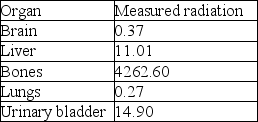 -Using the table above,what kind of cancer do you think Xofigo is used to treat?
 (Multiple Choice)
4.8/5 (92)
(92) In the following reaction,what type of bond is holding the two atoms together? K+Cl → K⁺ + Cl− → KCl
(Multiple Choice)
4.9/5 (85)
(85) Isotopes of an element have the same number of ________ and different numbers of ________.
(Multiple Choice)
4.9/5 (78)
(78) The hydrogen and oxygen atoms of a water molecule are held together by ________ bonds.
(Multiple Choice)
4.9/5 (82)
(82) Please read the following scenario to answer the following questions.
The last few miles of the marathon are the most difficult for Heather. Her hair is plastered to her head, sweat clings to her arms, and her legs feel as if they had nothing left. Heather grabs a cup of ice water. The ice cubes smash against her nose as she gulps some cool refreshment and keeps on running. Then a breeze kicks up and she finally feels some coolness against her skin. Drops of sweat, once clinging to her forehead, now spill down, and Heather feels a stinging as the sweat flows into her eyes.
-When Heather grabbed the glass of ice water,the ice cubes were floating at the top.Why were the ice cubes floating in the water?
(Multiple Choice)
4.9/5 (67)
(67) What are the reactant(s)in the following chemical reaction? C₆H₁₂O₆ + 6 H₂O + 6 O₂ → 6 CO₂ + 12 H₂O
(Multiple Choice)
4.9/5 (69)
(69) Beryllium's atomic mass is 9,and its atomic number is 4.How many neutrons are found in a beryllium atom?
(Multiple Choice)
4.9/5 (74)
(74) What name is given to bonds that involve the sharing of electrons?
(Multiple Choice)
4.9/5 (77)
(77) The bond between oppositely charged ions is a(n)________ bond.
(Multiple Choice)
4.9/5 (75)
(75) An uncharged atom of gold has an atomic number of 79 and an atomic mass of 197.This atom has ________ protons,________ neutrons,and ________ electrons.
(Multiple Choice)
4.7/5 (75)
(75) Sulfur has an atomic number of 16.How many covalent bonds can sulfur form?
(Multiple Choice)
4.7/5 (77)
(77) Please read the following scenario to answer the following questions.
The last few miles of the marathon are the most difficult for Heather. Her hair is plastered to her head, sweat clings to her arms, and her legs feel as if they had nothing left. Heather grabs a cup of ice water. The ice cubes smash against her nose as she gulps some cool refreshment and keeps on running. Then a breeze kicks up and she finally feels some coolness against her skin. Drops of sweat, once clinging to her forehead, now spill down, and Heather feels a stinging as the sweat flows into her eyes.
-Why did the sweat on Heather's forehead and arms form drops?
(Multiple Choice)
4.9/5 (81)
(81) 
Filters
- Essay(0)
- Multiple Choice(0)
- Short Answer(0)
- True False(0)
- Matching(0)