



 Chat with AI
Exam 28: The Life of a Flowering Plant

Exam 1: Introduction: Biology Today50 Questions
Exam 2: Essential Chemistry for Biology46 Questions
Exam 3: The Molecules of Life49 Questions
Exam 4: A Tour of the Cell52 Questions
Exam 5: The Working Cell52 Questions
Exam 6: Cellular Respiration: Obtaining Energy from Food51 Questions
Exam 7: Photosynthesis: Using Light to Make Food53 Questions
Exam 8: Cellular Reproduction: Cells from Cells51 Questions
Exam 9: Patterns of Inheritance49 Questions
Exam 10: The Structure and Function of DNA53 Questions
Exam 11: How Genes Are Controlled49 Questions
Exam 12: DNA Technology50 Questions
Exam 13: How Populations Evolve50 Questions
Exam 14: How Biological Diversity Evolves46 Questions
Exam 15: The Evolution of Microbial Life58 Questions
Exam 16: The Evolution of Plants and Fungi53 Questions
Exam 17: The Evolution of Animals58 Questions
Exam 18: An Introduction to Ecology and the Biosphere53 Questions
Exam 19: Population Ecology47 Questions
Exam 20: Communities and Ecosystems52 Questions
Exam 21: Unifying Concepts of Animal Structure and Function49 Questions
Exam 22: Nutrition and Digestion57 Questions
Exam 23: Circulation and Respiration61 Questions
Exam 24: The Body's Defenses57 Questions
Exam 25: Hormones52 Questions
Exam 26: Reproduction and Development53 Questions
Exam 27: Nervous, Sensory, and Locomotor Systems62 Questions
Exam 28: The Life of a Flowering Plant68 Questions
Exam 29: The Working Plant57 Questions
Select questions type


Read the following scenario to answer the following questions.
The North American beaver is a large rodent that builds dams to convert freshwater streams into ponds. Beavers build their dams out of trees, which they cut down using their front teeth. Beavers also eat the leaves and bark of trees, as well as the starchy roots of water lilies.
-Water lily shoots and roots have very little structural support because this support is not needed in aquatic habitats.What structures would you be LEAST likely to see in a water lily stem?

Free
(Multiple Choice)
4.8/5  (81)
(81) Correct Answer: Verified
C
Scenario Questions
Read the following scenario to answer the following questions.
In late 2006, bee workers in the United States started to notice a disturbing phenomenon: the sudden disappearance of honeybees from commercial hives. This mysterious condition was called "colony collapse disorder," and it has caused a drastic reduction in commercial honeybee populations all over the country. It is estimated that one-third of our food supply relies on bees and is in danger. Crops that rely most heavily on honeybees include apples, almonds, blueberries, and pumpkins. If colony collapse disorder cannot be cured or treated effectively, farmers may have to turn to other insects, perhaps other bee species or even moths.
-Which plant structure is adapted for attracting beneficial insects such as honeybees?
Free
(Multiple Choice)
4.8/5 (81)
(81) Correct Answer:Verified
VerifiedC
Unlike angiosperms,gymnosperms like pines have single instead of double fertilization,but otherwise have an identical life cycle.What structure should have the greatest difference between angiosperms and gymnosperms?
Free
(Multiple Choice)
4.9/5 (79)
(79) Correct Answer:Verified
VerifiedC
Which of the following best describes the primary function of typical leaves?
(Multiple Choice)
4.7/5 (76)
(76) Which of the following are the most abundant cell type found in most plants?
(Multiple Choice)
4.8/5 (80)
(80) Which of the following describes the single layer of tightly packed cells that cover the entire root?
(Multiple Choice)
4.7/5 (81)
(81) Read the following scenario to answer the following questions.
The North American beaver is a large rodent that builds dams to convert freshwater streams into ponds. Beavers build their dams out of trees, which they cut down using their front teeth. Beavers also eat the leaves and bark of trees, as well as the starchy roots of water lilies.
-When a beaver is eating bark,what plant structures is it ingesting?
(Multiple Choice)
4.8/5 (81)
(81) Which of the following plant types complete their life cycle in 2 years?
(Multiple Choice)
4.8/5 (82)
(82) Examine the figure below.What process has to occur to produce a haploid embryo sac? 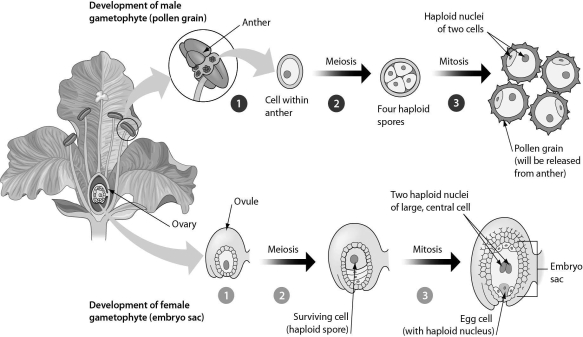
(Multiple Choice)
4.8/5 (74)
(74) Which of the following is the part of a flower that contains the female reproductive structures?
(Multiple Choice)
4.9/5 (74)
(74) Which of the following is the waxy coating secreted on leaves and most stems?
(Multiple Choice)
4.8/5 (79)
(79) The ________ enclose and protect the flower bud,while the ________ advertise the flower to insects and other pollinators.
(Multiple Choice)
4.7/5 (82)
(82) Read the following scenario to answer the following questions.
 The pineapple, grown for its sweet fruit, is a tropical monocot with a diploid number of 50. It can live for many years. The plant starts as one short stem with tough leaves. The flowers of the pineapple are located as a cluster at the very top of the stem. After pollination, the single fruit forms from the fusion of the ovaries of the flowers in the cluster. The seeds are located just underneath the surface of the fruit. The pineapple fruit is harvested by cutting at the base of the fruit. After the first fruit is produced, side shoots grow from the main stem, which can go on to produce additional fruits.
-What evidence best supports the pineapple's classification as a monocot?
The pineapple, grown for its sweet fruit, is a tropical monocot with a diploid number of 50. It can live for many years. The plant starts as one short stem with tough leaves. The flowers of the pineapple are located as a cluster at the very top of the stem. After pollination, the single fruit forms from the fusion of the ovaries of the flowers in the cluster. The seeds are located just underneath the surface of the fruit. The pineapple fruit is harvested by cutting at the base of the fruit. After the first fruit is produced, side shoots grow from the main stem, which can go on to produce additional fruits.
-What evidence best supports the pineapple's classification as a monocot? (Multiple Choice)
4.7/5 (82)
(82) A plant's diploid form is called the ________; the haploid form is called the ________.
(Multiple Choice)
4.9/5 (81)
(81) In a sporophyte of an angiosperm,growth occurs at ________ via ________.
(Multiple Choice)
4.8/5 (77)
(77) A tree grows wider each year because of ________. I)apical meristem
II)vascular cambium
III)cork cambium
(Multiple Choice)
4.9/5 (91)
(91) While on a hike,you notice that several burrs have become attached to your socks.You quickly pull them off.Inside the burr are several seeds.Burrs are produced by certain plants and frequently catch on animal fur (or people's clothing).After thinking about it,you decide that the burr is a type of ________ that is an adaptation for ________.
(Multiple Choice)
4.9/5 (74)
(74) Which of the following is a multicellular mass that nourishes the embryo until it becomes a self-supporting seedling?
(Multiple Choice)
4.8/5 (80)
(80) Please refer to the following art of the cross-sections of two trees to answer the following questions.
 -These trees most likely grew in an environment with ________.
 (Multiple Choice)
4.9/5 (83)
(83) 
Filters
- Essay(0)
- Multiple Choice(0)
- Short Answer(0)
- True False(0)
- Matching(0)