



 Chat with AI
Exam 28: The Life of a Flowering Plant

Exam 1: Introduction: Biology Today50 Questions
Exam 2: Essential Chemistry for Biology46 Questions
Exam 3: The Molecules of Life49 Questions
Exam 4: A Tour of the Cell52 Questions
Exam 5: The Working Cell52 Questions
Exam 6: Cellular Respiration: Obtaining Energy from Food51 Questions
Exam 7: Photosynthesis: Using Light to Make Food53 Questions
Exam 8: Cellular Reproduction: Cells from Cells51 Questions
Exam 9: Patterns of Inheritance49 Questions
Exam 10: The Structure and Function of DNA53 Questions
Exam 11: How Genes Are Controlled49 Questions
Exam 12: DNA Technology50 Questions
Exam 13: How Populations Evolve50 Questions
Exam 14: How Biological Diversity Evolves46 Questions
Exam 15: The Evolution of Microbial Life58 Questions
Exam 16: The Evolution of Plants and Fungi53 Questions
Exam 17: The Evolution of Animals58 Questions
Exam 18: An Introduction to Ecology and the Biosphere53 Questions
Exam 19: Population Ecology47 Questions
Exam 20: Communities and Ecosystems52 Questions
Exam 21: Unifying Concepts of Animal Structure and Function49 Questions
Exam 22: Nutrition and Digestion57 Questions
Exam 23: Circulation and Respiration61 Questions
Exam 24: The Body's Defenses57 Questions
Exam 25: Hormones52 Questions
Exam 26: Reproduction and Development53 Questions
Exam 27: Nervous, Sensory, and Locomotor Systems62 Questions
Exam 28: The Life of a Flowering Plant68 Questions
Exam 29: The Working Plant57 Questions
Select questions type


Read the following scenario to answer the following questions.
 The pineapple, grown for its sweet fruit, is a tropical monocot with a diploid number of 50. It can live for many years. The plant starts as one short stem with tough leaves. The flowers of the pineapple are located as a cluster at the very top of the stem. After pollination, the single fruit forms from the fusion of the ovaries of the flowers in the cluster. The seeds are located just underneath the surface of the fruit. The pineapple fruit is harvested by cutting at the base of the fruit. After the first fruit is produced, side shoots grow from the main stem, which can go on to produce additional fruits.
-Where would we expect to find cells with 25 unpaired chromosomes in a pineapple plant?
The pineapple, grown for its sweet fruit, is a tropical monocot with a diploid number of 50. It can live for many years. The plant starts as one short stem with tough leaves. The flowers of the pineapple are located as a cluster at the very top of the stem. After pollination, the single fruit forms from the fusion of the ovaries of the flowers in the cluster. The seeds are located just underneath the surface of the fruit. The pineapple fruit is harvested by cutting at the base of the fruit. After the first fruit is produced, side shoots grow from the main stem, which can go on to produce additional fruits.
-Where would we expect to find cells with 25 unpaired chromosomes in a pineapple plant? (Multiple Choice)
4.9/5  (75)
(75) Examine the figure below.Secondary growth involves cell division in the ________. 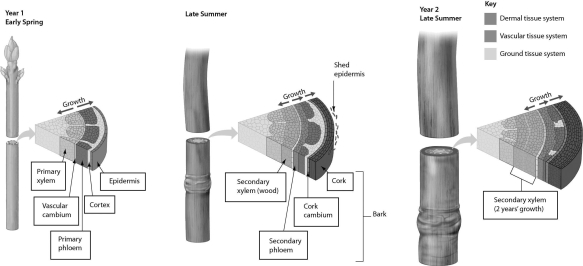
(Multiple Choice)
4.9/5 (80)
(80) Most domesticated food crops come from which of the following plant groups?
(Multiple Choice)
4.9/5 (87)
(87) Which of the following is the major component of most plant cell walls?
(Multiple Choice)
4.8/5 (73)
(73) Which of the following cell types provide support in growing parts of a plant?
(Multiple Choice)
4.8/5 (86)
(86) Please refer to the following art of the cross-sections of two trees to answer the following questions.
 -Which statement CORRECTLY compares the growth of these two trees?
 (Multiple Choice)
4.9/5 (62)
(62) Which of the following is the usual trigger for seed germination?
(Multiple Choice)
4.9/5 (74)
(74) 
Filters
- Essay(0)
- Multiple Choice(0)
- Short Answer(0)
- True False(0)
- Matching(0)