



 Chat with AI
Exam 4: A Tour of the Cell

Exam 1: Introduction: Biology Today50 Questions
Exam 2: Essential Chemistry for Biology46 Questions
Exam 3: The Molecules of Life49 Questions
Exam 4: A Tour of the Cell52 Questions
Exam 5: The Working Cell52 Questions
Exam 6: Cellular Respiration: Obtaining Energy from Food51 Questions
Exam 7: Photosynthesis: Using Light to Make Food53 Questions
Exam 8: Cellular Reproduction: Cells from Cells51 Questions
Exam 9: Patterns of Inheritance49 Questions
Exam 10: The Structure and Function of DNA53 Questions
Exam 11: How Genes Are Controlled49 Questions
Exam 12: DNA Technology50 Questions
Exam 13: How Populations Evolve50 Questions
Exam 14: How Biological Diversity Evolves46 Questions
Exam 15: The Evolution of Microbial Life58 Questions
Exam 16: The Evolution of Plants and Fungi53 Questions
Exam 17: The Evolution of Animals58 Questions
Exam 18: An Introduction to Ecology and the Biosphere53 Questions
Exam 19: Population Ecology47 Questions
Exam 20: Communities and Ecosystems52 Questions
Exam 21: Unifying Concepts of Animal Structure and Function49 Questions
Exam 22: Nutrition and Digestion57 Questions
Exam 23: Circulation and Respiration61 Questions
Exam 24: The Body's Defenses57 Questions
Exam 25: Hormones52 Questions
Exam 26: Reproduction and Development53 Questions
Exam 27: Nervous, Sensory, and Locomotor Systems62 Questions
Exam 28: The Life of a Flowering Plant68 Questions
Exam 29: The Working Plant57 Questions
Select questions type


Lysosomes are responsible for ________.

Free
(Multiple Choice)
4.9/5  (78)
(78) Correct Answer: Verified
C
Which plant organelle is responsible for photosynthesis?
Free
(Multiple Choice)
4.7/5 (78)
(78) Correct Answer:Verified
VerifiedD
A hormone that will be secreted from a cell is manufactured by ribosomes ________.
Free
(Multiple Choice)
5.0/5 (78)
(78) Correct Answer:Verified
VerifiedA
Read the following scenario to answer the following questions.
Different species of bacteria are resistant to different types of antibiotics. For example, one species of bacteria may be resistant to an antibiotic that targets bacterial ribosomes but may not be resistant to a different antibiotic that targets bacterial cell walls. In order to figure out what type of antibiotic(s) to which a species of bacteria was resistant, a researcher treated the bacteria with four different antibiotics (A, B, C, and D) and measured how many bacteria were alive over the course of a few weeks. The data that she collected are summarized below.
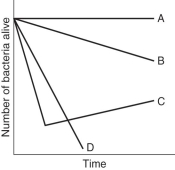 -The bacteria show the greatest resistance to which antibiotic?
 (Multiple Choice)
4.8/5 (84)
(84) Examine the structures of the plant and animal cells below.Which of the following organelles connect(s)to the nuclear envelope? 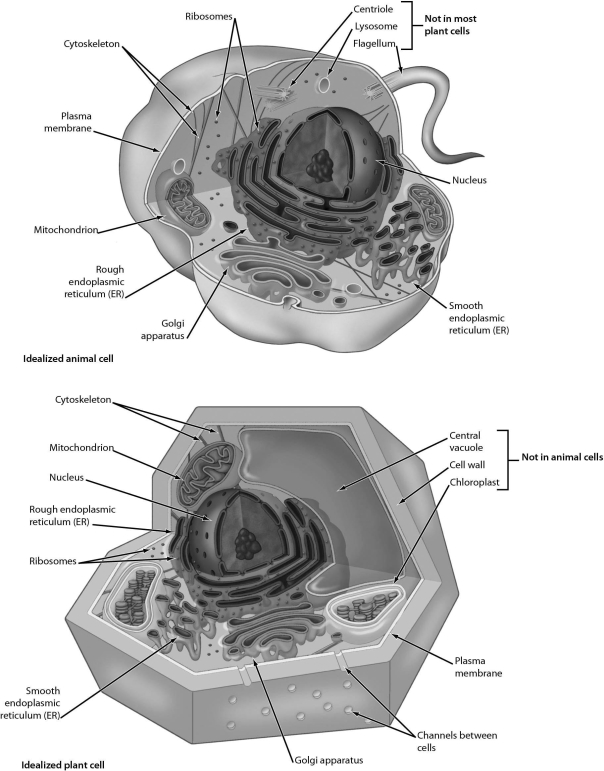
(Multiple Choice)
4.9/5 (88)
(88) Scenario Questions
Read the following scenario to answer the following questions.
The earliest cells detectable in fossils were different from the cells in animals, plants, fungi, and protists living today. These first prokaryotic cells gave rise to eukaryotic cells approximately 1.7 billion years ago. The structure of eukaryotic cells today suggests how they might have evolved from their prokaryotic ancestors. Scientists examining mitochondria and chloroplasts now think that these organelles were probably free-living prokaryotes before becoming a part of eukaryotic cells long ago.
-Which of the following is a characteristic of mitochondria that suggests that they might have evolved from free-living bacteria?
(Multiple Choice)
4.7/5 (84)
(84) Some ribosomes are suspended in the cytosol of a cell,whereas other ribosomes ________.
(Multiple Choice)
4.8/5 (84)
(84) Read the following scenario to answer the following questions.
Different species of bacteria are resistant to different types of antibiotics. For example, one species of bacteria may be resistant to an antibiotic that targets bacterial ribosomes but may not be resistant to a different antibiotic that targets bacterial cell walls. In order to figure out what type of antibiotic(s) to which a species of bacteria was resistant, a researcher treated the bacteria with four different antibiotics (A, B, C, and D) and measured how many bacteria were alive over the course of a few weeks. The data that she collected are summarized below.
-Why do you think the bacteria start to decline when treated with antibiotic C but then begin to grow as time goes on?
-Why do you think the bacteria start to decline when treated with antibiotic C but then begin to grow as time goes on? (Multiple Choice)
4.7/5 (75)
(75) Similar to the nucleus,chloroplasts and mitochondria are ________.
(Multiple Choice)
4.9/5 (75)
(75) Cells in the thyroid gland produce and secrete thyroid hormone (a polymer of amino acids)that helps to regulate metabolism.What organelle is most likely abundant in cells of the thyroid gland?
(Multiple Choice)
4.9/5 (72)
(72) Scenario Questions
Read the following scenario to answer the following questions.
The earliest cells detectable in fossils were different from the cells in animals, plants, fungi, and protists living today. These first prokaryotic cells gave rise to eukaryotic cells approximately 1.7 billion years ago. The structure of eukaryotic cells today suggests how they might have evolved from their prokaryotic ancestors. Scientists examining mitochondria and chloroplasts now think that these organelles were probably free-living prokaryotes before becoming a part of eukaryotic cells long ago.
-Which of the following is a characteristic of chloroplasts that suggests that they might have evolved from free-living bacteria?
(Multiple Choice)
4.7/5 (92)
(92) Which of the following is a function of the plasma membrane?
(Multiple Choice)
4.9/5 (71)
(71) Based on its function in detoxifying drugs,you would expect to find a large amount of smooth ER in ________ cells.
(Multiple Choice)
4.9/5 (68)
(68) Plant cells,unlike animal cells,are characterized by the presence of a ________.
(Multiple Choice)
5.0/5 (69)
(69) Which of the following is a feature of prokaryotic cells but NOT eukaryotic cells?
(Multiple Choice)
4.7/5 (81)
(81) Which of the following parts of a cell is (are)most like the shipping center of a company?
(Multiple Choice)
4.8/5 (88)
(88) The structural combination of DNA and protein forms ________.
(Multiple Choice)
4.7/5 (90)
(90) 
Filters
- Essay(0)
- Multiple Choice(0)
- Short Answer(0)
- True False(0)
- Matching(0)