



 Chat with AI
Exam 29: The Working Plant

Exam 1: Introduction: Biology Today50 Questions
Exam 2: Essential Chemistry for Biology46 Questions
Exam 3: The Molecules of Life49 Questions
Exam 4: A Tour of the Cell52 Questions
Exam 5: The Working Cell52 Questions
Exam 6: Cellular Respiration: Obtaining Energy from Food51 Questions
Exam 7: Photosynthesis: Using Light to Make Food53 Questions
Exam 8: Cellular Reproduction: Cells from Cells51 Questions
Exam 9: Patterns of Inheritance49 Questions
Exam 10: The Structure and Function of DNA53 Questions
Exam 11: How Genes Are Controlled49 Questions
Exam 12: DNA Technology50 Questions
Exam 13: How Populations Evolve50 Questions
Exam 14: How Biological Diversity Evolves46 Questions
Exam 15: The Evolution of Microbial Life58 Questions
Exam 16: The Evolution of Plants and Fungi53 Questions
Exam 17: The Evolution of Animals58 Questions
Exam 18: An Introduction to Ecology and the Biosphere53 Questions
Exam 19: Population Ecology47 Questions
Exam 20: Communities and Ecosystems52 Questions
Exam 21: Unifying Concepts of Animal Structure and Function49 Questions
Exam 22: Nutrition and Digestion57 Questions
Exam 23: Circulation and Respiration61 Questions
Exam 24: The Body's Defenses57 Questions
Exam 25: Hormones52 Questions
Exam 26: Reproduction and Development53 Questions
Exam 27: Nervous, Sensory, and Locomotor Systems62 Questions
Exam 28: The Life of a Flowering Plant68 Questions
Exam 29: The Working Plant57 Questions
Select questions type


Which of the following describes a chemical element that a plant must obtain from its environment in order to complete its life cycle?
(Multiple Choice)
4.8/5  (78)
(78) Experimental plants that were sent up in space shuttle missions did not exhibit all of their normal tropisms.Which of the following responses would you most expect to be lacking from these plants?
(Multiple Choice)
4.9/5 (90)
(90) A farmer decides she wants to grow certified organic corn and sets out to meet all USDA standards to do so.Her crop grows well for the first 3 years; however,she notices during the 4th and 5th years that plants are getting smaller and producing much less corn.She has not altered farming practices and begins to wonder what is happening.She remembers someone mentioning planting peanuts every 3rd year in place of a corn crop,which leads to much healthier corn.Why would a farmer want to change to a different crop,especially something like peanuts?
(Multiple Choice)
4.8/5 (79)
(79) 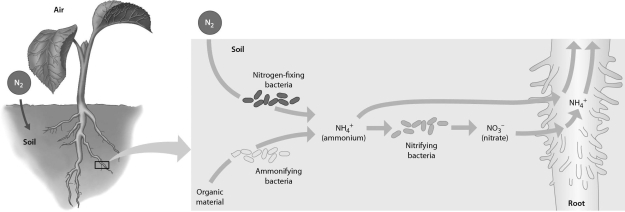 -In the figure above,which of the following produce nitrogen in a form that can be used directly by the plant,without need for conversion?
 (Multiple Choice)
4.8/5 (83)
(83) Which of the following is exemplified by a pea tendril contacting a string or wire and coiling around it for support?
(Multiple Choice)
4.9/5 (86)
(86) Examine the figure below.Which of the following is the site of carbon dioxide uptake by a plant? 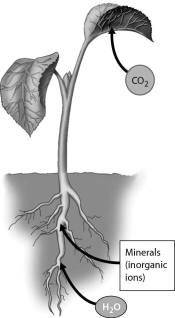
(Multiple Choice)
4.9/5 (87)
(87) Which of the following triggers flowering for plants sensitive to photoperiod?
(Multiple Choice)
4.8/5 (81)
(81) Which of the following best describes the condition of a twig if the auxin produced by its apical meristem is conveyed equally down all sides?
(Multiple Choice)
4.9/5 (90)
(90) The figure below shows plants grown in the dark,and illustrates ________ in plants. 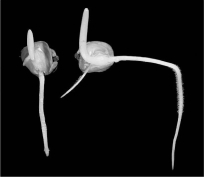
(Multiple Choice)
4.7/5 (73)
(73) Which of the following weather conditions would cause transpiration to be most rapid?
(Multiple Choice)
4.8/5 (75)
(75) Across the globe,billions of people eat rice.In order to make rice grains (the seed),a rice plant must flower and be pollinated.Rice plants flower only after days become shorter (i.e.,summer to autumn).What is the best classification for rice?
(Multiple Choice)
4.9/5 (81)
(81) Which of the following mechanisms best explains how xylem sap moves up against the downward pull of gravity?
(Multiple Choice)
4.8/5 (89)
(89) Read the following scenario to answer the following questions.
In the late 1800s, Charles Darwin and his son Francis conducted the first experiments on phototropism. Several years later, their work was furthered by Peter Boysen-Jensen, Arpad Paal, and Frits Went. Peter Boysen-Jensen separated the tip of grass shoots from the rest of the plant using either tiny blocks of agar (a gelatin) or a mica wafer (an impervious rock). Like the Darwins, Boysen-Jensen noticed that the grass did not grow toward a light without its tips. However, when he separated the tip from the rest of the plant using agar, the grass would grow toward a light. The grass would not grow toward a light if the tip of the shoot was separated using a mica wafer. Arpad Paal cut off the tips of grass shoots that were growing in the dark. He placed these cut tips back on the shoots, but with only part of the tip covering the cut surface, and found that the plants grew, in the dark, in the opposite direction from the side with the tip covering it. Lastly, Frits Went removed the tips of many grass shoots and placed them on a large block of agar for a few hours. Then, he cut up the agar block, and was able to make grass shoots without any tips at all grow toward a light by putting these agar blocks on the cut surfaces of the shoots (i.e., no tips were placed back on the shoots, only the agar).
-Boysen-Jensen also used the mica to separate a tip of a grass shoot only partially,by cutting the tip halfway and inserting a wafer of mica into the cut.If this experiment supported the Darwins' hypothesis,what would Boysen-Jensen have observed?
(Multiple Choice)
4.7/5 (80)
(80) Which of the following best describes substances that enter a plant through the root system?
(Multiple Choice)
4.8/5 (75)
(75) Read the following scenario to answer the following questions.
In the late 1800s, Charles Darwin and his son Francis conducted the first experiments on phototropism. Several years later, their work was furthered by Peter Boysen-Jensen, Arpad Paal, and Frits Went. Peter Boysen-Jensen separated the tip of grass shoots from the rest of the plant using either tiny blocks of agar (a gelatin) or a mica wafer (an impervious rock). Like the Darwins, Boysen-Jensen noticed that the grass did not grow toward a light without its tips. However, when he separated the tip from the rest of the plant using agar, the grass would grow toward a light. The grass would not grow toward a light if the tip of the shoot was separated using a mica wafer. Arpad Paal cut off the tips of grass shoots that were growing in the dark. He placed these cut tips back on the shoots, but with only part of the tip covering the cut surface, and found that the plants grew, in the dark, in the opposite direction from the side with the tip covering it. Lastly, Frits Went removed the tips of many grass shoots and placed them on a large block of agar for a few hours. Then, he cut up the agar block, and was able to make grass shoots without any tips at all grow toward a light by putting these agar blocks on the cut surfaces of the shoots (i.e., no tips were placed back on the shoots, only the agar).
-If Wents placed his agar blocks only halfway on the cut surfaces of grass shoots with their tips removed,what should he have observed?
(Multiple Choice)
4.9/5 (80)
(80) Read the following scenario to answer the following questions.
In the late 1800s, Charles Darwin and his son Francis conducted the first experiments on phototropism. Several years later, their work was furthered by Peter Boysen-Jensen, Arpad Paal, and Frits Went. Peter Boysen-Jensen separated the tip of grass shoots from the rest of the plant using either tiny blocks of agar (a gelatin) or a mica wafer (an impervious rock). Like the Darwins, Boysen-Jensen noticed that the grass did not grow toward a light without its tips. However, when he separated the tip from the rest of the plant using agar, the grass would grow toward a light. The grass would not grow toward a light if the tip of the shoot was separated using a mica wafer. Arpad Paal cut off the tips of grass shoots that were growing in the dark. He placed these cut tips back on the shoots, but with only part of the tip covering the cut surface, and found that the plants grew, in the dark, in the opposite direction from the side with the tip covering it. Lastly, Frits Went removed the tips of many grass shoots and placed them on a large block of agar for a few hours. Then, he cut up the agar block, and was able to make grass shoots without any tips at all grow toward a light by putting these agar blocks on the cut surfaces of the shoots (i.e., no tips were placed back on the shoots, only the agar).
-Considering the experiments of the Darwins,Boysen-Jensen,Paal,and Went,what do you conclude about phototropism?
(Multiple Choice)
4.8/5 (83)
(83) 
Filters
- Essay(0)
- Multiple Choice(0)
- Short Answer(0)
- True False(0)
- Matching(0)