



 Chat with AI
Exam 17: The Evolution of Animals

Exam 1: Introduction: Biology Today50 Questions
Exam 2: Essential Chemistry for Biology46 Questions
Exam 3: The Molecules of Life49 Questions
Exam 4: A Tour of the Cell52 Questions
Exam 5: The Working Cell52 Questions
Exam 6: Cellular Respiration: Obtaining Energy from Food51 Questions
Exam 7: Photosynthesis: Using Light to Make Food53 Questions
Exam 8: Cellular Reproduction: Cells from Cells51 Questions
Exam 9: Patterns of Inheritance49 Questions
Exam 10: The Structure and Function of DNA53 Questions
Exam 11: How Genes Are Controlled49 Questions
Exam 12: DNA Technology50 Questions
Exam 13: How Populations Evolve50 Questions
Exam 14: How Biological Diversity Evolves46 Questions
Exam 15: The Evolution of Microbial Life58 Questions
Exam 16: The Evolution of Plants and Fungi53 Questions
Exam 17: The Evolution of Animals58 Questions
Exam 18: An Introduction to Ecology and the Biosphere53 Questions
Exam 19: Population Ecology47 Questions
Exam 20: Communities and Ecosystems52 Questions
Exam 21: Unifying Concepts of Animal Structure and Function49 Questions
Exam 22: Nutrition and Digestion57 Questions
Exam 23: Circulation and Respiration61 Questions
Exam 24: The Body's Defenses57 Questions
Exam 25: Hormones52 Questions
Exam 26: Reproduction and Development53 Questions
Exam 27: Nervous, Sensory, and Locomotor Systems62 Questions
Exam 28: The Life of a Flowering Plant68 Questions
Exam 29: The Working Plant57 Questions
Select questions type


A(n)________ is an example of a chordate that is not a vertebrate.
(Multiple Choice)
4.8/5  (81)
(81) While on an archaeology expedition,you unearth a skeleton with the following characteristics: four long,slender finger bones and a smaller opposable thumb bone,long arm bones,fingernails,and eye sockets close together on a skull.What type of organism do you suspect you may have found?
(Multiple Choice)
4.8/5 (64)
(64) Art Questions
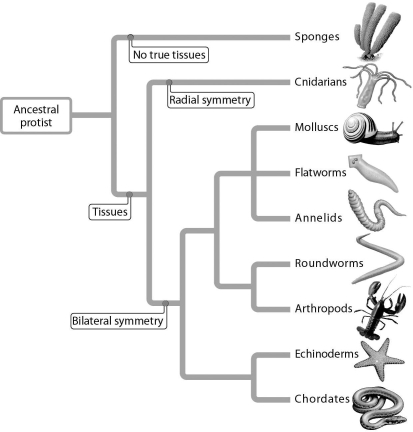 -All organisms with bilateral symmetry also have ________.
 (Multiple Choice)
4.9/5 (82)
(82) The figure below shows a simple worm.Bilateral symmetry and a highly branched gastrovascular cavity all suggest that the worm is a(n)________. 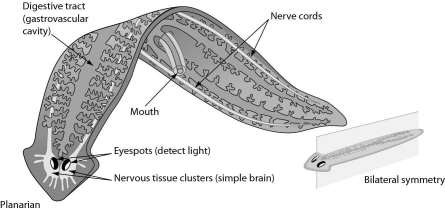
(Multiple Choice)
4.9/5 (77)
(77) ________ are characterized by stinging cells used for defense and for capturing prey.
(Multiple Choice)
4.9/5 (62)
(62) Which animals have a cylindrical body that is tapered at both ends?
(Multiple Choice)
4.8/5 (88)
(88) Which of the following is one way in which scientists can test hypotheses about events that occurred in the distant past?
(Multiple Choice)
4.9/5 (68)
(68) 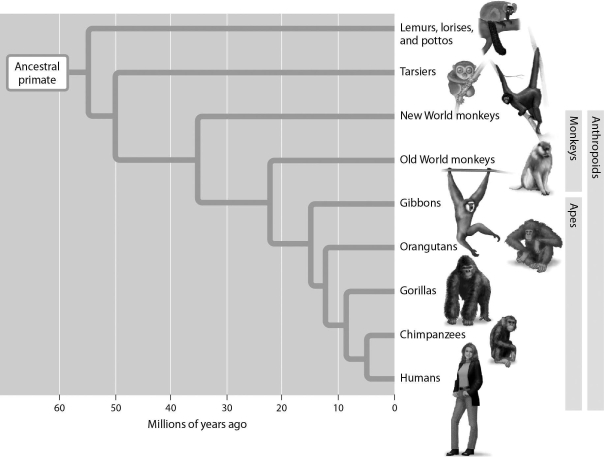 -According to this evolutionary tree,approximately how many years ago did humans and orangutans share a common ancestor?
 (Multiple Choice)
4.8/5 (85)
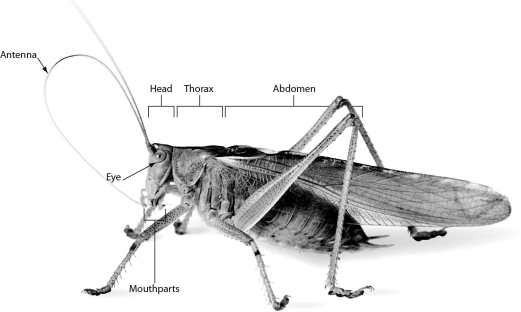
(85) 
Scenario Questions
Read the following scenario to answer the following questions.
Birds are a widespread group of animals with approximately 10,000 different species found throughout the world today. Because they are relatively easy to find and so visually appealing, they have been studied more thoroughly than many other groups of animals. They are also valuable biological indicators because many species live in different habitats during different times of the year and cover long migration routes. According to the World Conservation Union, extinction threatens over 1,200 bird species today, and at least 179 are critically endangered. Some of the most endangered species include the Tahiti monarch, with only 10 pairs remaining, and the Bali starling, with only 12 wild individuals left. In Hawaii, the last captive po'ouli died in 2005, and the last two known to be alive in the wild have not been seen since 2003-2004. Common birds are also disappearing. In North America, red-winged blackbird populations declined by at least 1 percent each year between 1980 and 1999. These examples can serve as a warning. Habitat loss through destruction, degradation, and fragmentation are serious problems that affect 86 percent of threatened birds and are exacerbated by unsustainable forestry practices and intensifying agriculture. All of this shows that conservation of habitats is critical if many of the world's bird species are going to be saved from extinction in the near future.
-Approximately what percent of bird species are threatened with extinction today?
(Multiple Choice)
4.7/5 (77)
(77) 
Filters
- Essay(0)
- Multiple Choice(0)
- Short Answer(0)
- True False(0)
- Matching(0)