



 Chat with AI
Exam 17: The Evolution of Animals

Exam 1: Introduction: Biology Today50 Questions
Exam 2: Essential Chemistry for Biology46 Questions
Exam 3: The Molecules of Life49 Questions
Exam 4: A Tour of the Cell52 Questions
Exam 5: The Working Cell52 Questions
Exam 6: Cellular Respiration: Obtaining Energy from Food51 Questions
Exam 7: Photosynthesis: Using Light to Make Food53 Questions
Exam 8: Cellular Reproduction: Cells from Cells51 Questions
Exam 9: Patterns of Inheritance49 Questions
Exam 10: The Structure and Function of DNA53 Questions
Exam 11: How Genes Are Controlled49 Questions
Exam 12: DNA Technology50 Questions
Exam 13: How Populations Evolve50 Questions
Exam 14: How Biological Diversity Evolves46 Questions
Exam 15: The Evolution of Microbial Life58 Questions
Exam 16: The Evolution of Plants and Fungi53 Questions
Exam 17: The Evolution of Animals58 Questions
Exam 18: An Introduction to Ecology and the Biosphere53 Questions
Exam 19: Population Ecology47 Questions
Exam 20: Communities and Ecosystems52 Questions
Exam 21: Unifying Concepts of Animal Structure and Function49 Questions
Exam 22: Nutrition and Digestion57 Questions
Exam 23: Circulation and Respiration61 Questions
Exam 24: The Body's Defenses57 Questions
Exam 25: Hormones52 Questions
Exam 26: Reproduction and Development53 Questions
Exam 27: Nervous, Sensory, and Locomotor Systems62 Questions
Exam 28: The Life of a Flowering Plant68 Questions
Exam 29: The Working Plant57 Questions
Select questions type


Art Questions
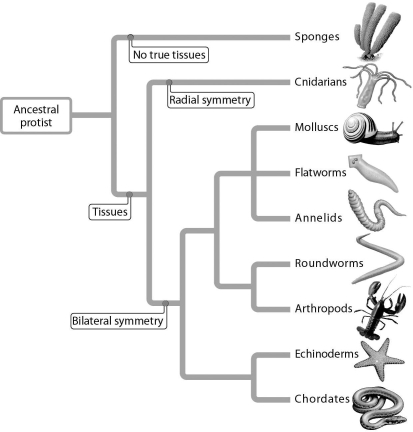 -Flatworms are similar to cnidarians in that both ________.
 (Multiple Choice)
4.9/5  (74)
(74) There are more species of ________ than of any other type of animal.
(Multiple Choice)
4.8/5 (77)
(77) Humans are chordates.Which animal group is most closely related to chordates?
(Multiple Choice)
4.8/5 (82)
(82) The common ancestor of all animals is likely to have been a ________.
(Multiple Choice)
4.8/5 (70)
(70) The segmented body of the worm below suggests that it is a(n)________. 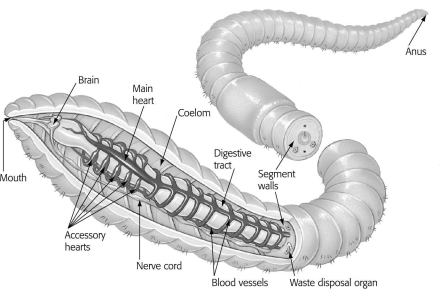
(Multiple Choice)
4.8/5 (75)
(75) You encounter an insect with small eyes,long sensory antennae,and a long mouthpart shaped like a sword.What can you conclude about the environment in which it lives?
(Multiple Choice)
4.8/5 (80)
(80) Scenario Questions
Read the following scenario to answer the following questions.
Birds are a widespread group of animals with approximately 10,000 different species found throughout the world today. Because they are relatively easy to find and so visually appealing, they have been studied more thoroughly than many other groups of animals. They are also valuable biological indicators because many species live in different habitats during different times of the year and cover long migration routes. According to the World Conservation Union, extinction threatens over 1,200 bird species today, and at least 179 are critically endangered. Some of the most endangered species include the Tahiti monarch, with only 10 pairs remaining, and the Bali starling, with only 12 wild individuals left. In Hawaii, the last captive po'ouli died in 2005, and the last two known to be alive in the wild have not been seen since 2003-2004. Common birds are also disappearing. In North America, red-winged blackbird populations declined by at least 1 percent each year between 1980 and 1999. These examples can serve as a warning. Habitat loss through destruction, degradation, and fragmentation are serious problems that affect 86 percent of threatened birds and are exacerbated by unsustainable forestry practices and intensifying agriculture. All of this shows that conservation of habitats is critical if many of the world's bird species are going to be saved from extinction in the near future.
-What is a feature of birds that makes them valuable as biological indicators?
(Multiple Choice)
4.9/5 (88)
(88) A characteristic that is shared by snakes and birds is ________.
(Multiple Choice)
4.8/5 (66)
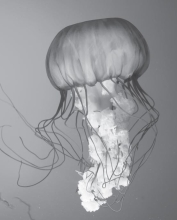
(66) 
You discover an organism that has scaly skin and is aquatic but returns to the land to reproduce.What else would you expect to find in this organism?
(Multiple Choice)
4.9/5 (90)
(90) Art Questions
-Annelids are most closely related to ________.
-Annelids are most closely related to ________. (Multiple Choice)
4.9/5 (82)
(82) Which of these human characteristics is hypothesized to have evolved first?
(Multiple Choice)
4.9/5 (75)
(75) 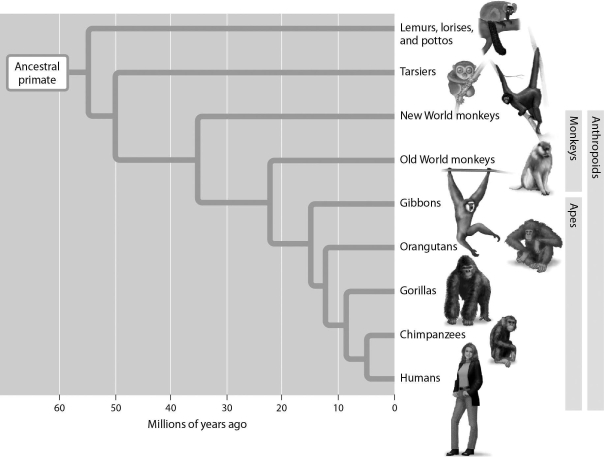 -According to this evolutionary tree,how would you characterize a new anthropoid specimen discovered and estimated to be approximately 42 million years old?
 (Multiple Choice)
4.8/5 (72)
(72) 
Filters
- Essay(0)
- Multiple Choice(0)
- Short Answer(0)
- True False(0)
- Matching(0)