



 Chat with AI
Exam 12: Perfect Competition

Exam 1: What Is Economics483 Questions
Exam 2: The Economic Problem440 Questions
Exam 3: Demand and Supply515 Questions
Exam 4: Elasticity530 Questions
Exam 5: Efficiency and Equity450 Questions
Exam 6: Government Actions in Markets412 Questions
Exam 7: Global Markets in Action205 Questions
Exam 8: Utility and Demand366 Questions
Exam 10: Organizing Production385 Questions
Exam 11: Output and Costs493 Questions
Exam 12: Perfect Competition487 Questions
Exam 13: Monopoly599 Questions
Exam 14: Monopolistic Competition318 Questions
Exam 15: Oligopoly276 Questions
Exam 16: Public Choices, Public Goods, and Healthcare205 Questions
Exam 17: Externalities437 Questions
Exam 18: Markets for Factors of Production382 Questions
Exam 19: Economic Inequality351 Questions
Exam 20: Uncertainty and Information233 Questions
Select questions type


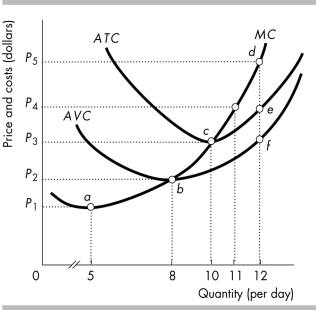 -The figure above shows a firm in a perfectly competitive market. If the price rises from P3 to P4 then output will increase by
 (Multiple Choice)
4.9/5  (89)
(89) 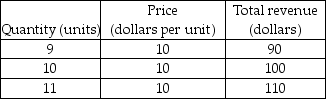 -Based on the table above, what is the marginal revenue of the tenth unit of output?
 (Multiple Choice)
4.9/5 (70)
(70) 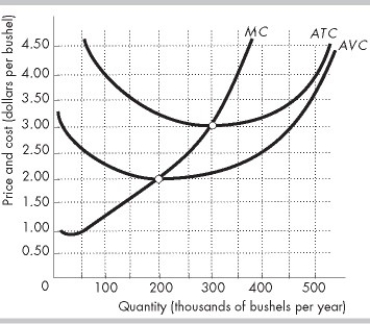 -The figure above shows a typical perfectly competitive corn farm, whose marginal cost curve is MC and average total cost curve is ATC. The market is initially in a long-run equilibrium, where the price is $3.00 per bushel. Then, the market demand for corn decreases and, in the short run, the price falls to $2.50 per bushel. In the new short-run equilibrium, the farm
 (Multiple Choice)
5.0/5 (87)
(87) 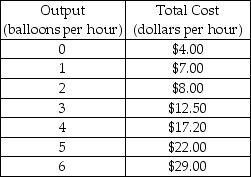 -In the above table, the average variable cost at 2 units of output is
 (Multiple Choice)
4.8/5 (88)
(88) A perfectly competitive firm's economic profit is maximized by producing the amount of output such that
(Multiple Choice)
5.0/5 (79)
(79) In the long run, a perfectly competitive firm leaves the market if the market price is less than the firm's average total cost.
(True/False)
4.9/5 (83)
(83) If the market price of a perfectly competitive firm's product is below its average variable cost, then the firm's
(Multiple Choice)
4.9/5 (79)
(79) A perfectly competitive firm's short-run supply curve is the same as its
(Multiple Choice)
4.8/5 (77)
(77) Does a perfectly competitive producer have any incentive to undercut the current market price? Explain your answer
(Essay)
5.0/5 (78)
(78) 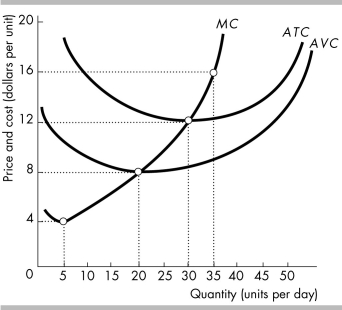 -In the above figure, if the price is $8 per unit, how many units will a profit maximizing perfectly competitive firm produce?
 (Multiple Choice)
4.9/5 (74)
(74) 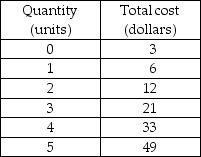 -The above table gives the quantity of output and the total cost for a perfectly competitive firm that can sell all of its output at $9 per unit.
a) Find the profit maximizing level of output for this firm.
b) How much economic profit is the firm making?
-The above table gives the quantity of output and the total cost for a perfectly competitive firm that can sell all of its output at $9 per unit.
a) Find the profit maximizing level of output for this firm.
b) How much economic profit is the firm making? (Essay)
5.0/5 (66)
(66) 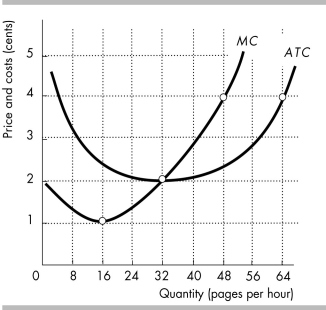 -Fast Copy is a perfectly competitive firm. The figure above shows Fast Copy's cost curves. If the market price is 2 cents per page, what is Fast Copy's profit maximizing level of output?
 (Multiple Choice)
4.9/5 (81)
(81) 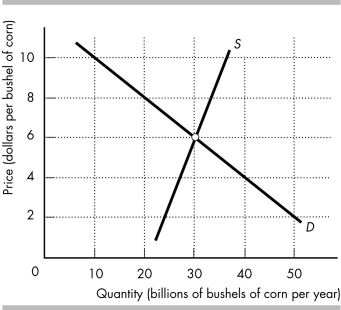 -Farmer Brown produces corn in a perfectly competitive market. Farmer Brown produces and sells 500 bushels of corn. The market supply and demand curves are illustrated in the above figure.
a) What is Farmer Brown's total revenue?
b) What is Farmer Brown's marginal revenue?
-Farmer Brown produces corn in a perfectly competitive market. Farmer Brown produces and sells 500 bushels of corn. The market supply and demand curves are illustrated in the above figure.
a) What is Farmer Brown's total revenue?
b) What is Farmer Brown's marginal revenue? (Essay)
4.8/5 (76)
(76) Easy entry and exit ensure that perfectly competitive firms cannot make a long-run economic profit.
(True/False)
4.8/5 (80)
(80) In a perfectly competitive market, a permanent decrease in demand initially brings a lower price, economic
(Multiple Choice)
4.7/5 (88)
(88) "A perfectly competitive firm is called a price maker because all the firms together must make the market price." Is the previous statement correct or incorrect? Briefly explain your answer.
(Essay)
4.7/5 (77)
(77) The market for maple syrup is perfectly competitive. Suppose that the market is in long-run equilibrium when the market demand for maple syrup increases. What happens in the short run?
(Multiple Choice)
5.0/5 (85)
(85) Fresno County, California is the largest agricultural producing county in the country and almonds are an important crop with more than 99,000 acres harvested. Each acre produces about a ton of almonds and sold at a price of $4300 a ton. The Sagardia Brothers grew 600 acres of almonds that year. In what type of market does the Sagardia Brother operate?
(Multiple Choice)
5.0/5 (77)
(77) 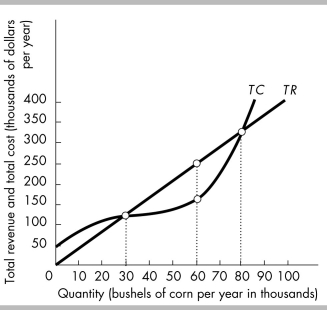 -Given the total cost and total revenue curves in the above figure, what are the output levels at which the perfect competitor will incur economic losses?
 (Multiple Choice)
4.9/5 (89)
(89) 
Filters
- Essay(0)
- Multiple Choice(0)
- Short Answer(0)
- True False(0)
- Matching(0)